If you’ve ever tried to train for both strength and muscle size, odds are you’ve run into some confusion.
Is it enough to just lift heavy?
Should sets feel “easy” if you’re getting stronger?
And why is it that sometimes a lighter set feels way harder than a heavy one?
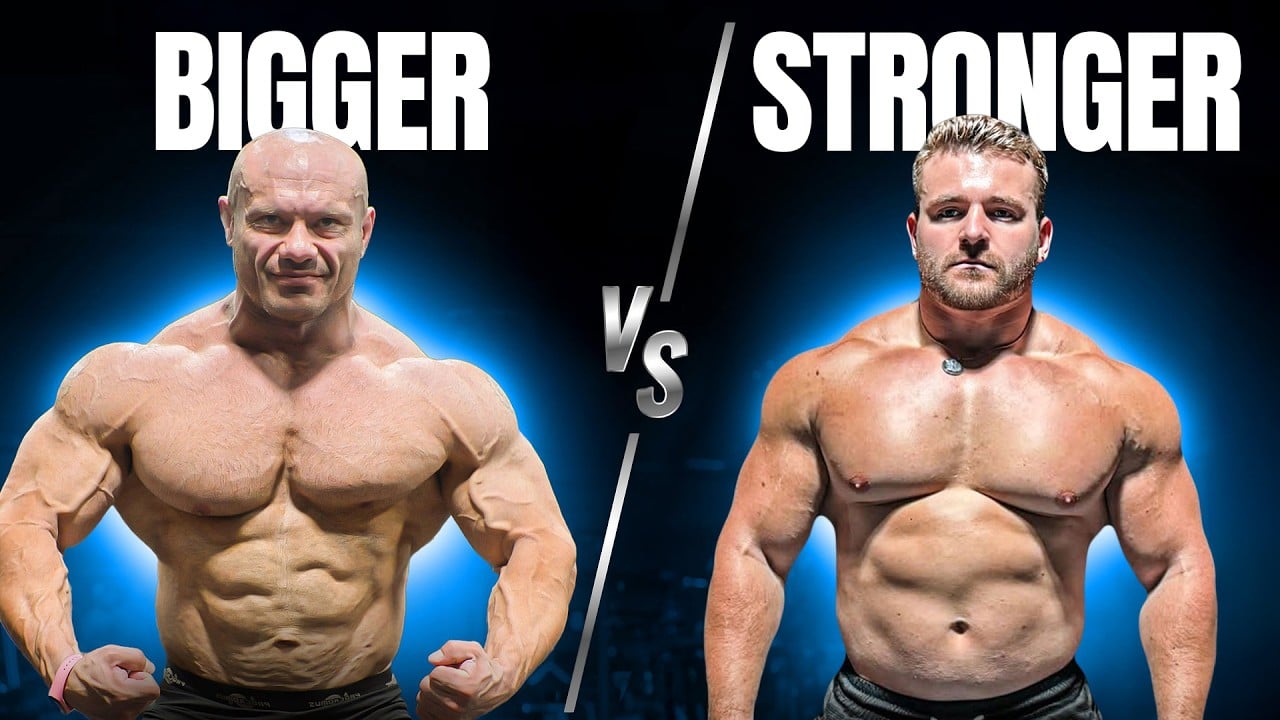
Dr. Mike Israetel, sports scientist, former bodybuilder, and co-founder of Renaissance Periodization, shared an in-depth breakdown on this topic in a recent YouTube video. His take? The key difference between strength and hypertrophy isn’t just in reps or exercises — it’s in how you approach the reps, mentally and physically.
Jump to:
- The key takeaway: Technique should match the goal — strength or hypertrophy
- Shared foundations: Size supports strength, but other factors matter
- Exercise selection: Function vs focus
- Reps and sets: Ranges diverge by goal
- Volume demands: Less for strength, more for size
- The two mentalities: Easy vs hard reps
- How good hypertrophy technique looks
- The mind-muscle connection: Feel the work
- Why strength training limits volume and recovery
- How to grow optimally: Progress + precision
- Final tip: Trust the burn
The key takeaway: Technique should match the goal — strength or hypertrophy
If you’re training for strength, your goal is to make the lift feel as easy and efficient as possible.
If you’re training for muscle size (hypertrophy), your goal is to make the lift feel as hard as possible — specifically on the target muscle.
Mix these up, and you risk missing optimal results in both directions. Advanced lifters especially need to be clear about their goals, since subtle technical distinctions have a big long-term impact on gains.
Strength and hypertrophy training share several fundamentals.
In general, bigger muscles are stronger muscles. The cross-sectional area of a muscle — essentially how “thick” it is — greatly affects its force potential.
“Not all V8s make faster cars than V6s, but engine size tends to matter,” says Dr. Mike.
However, strength isn’t just about size. Neural efficiency — how coordinated and powerful your nervous system is — plays a huge role. Powerlifters often lift more than bodybuilders because they’re better neurologically trained, even if they’re smaller.
Long-term practice in specific lifts also leads to muscle architectural changes. Squat a certain way long enough, and your muscles actually adapt to perform better in that squat pattern. That’s why specificity matters for strength: it’s movement-specific, not just muscle-specific.
Exercise selection: Function vs focus
Here’s where intent changes everything.
Strength training involves exercises that mimic or replicate competition lifts:
- Squats
- Deadlifts
- Bench press
The goal is to perform the movement with heavy load and maximum efficiency.
Hypertrophy training chooses exercises that maximally load and isolate the target muscle:
- Leg presses
- Machine chest flies
- Front-foot elevated lunges
Your form should emphasize muscle tension, not weight moved.
Reps and sets: Ranges diverge by goal
For pure strength development, most lifters should focus on sets of 3–6 reps. This is where your muscles learn to coordinate maximum output.
When training for hypertrophy, research supports a broader range: anywhere from 5 to 30 reps can build muscle — provided you train near failure.
However, if your goal is size that converts well into strength (e.g., you’re a powerlifter trying to add mass to your legs), then aim for 5 to 10 reps. This hits the “hypertrophy sweet spot” for functional strength gains.
Volume demands: Less for strength, more for size
Strength training is more neurologically taxing and should be treated that way. For most people, this means:
- 5–15 quality sets per movement/muscle group per week for strength
- 10–30 sets per week for hypertrophy, especially in specialized programs
This is why trying to train for both at once becomes tricky — hypertrophy requires more systemic recovery and cumulative fatigue tolerance, while strength demands high-intensity, low-fatigue sessions to avoid overloading the nervous system.
The two mentalities: Easy vs hard reps
Here’s what’s often misunderstood.
For strength: “Make it look easy.” You want reps to move fast, cleanly, and with minimal strain on the joints. That’s a victory.
For hypertrophy: “Make the rep feel hard — on the muscle.” You should finish a leg press or curl set thinking, “My quads are cooked” or “My biceps are lit up.”
If a hypertrophy set feels “easy,” you’re likely off-target, under-stimulating the muscle, or using poor tempo or technique.
Strength training = efficiency
Strength-focused lifters seek the path of least resistance.
You’re trying to recruit as many helpful muscle groups as possible to spread the load evenly and minimize strain on any one tissue.
This allows for maximum loading and long-term performance gains in specific movement patterns.
Hypertrophy training = inefficiency
Muscle growth thrives on the path of most resistance.
Your job is to isolate and challenge one or two target muscles at a time. You require deep stretches, full range of motion, and internal tension — the muscle should be under serious localized stress.
How good hypertrophy technique looks
To follow the ideal hypertrophy protocol, emphasize the following:
- Maximum range of motion for the target muscle
- Deep stretch near the bottom of each rep
- Constant tension — avoid rest or unloading points
- Burn in the target muscle approaching or at failure
For example, consider the stiff-legged deadlift. You won’t lift as much as a conventional deadlift, but your hamstrings will be on fire — and that’s the idea. In contrast, during a conventional deadlift, many different muscles pitch in to help you move the weight, sparing the hamstrings from the brunt of the load.
The mind-muscle connection: Feel the work
An easy way to check if your technique is dialed in for growth is to scan for internal sensation:
- Do you feel deep, localized tension?
- Is there a burn in the target muscle — and only in the target muscle?
- Does the exercise get harder in the right spot, not just randomly?
If you’re doing triceps pushdowns and feel your shoulders more than your triceps, reassess the form. Adjust your tempo and elbow position until the triceps light up.
Why strength training limits volume and recovery
Heavier loads stress your connective tissues, joints, and nervous system in ways hypertrophy training usually doesn’t.
By focusing heavily on strength while seeking size gains, you’re at increased risk for:
- Joint wear and tear
- Overuse injuries
- Compromised recovery and limited total weekly training volume
But with hypertrophy-specific technique, you can use lighter loads, higher reps, and better isolate target muscles with reduced injury risk — allowing more total volume and thus more growth over time.
How to grow optimally: Progress + precision
There’s a danger in hypertrophy training of getting too caught up in the “feel” and forgetting about progressive overload.
To avoid this, Dr. Mike recommends:
- Focus each rep on tension, control, and mind-muscle connection.
- Track every set with a structured progression scheme — e.g., adding 2–5 lbs or 1 extra rep each week.
- Maintain technique even as you progress — never sacrifice quality for quantity.
This way, you’re combining the quality of each rep with progressive training loads that ensure long-term hypertrophy gains.
Final tip: Trust the burn
Dr. Mike sums it up like this:
“If you feel more deep pain and burning in the target muscle, that’s where the growth is. Follow it.”
Strength is about mastery and efficiency.
Size is about grind and depth of stimulation.
Use hypertrophy-focused technique to guide your muscle development — even if you’re also chasing strength. Train with purpose, pick the right tool for the job, and know when to crank the muscle anguish dial all the way up.
Because at the end of the day, those most resistance-filled, slow-burning, brutally deep reps?
They’re the ones that get you jacked.