Calisthenics isn’t just for lean athletes or gymnasts.
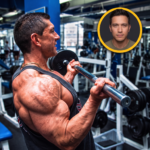
In a jaw-dropping YouTube collaboration, World’s Strongest Man Mitchell Hopper takes on five stages of increasingly difficult bodyweight challenges at Alhambra’s Next Level Gym — guided by calisthenics coach Warren Pro Fitness.

The goal? To see if a 330-pound strongman could make it as a calisthenics athlete.
Throughout the workout, each level reveals more about what’s truly required for body control, core strength, and endurance.
If you’ve ever wondered what it takes to perform muscle-ups, front levers, or planche push-ups — and if they’re even possible outside elite body types — you’re about to find out.
Jump to:
Level 1: Master the Basics — The Pull-Up
The challenge opens with a calisthenics staple — the strict pull-up. While it may seem simple, most people underestimate just how exclusive this move can be.
“What percentage of the general population can do a proper pull-up?” asked the strongman. Warren estimated 10%, while the athlete optimistically guessed 40%.
He quickly completed the pull-up and advanced it with a clapping pull-up, a more explosive variation that requires even more control and power. It was a strong opening, signaling promise for the rest of the challenge.
Level 2: Core of Steel — The Dragon Flag
Popularized by Bruce Lee, the dragon flag tests total core strength. Performed by gripping an overhead bar and maintaining a straight body while descending and lifting, it recruits lats and abdominals under extreme tension.
“It’s about 60–70% core,” Warren explained. “You’ll find where your weak point is. Calisthenics doesn’t lie.”
The key here is retraction from the top, correct body alignment, and deliberate control. The strongman passed this level smoothly — another sign of elite strength transfer.
Level 3: Pull, Pop, and Push — The Muscle-Up
The muscle-up is often referred to as the “holy grail” of upper body calisthenics. Combining a pull-up with a transition into a dip, this move demands not only strength but explosive coordination.
To achieve this at over 320 pounds is almost unheard of. According to Warren, he had only seen one 300-pounder, a New York athlete named D300, successfully perform one. But the strongman trained with regressions using a box and swing timing, gradually improving his technique. With coaching cues like driving the knees to the chest and pulling the bar to belly height, he eventually nailed it.
“That’s a functional world record,” Warren exclaimed.
This breakthrough underscores the power of proper cueing and tailored progressions, even for maximal bodyweight feats.
Level 4: Static Strength — The Front Lever
This advanced static hold involves suspending your body horizontally using only your arms and lats. It combines balance, scapular control, and immense posterior chain recruitment.
Warren guided the strongman through variations:
- Tuck front lever: knees to chest to reduce load
- 90° front lever: hips and knees at right angles
- One-leg extended front lever: increased difficulty
Each progression revealed the complexity of maintaining scapular retraction under heavy load. Despite tremendous upper body mass, the strongman managed to hold intermediate variations — which could develop into a full lever within just two months of weekly practice, according to Warren.
Level 5: The Holy Grail of Push Movements — Planche Push-Ups
Widely regarded as one of the hardest pushing exercises in calisthenics, the planche push-up requires lifting the entire body off the ground while performing a push-up — with no foot support.
Progressions involved:
- Pseudo push-ups: forward-leaning push-ups with protracted shoulders
- Band-assisted planche holds: using resistance bands to reduce bodyweight load
Even with assistance, the difficulty was off the charts. But Warren emphasized that the struggle is a natural part of the learning curve. With consistent practice and core engagement, progress is possible regardless of body type.
The Takeaway: Calisthenics Has No Size Limit
This five-level gauntlet isn’t just entertaining — it’s also deeply educational. It proves that bodyweight mastery is more about training smart than looking lean. The strongman athlete defied visual stereotypes, completing elite-level feats through sheer strength, technique, and progressive planning.
Key Lessons:
- Progressions matter: From band support to positional drills, every level can be scaled.
- Form over ego: Focus on control, not reps.
- Different doesn’t mean disqualified: Excess mass doesn’t bar you from calisthenics success.
- Record your progress: Coaching and video analysis revealed form flaws and led to breakthroughs.
Ready to Try? Start Here:
If you’re inspired to dive into calisthenics, start with:
- Pull-ups or assisted pull-ups
- Dragon flag regressions (like negatives)
- High pulls to build muscle-up prep strength
- Front lever tucks once per week
- Pseudo push-ups for planche prep — use wrist supports if needed
As Warren puts it, “Weight matters in calisthenics. Every sock, shoe, or toenail counts.” But that doesn’t mean heavy athletes are out of the game. It just means they need strategy, patience, and good coaching.
Follow Warren Pro Fitness for more jaw-dropping bodyweight feats, and prove for yourself that there’s no “ideal body type” for mastering the bar.
Until then: keep training, stay humble, and remember — strength is for everyone.