Creaky joints during workouts aren’t just an annoying side effect of training hard.
When that clicking and popping keeps coming back, especially with pain, the real culprit isn’t muscles or bones.
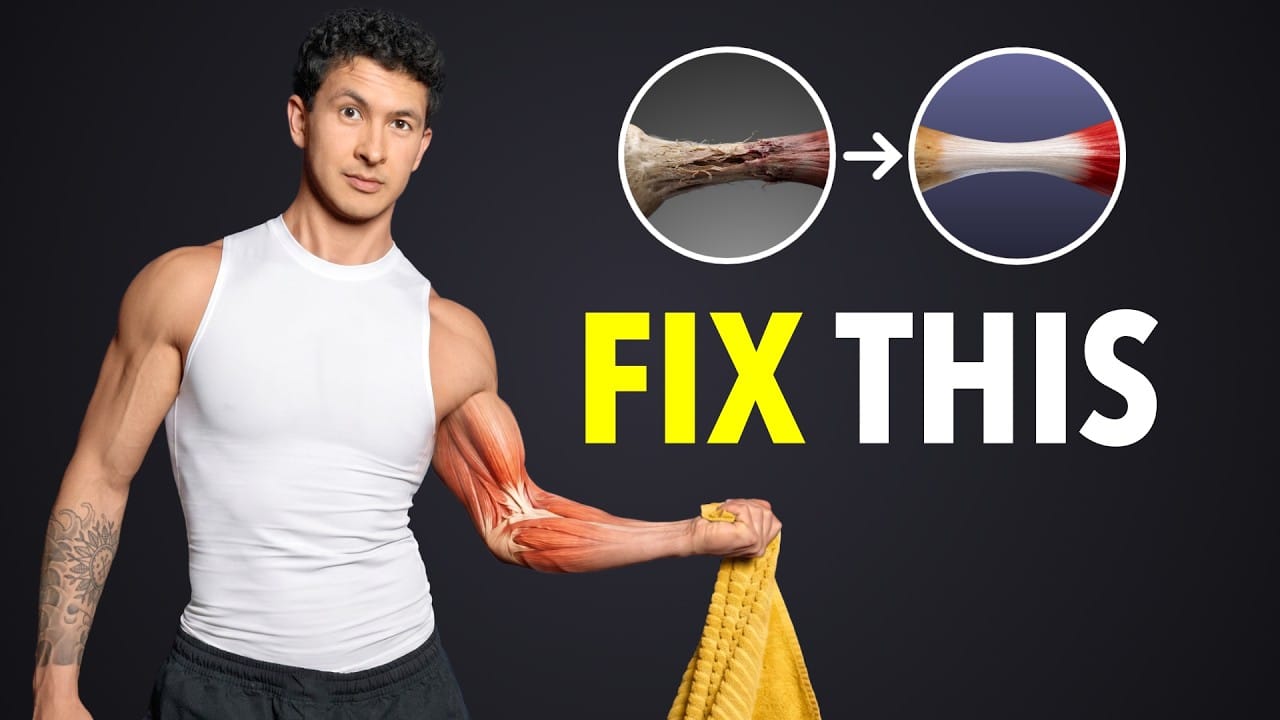
It’s tendons—and they’re sending a warning signal most people ignore.
Recent insights from leading researchers reveal why traditional approaches fail and what actually works to rebuild stronger, pain-free tendons in as little as 30 days.
Jump to:
- Why Tendons Break Down Faster Than Muscles
- The Steroid Connection Nobody Talks About
- Warning Signs Your Tendons Are Struggling
- Why Rest Makes Tendon Problems Worse
- Mistake #1: Poor Load Management
- Mistake #2: Using Momentum
- The Exercise Type That Heals Tendons in Weeks
- Specific Exercises for Each Joint
- Managing Pain During Rehab
- Complete Tendon Healing Protocol
- Long-Term Prevention Strategy
Why Tendons Break Down Faster Than Muscles
Tendons act as cables connecting muscle to bone, enabling every movement from bicep curls to tennis swings. But their role goes beyond simple motion.
Coach Q Wiley, a physiotherapist who works with professional athletes, explains their protective function:

If you want something simple that actually works, this is one of the most effective tools I’ve used to build strength, conditioning, and endurance without needing a full gym setup.
- Full-body training with one weight using swings, squats, and presses
- Solid cast iron build that feels stable and lasts for years
- Comfortable grip that makes high-rep workouts easier to handle
Imagine that you jump down off of a couple of stairs and you landed on both feet. Well, when you land on the ground, you don’t want your muscle to take on all of the load. Tendon can be very protective of muscle in that it can basically stretch out quite a bit in a very fast, short period of time that allows the muscle to not have to extend as quickly.
This protective mechanism requires absurd strength. Unfortunately, standard weightlifting primarily builds muscle, not tendon resilience.
Dr. Keith Baar, a UC Davis professor whose lab produces groundbreaking tendon research, highlights a critical mismatch:
The biggest thing that we’re discovering now is that tendons don’t like what muscle likes to get stronger. There’s a big difference in the types of loads that we do to optimize tendon versus when we’re trying to target our exercise for muscles or our heart.
When muscles develop faster than tendons, strength imbalances create injury risk. Dr. Baar works extensively with professional teams because 70% of sports injuries involve tendons.
The Steroid Connection Nobody Talks About
Steroid users experience higher tendon injury rates because anabolic compounds accelerate muscle growth while leaving tendons behind.
Dr. Baar points to 1990s baseball as a case study:
Everybody was injecting himself with anabolic steroids, they would get big muscles and then they would tear the tendon. Their performance would go up and then bang. Statisticians can go back and determine who was taking steroids based on their stats because it’s that predictable.
But natural lifters face similar risks on a smaller scale. Pushing training volume or intensity too quickly creates the same muscle-tendon strength gap.
If you want something simple that actually works, this is one of the most effective tools I’ve used to build strength, conditioning, and endurance without needing a full gym setup.
- Full-body training with one weight using swings, squats, and presses
- Solid cast iron build that feels stable and lasts for years
- Comfortable grip that makes high-rep workouts easier to handle
Warning Signs Your Tendons Are Struggling
Clicking and popping sounds often signal tendon stress. When tendons experience irritation, they swell slightly.
As Coach Wiley describes it:
It’s a chubby tendon, if you will. And so now in the shoulder, particularly, you’re asking that tendon to move and slide through very, very narrow joint spaces. And so just a little bit of a fatter tendon, now you may feel that tendon as it pops and rolls.
Clicking alone doesn’t always mean damage. But clicking plus pain signals a problem requiring intervention.
Why Rest Makes Tendon Problems Worse
Complete rest represents one of the worst approaches for tendon injuries, despite being commonly prescribed.
Dr. Baar emphasizes why:
A tendon isn’t a tendon without load. So if you’re just resting it, it’s never going to fix itself.
Pain temporarily subsides because nothing stresses the tendon. However, healthy portions weaken during rest while damaged areas never properly rebuild.
If you want something simple that actually works, this is one of the most effective tools I’ve used to build strength, conditioning, and endurance without needing a full gym setup.
- Full-body training with one weight using swings, squats, and presses
- Solid cast iron build that feels stable and lasts for years
- Comfortable grip that makes high-rep workouts easier to handle
Once activity resumes, pain returns immediately—often worse than before. This cycle worsens with age as minor injuries accumulate without proper healing.
Mistake #1: Poor Load Management
Sudden volume or intensity increases create most tendon problems. Adding too much bench pressing, running mileage, or sporting activity overloads tendons before they adapt.
Coach Wiley notes:
It’s less about being an overuse-related injury, it’s more of more is just more. We can adapt to more, it just takes a long time. Tendons take a little bit longer to adapt than muscle.
The safe threshold? Increase volume or intensity by no more than 30% at a time.
Practical application:
- Currently doing 4 sets of bench weekly? Add only 1-2 sets maximum
- Comfortably lifting 100 lbs? Progress to 130 lbs, not 150 lbs
- Starting a new sport? Limit initial frequency and gradually build
This conservative approach applies to both gym training and recreational activities.
If you want something simple that actually works, this is one of the most effective tools I’ve used to build strength, conditioning, and endurance without needing a full gym setup.
- Full-body training with one weight using swings, squats, and presses
- Solid cast iron build that feels stable and lasts for years
- Comfortable grip that makes high-rep workouts easier to handle
Mistake #2: Using Momentum
Bouncing weights, whether off the chest during bench press or at the bottom of squats, introduces damaging tendon stress.
Coach Wiley explains:
When we’re lifting a lot, what happens, especially as we’re trying to up our weights, is that we have a tendency to use more momentum. That’s the stimulus that’s going to be detrimental to our connective tissues.
Olympic weightlifters handle momentum successfully because their tendons adapted over years. Recreational lifters lack this adaptation.
The solution: Control the bottom portion of every rep. This protects tendons while research suggests it may enhance muscle growth simultaneously.
The Exercise Type That Heals Tendons in Weeks
Isometric exercises—contracting muscles without movement—provide proven tendon healing and strengthening benefits.
Dr. Baar’s research demonstrates remarkable results:
If you want something simple that actually works, this is one of the most effective tools I’ve used to build strength, conditioning, and endurance without needing a full gym setup.
- Full-body training with one weight using swings, squats, and presses
- Solid cast iron build that feels stable and lasts for years
- Comfortable grip that makes high-rep workouts easier to handle
What our work has shown us is that when we do isometrics, we maximize the creep in the tendon, and we get equal signal for that load through the whole tendon, including the scarred area. By 2 weeks, almost everybody is like, “Oh, yeah. I don’t I can do pretty much everything again.”
Isometrics work by progressively loading tendon tissue. Holding a static position causes healthy tendon portions to stretch first, then progressively loads weaker areas.
After approximately 30 seconds, the entire tendon receives strengthening stimulus, including damaged sections.
Choosing the Right Isometric Exercise
Match exercises to problematic movements. If bench pressing hurts, perform isometric chest press holds. If overhead pressing causes pain, hold that position instead.
Coach Wiley advises:
Whatever motion doesn’t feel good, you’re trying to find a way that you can load that motion very hard, or hold a position. If I had a problem bench pressing, I’m going to probably use something pretty similar to a bench press, and just do an iso hold there.
Specific Exercises for Each Joint
Shoulder Pain During Chest Pressing
- Bench press or Smith machine hold (weight immovable)
- Chest press machine mid-position hold
- Push-up hold at halfway point
- Wall push hold (home alternative)
Hold each position 30 seconds minimum, complete three total sets.
Shoulder Pain During Overhead Movements
Use overhead press variations held at mid-range for identical duration and set structure.
If you want something simple that actually works, this is one of the most effective tools I’ve used to build strength, conditioning, and endurance without needing a full gym setup.
- Full-body training with one weight using swings, squats, and presses
- Solid cast iron build that feels stable and lasts for years
- Comfortable grip that makes high-rep workouts easier to handle
Elbow Pain (Biceps)
- Curl variations held at 90-degree elbow angle
- Pull-down or chin-up mid-position holds
Elbow Pain (Triceps)
- Tricep pushdown holds for extension pain
- Overhead extension holds for overhead tricep movements
Knee Pain
- Knee extension machine mid-position hold
- Wall sit with back against wall, knees forward (home option)
Managing Pain During Rehab
Temporary pain relief should occur immediately after performing isometrics. However, feeling discomfort during the exercise is acceptable.
Guidelines:
- Pain during exercise should not exceed 3-4 out of 10
- Pain should not worsen the following day
- If either occurs, reduce weight or effort level
Complete Tendon Healing Protocol
Immediate relief phase (1-2 weeks):
- Select one exercise matching your problem area
- Perform 3 sets twice daily (morning and evening)
- Hold each repetition 30+ seconds
Rebuilding phase (4-8 weeks):
- Continue exercises 3-4 times weekly
- Maintain consistent practice even after pain subsides
Dr. Baar emphasizes commitment:
If they feel like, “Oh, yeah. Hey, it’s better.” and then they stop doing it, it’s just going to come back. The ones who really get rid of the pain permanently are the ones who can say, “This is something I want to keep going with.”
Long-Term Prevention Strategy
Preventing future tendon problems requires ongoing maintenance, not just reactive treatment.
If you want something simple that actually works, this is one of the most effective tools I’ve used to build strength, conditioning, and endurance without needing a full gym setup.
- Full-body training with one weight using swings, squats, and presses
- Solid cast iron build that feels stable and lasts for years
- Comfortable grip that makes high-rep workouts easier to handle
Sustainable approaches:
- Spend 5-10 minutes post-workout on tendon exercises
- Dedicate one full day weekly to tendon work
- Continue controlling momentum during all lifts
- Follow the 30% rule when increasing training demands
Tendons represent the often-overlooked foundation of training longevity. While muscles adapt quickly to progressive overload, tendons require patient, targeted stimulus.
Ignoring squeaky joints today creates debilitating pain tomorrow. But addressing tendon health proactively—through controlled training progression and strategic isometric work—builds resilient connective tissue capable of supporting decades of high-performance activity.
The choice between temporary convenience and long-term function comes down to 30-second holds performed consistently. Your future self will thank you.