Two people follow nearly identical training programs, yet one develops powerful, well-proportioned glutes while the other ends up with overdeveloped quads and hamstrings but lagging glutes.
This frustrating asymmetry isn’t about effort or genetics—it’s about muscle dominance patterns that develop silently over time.
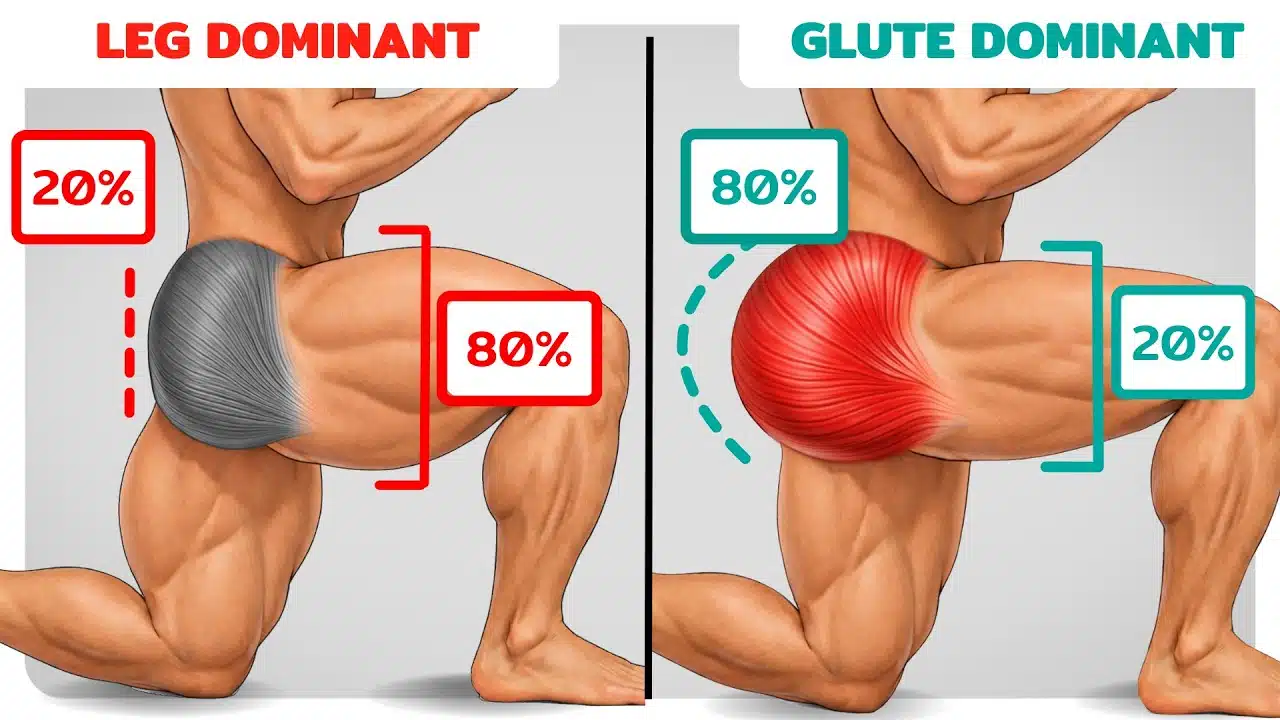
In a recent video, fitness experts at Barefoot Strength revealed the hidden mechanisms behind glute underdevelopment and provided science-backed solutions to fix it.
Understanding why glutes—the body’s largest muscle group—lose their dominance could transform training results.
Jump to:
- The Muscle Tug-of-War That Stunts Glute Growth
- Test Your Glute Dominance in 60 Seconds
- Reason #1: Tight Hip Flexors Are Blocking Glute Activation
- Reason #2: Core Weakness Undermines Glute Power
- Reason #3: Weak Feet Sabotage Everything Above Them
- Solution #1: Restore Hip Flexor Mobility
- Solution #2: Build Core Stability
- Solution #3: Strengthen Feet and Restore Arch Function
- The Two Best Exercises for Maximum Glute Growth
- Building Dominant Glutes Requires Consistent Action
The Muscle Tug-of-War That Stunts Glute Growth
When glutes are weak, something remarkable happens inside the body during common exercises like squats. Standing up from a squat requires simultaneous knee extension (driven by quads) and hip extension (dominated by glutes with hamstring assistance).
But when glutes can’t pull their weight, hamstrings—the secondary hip muscles—must compensate by working significantly harder. This creates an unexpected problem at the knee joint.
Because hamstrings attach to the back of the knee and function as knee flexors, their excessive contraction starts bending the knees. This directly opposes what the quads are trying to accomplish—straightening the knees to complete the standing motion.
The result? A counterproductive tug-of-war where both hamstrings and quads work exponentially harder.
A 2015 study quantified this phenomenon, finding that when glutes lose dominance and hamstrings take over, quad contraction increases by 33%. Over months and years of training, this pattern causes disproportionate leg muscle development while glutes remain stubbornly underdeveloped.
Test Your Glute Dominance in 60 Seconds
Before addressing solutions, confirming whether glutes are actually underactive is essential. A simple science-backed test reveals the truth.
Lie on your back with both knees bent and feet flat on the floor. Lift one leg and straighten it out in front. Using only the grounded leg, push through the foot to lift hips into a bridge position.
Hold this position for up to a minute, paying close attention to which muscles are working hardest. Repeat on the other side.
If glutes do all the work, they’re properly active. But if hamstrings, lower back, or quads dominate the contraction, glutes are weak and underactive—confirmation of what’s happening during every training session.
Reason #1: Tight Hip Flexors Are Blocking Glute Activation
The most common cause of glute weakness stems from tight hip flexors, typically resulting from excessive sitting. When hip flexors stay shortened for hours daily, they adapt to that length and become chronically tight.
This creates a neurological problem through a mechanism called reciprocal inhibition. Muscles work in pairs—when one contracts, its opposite must relax. Think biceps and triceps at the elbow.
Hip flexors and glutes form another critical pair. As glutes shorten to contract, hip flexors must lengthen to allow hip extension. But chronically tight hip flexors can’t lengthen properly, blocking glutes from contracting fully.
This dysfunction—called altered reciprocal inhibition—results in severely weakened glute engagement.
A 2024 study tested this directly by comparing women with tight hip flexors to those with normal hip flexibility during squats. The tight-hip group showed 60% less glute activation and 2.6 times more hamstring activity relative to their glutes.
In short: tight hips block glute function, causing legs to overwork and eventually overdevelop.
Reason #2: Core Weakness Undermines Glute Power
The body operates on a fundamental principle: proximal stability enables distal power. A stable base allows maximum force generation—like running faster on pavement versus sand.
Glutes can only fire at maximum power when contracting off a solid base: the pelvis. The core’s job is keeping the pelvis steady.
When core muscles are strong, the pelvis stays neutral. Glutes fire harder and force transfers smoothly through hips and spine. But weak cores allow pelvic tilt, glutes lose leverage, and hamstrings must compensate.
Research validates this powerful relationship, showing glutes are significantly less active when cores aren’t properly engaged.
Reason #3: Weak Feet Sabotage Everything Above Them
This cause surprises most people, but research clearly demonstrates that foot dysfunction directly reduces glute activation while overactivating hamstrings.
When feet over-pronate, ankles collapse inward, knees fall into valgus position, causing internal hip rotation and anterior pelvic tilt. A tilted pelvis puts glutes at a mechanical disadvantage, making it harder for them to fire.
When glutes can’t fire properly, hamstrings take over and become overworked.
A 2023 study found a strong correlation between over-pronated feet and tight hamstrings. Since feet support the entire body, instability there compromises everything built on top.
Solution #1: Restore Hip Flexor Mobility
If tight hip flexors are inhibiting glutes, the first step is obvious: restore hip flexor length.
One study found that people with mobile hips used glutes twice as much as hamstrings when squatting versus those with tight hips, whose hamstrings worked harder than glutes. This shows that improving hip mobility alone can shift patterns from hamstring-dominant back to glute-dominant.
Barefoot Strength tested this in a 5-day glute transformation experiment where five participants performed hip flexor stretches for 20 minutes daily. After just five days, participants showed an average 17.3% improvement in glute activity during goblet squats. One participant improved by 38.1%.
The recommendation: incorporate hip mobility into warm-ups and daily routines. It doesn’t require 20 minutes at once—a few minutes daily goes a long way.
One effective drill is the kneeling hip extension exercise. Hold each stretch for at least 60 seconds per set, focusing on bracing the core so the pelvis remains neutral rather than tilted forward.
Solution #2: Build Core Stability
To develop big, powerful glutes, a strong core is non-negotiable. Studies show that adding core stability work to glute exercises increases glute activation by up to 26%.
Core and glutes connect indirectly through the pelvis (the base glutes contract from) and directly through fascial tissue. When they contract together, it creates a synergistic effect amplifying overall muscle activation.
The most effective way to strengthen this connection is through belly bracing technique—applicable to every exercise. What’s the point of isolated core stability work if cores aren’t actively engaged during running, jumping, and lifting?
Elite powerlifters belly brace before every lift, taking deep breaths and creating maximum midsection tension before bars even move. Many wear weightlifting belts for something to brace against, engaging these muscles even harder to generate maximum hip force and maintain proper positions.
Here’s a simple bracing technique: Poke fingers deep into the abdomen. Contract abs to force fingers back out. Now braced and ready to lift—but ensure the spine stays neutral, not flexed or extended.
Solution #3: Strengthen Feet and Restore Arch Function
For strong glutes, strong feet are essential. A 2020 study compared glute activation across different foot types, finding people with higher arches had significantly more glute activity during walking compared to those with flat or neutral feet.
The mechanism is straightforward: stable, well-supported arches provide solid bases that align ankles, knees, and pelvis so glutes can contract from their strongest positions.
Building foot arches requires a three-step protocol:
Step 1: Start with arch-supporting insoles. A 2005 study found wearing foot orthotics significantly increased glute activity during single-leg squats and lateral step-downs compared to no orthotics. Orthotics provide immediate mechanical support, giving glutes stable bases while building strength.
However, prolonged arch support use can weaken feet. A 2020 study found 12 weeks in arch support reduced intrinsic foot muscle strength by 14.7%.
Step 2: Add foot strengthening exercises. A 2024 study compared arch support alone versus arch support plus foot strengthening. The group that strengthened feet while wearing supports showed better results than the support-only group.
Step 3: Use silicone toe spacers. These restore natural toe splay and realign big toes, widening the foot’s base of support and positioning intrinsic foot muscles optimally to contract more powerfully, stabilizing arches.
Internal EMG testing showed wearing silicone toe spacers increased glute activity by 7% during step-up exercises.
The Two Best Exercises for Maximum Glute Growth
Once hip mobility improves, core stability builds, and foot arches strengthen, choosing exercises that maximize glute growth becomes crucial.
Step-Ups: The Glute Activation Champion
A 2020 literature review analyzing glute activation across 24 different exercises revealed step-ups produced the highest gluteus maximus activation.
Three reasons explain this:
- As a single-leg exercise, glutes work extremely hard both to stand up onto the box and stabilize on one leg
- Stepping onto boxes forces hips into deep flexion, stretching glutes—and stretched muscles generate more force when contracting
- Knees must travel forward past toes, shortening hamstrings across knee joints and reducing their contribution, making glutes the dominant hip extensors
Front Squats: The Superior Bilateral Movement
For those preferring bilateral movements, front squats beat back squats and deadlifts for glute activation.
A 2018 study compared muscle activation in all three movements among 13 trained athletes. Front squats showed 94% glute activation compared to 84% for back squats and 72% for deadlifts.
Front squat mechanics naturally favor glute dominance:
- Front barbell placement creates longer lever arms at hips, forcing glutes to produce more torque to counteract forward loads and keep torsos upright
- Front squats facilitate deeper squatting, increasing glute stretch (and stretched muscles generate more force)
- Deeper squats increase knee flexion, shortening hamstrings and reducing their contribution while shifting more load onto glutes
- Front rack positions force knees outward, promoting hip abduction and external rotation—both increasing glute activation
Building Dominant Glutes Requires Consistent Action
Understanding why glutes lose dominance and fail to grow proportionally is just the beginning. The real transformation happens through consistent daily application of these fixes in training.
Addressing tight hip flexors, building core stability, strengthening foot arches, and selecting optimal exercises creates the foundation for developing powerful, well-proportioned glutes that match leg development.
The difference between someone with underdeveloped glutes and someone with impressive glute development often isn’t training volume or intensity—it’s whether their bodies are biomechanically positioned to actually use those muscles effectively.
Fix the foundations, and glute growth follows naturally.