Building bigger arms doesn’t require endless hours in the gym or complicated routines that leave you confused.
In fact, fitness expert Jeff Cavaliere recently broke down a strategic 22-day arm building protocol that promises measurable results—if you’re willing to put in consistent, focused work.
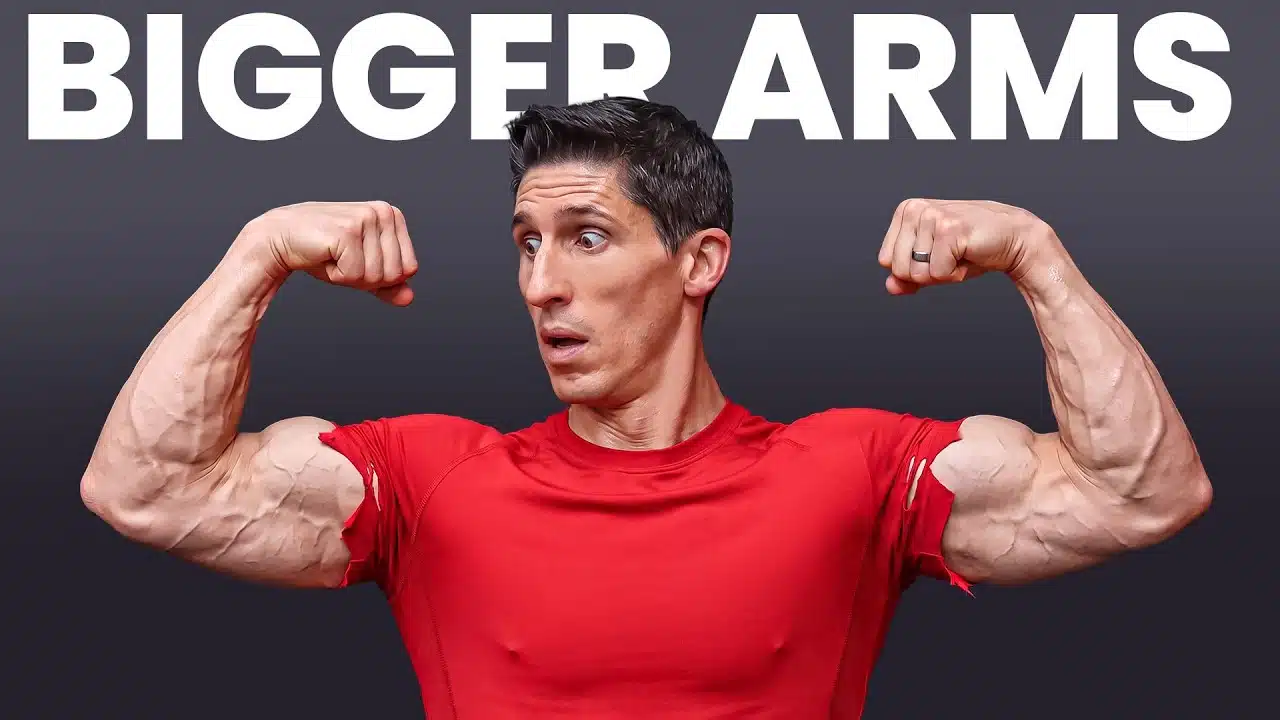
The approach alternates between biceps and triceps workouts three times per week, strategically targeting different aspects of arm development.
What makes this plan particularly effective is how it fits seamlessly into whatever training schedule you’re already following.
Jump to:
The Foundation: Measuring Progress and Weekly Structure
Day one requires zero exercise. Instead, grab a tape measure and record your arm size at the biceps peak and mid-triceps.
This baseline measurement becomes your benchmark for the gains you’ll see on day 22. The program structures workouts across three sessions per week for each muscle group—biceps and triceps—alternating between them with built-in recovery days.
I’m actually making it so it will fit whatever you’re doing right now. Let’s say you’re not doing anything at all, but your main goal is to increase the size of your arms, you’re just going to follow this plan exactly as it’s laid out day by day with nothing else to change.
For those already following a training program, simply remove dedicated biceps and triceps exercises but keep compound movements like pull-ups, rows, bench press, and overhead press. Add these specialized arm exercises at the end of your existing workouts.
Week One: Building Mind-Muscle Connection
Days 2, 9, and 16: Incline Waiter Curls for Biceps
The first biceps workout focuses on establishing a strong contraction. The incline waiter curl limits the dumbbell’s arc of motion, preventing momentum and shoulder involvement.
Keep the top of the dumbbell flat and parallel to the ceiling as you curl straight up. This positioning maximizes tension at peak contraction rather than mid-range.
Progressive overload strategy:
- Day 2: Four sets of nine reps to failure
- Day 9: Same exercise, but add three pulse contractions at the top of each rep
- Day 16: Increase to six pulse contractions per rep
Days 3, 10, and 17: Bench Dips for Triceps
Bench dips create complete triceps contraction because arms position behind the body with full elbow extension. This targets the long head along with medial and lateral heads simultaneously.
Critical form point: Position hands with fingers angled outward on the bench rather than pointing forward. This maintains healthier shoulder positioning and prevents internal rotation stress.
Look at the positioning of your hands on the bench. I’ve talked about it before, you don’t want your hands facing forward, which could create a little bit of internal rotation at the shoulder, which wouldn’t be a good thing to accrue over the course of the next 21 days.
Perform four sets to failure, then progress using the same pulse method as biceps—three pulses on day 10, six pulses on day 17.
Building Width: Targeting Overlooked Muscles
Days 4, 11, and 18: Cross Body Hammer Curls
Arm width from the front depends heavily on the brachialis—a muscle lying beneath the biceps that many lifters neglect. Alternating cross body hammer curls minimize biceps involvement through pronation while maximizing brachialis recruitment.
Keep dumbbells close to your body as you curl up and across. This positioning emphasizes the primary elbow flexor (brachialis) rather than relying on supination for biceps activation.
Progressive loading:
- Week 1: Four sets of 12 reps to failure
- Week 2: Add five pounds, use rest-pause technique to complete all 12 reps
- Week 3: Add another five pounds (10 total from week one), continue rest-pause
Days 5, 12, and 19: Medial Head Lockouts
The medial head of the triceps—often ignored—becomes prominent through complete elbow lockout. Most people cut the final inch of triceps exercises, missing crucial medial head activation.
Option one (gym setting): Tricep pushdowns with modified grip. Position the bar further out on fingers and allow wrists to extend backward naturally. This removes forearm involvement and emphasizes controlled elbow extension through full lockout.
Option two (home training): Thumbs-up dumbbell bench press. Keep elbows tight to sides and follow the dumbbells upward with your thumbs, encouraging complete elbow extension at the top.
Both exercises follow the same progression as hammer curls—starting with four sets of 12 reps, then adding five pounds in week two and 10 pounds in week three using rest-pause technique.
Eccentric Overload: The Hypertrophy Driver
Days 6, 13, and 20: Cheat Curls
Eccentric training—focusing on the lowering phase—represents one of the most powerful hypertrophy stimuli. Cheat curls allow controlled momentum on the way up to handle heavier loads, then emphasize the eccentric lowering.
Probably the most significant thing I’ve ever done for building my biceps was to do this from an early age. Well, you’re going to start doing it now over the course of the next 22 days.
Use minimal body lean—just enough to reach vertical, not beyond. Lock that position and control the weight down slowly.
- Day 6: Four sets of eight reps with 3-second eccentrics to failure
- Day 13: Increase to 4-second eccentrics
- Day 20: Start with 5-second eccentrics, drop to 4 seconds when unable to maintain control, then finish with 3 seconds
Days 7, 14, and 21: PJR Pullovers
This exercise delivers eccentric overload specifically to the triceps long head. Position yourself as if performing dumbbell pullovers with the weight starting overhead.
Lower the dumbbell slowly toward your forehead, controlling the eccentric phase completely. Because this can involve heavy weight, use your lats to pull the dumbbell back to starting position—the concentric matters less than the controlled lowering.
Follow the same eccentric progression as cheat curls, building from 3-second to eventually 5-second, 4-second, 3-second dropsets by day 21.
Why This Protocol Works
Rather than cramming 12+ sets into one weekly arm session, this approach distributes volume across three separate workouts with 48 hours between sessions. Research consistently shows this frequency increases muscle protein synthesis and provides superior stimulus for stubborn muscle groups.
The program systematically addresses three critical growth factors:
- Mind-muscle connection: Establishing proper contraction patterns through pulses and holds
- Progressive overload: Adding weight and intensity through rest-pause training
- Eccentric emphasis: Maximizing hypertrophy through controlled lowering phases
Each workout remains brief enough to tack onto existing training without causing excessive fatigue, yet provides sufficient volume when accumulated across the three weekly sessions.
Day 22: The Moment of Truth
After three weeks of consistent, focused work, measurement day arrives. Wrap that tape measure around your arms at the same locations you measured on day one.
The objective data reveals exactly what strategic, frequent training can accomplish in less than a month. Those t-shirt sleeves should feel noticeably tighter—tangible proof that intelligent programming beats random volume every time.
Consider challenging a training partner and comparing results head-to-head. Competition often drives better adherence and effort.