After over a decade of training clients and perfecting workout routines, one fitness expert has finally cracked the code to maximum results in minimum time.
Jeremy Ethier, a kinesiologist and popular fitness coach, recently shared his go-to full-body workout that he returns to time and again—but with a crucial twist.
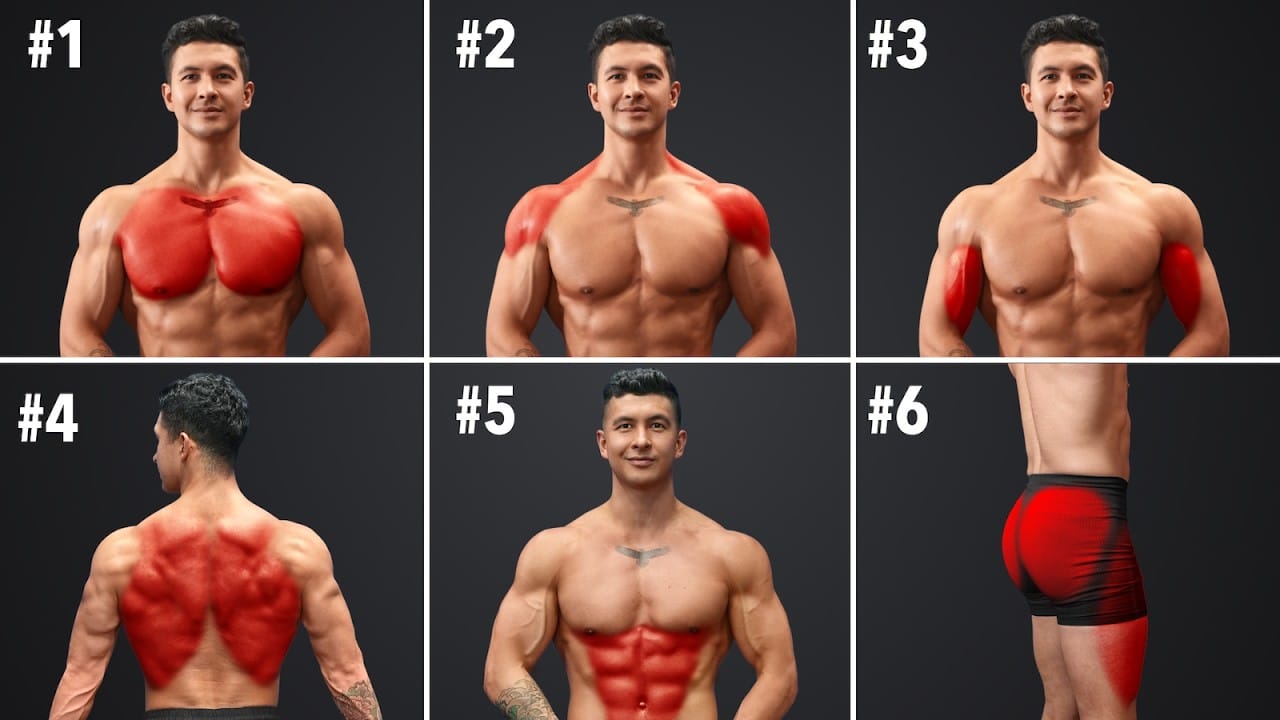
The secret isn’t just about choosing six powerful exercises.
It’s about personalizing each movement based on individual body structure, experience level, and specific goals—something most cookie-cutter programs completely ignore.
Jump to:
The Chest Builder That Outperforms Flat Bench
Ethier kicks off his routine with an exercise that might surprise traditional lifters: low incline dumbbell press.
Research shows this movement grows the entire chest just as effectively as flat presses, while delivering bonus upper chest development and strengthening shoulders and triceps.
But here’s where customization becomes critical.
Finding Your Perfect Incline Angle
Ethier recommends a simple wall test using just your phone. Place your phone against your chest while standing against a wall.
If it points straight up, you have a flat sternum.
If it points straight up, you have a flat sternum like me. And in this case, super easy for your shoulders to end up dominating the movement. So in this case, you want to use a lower incline one notch up from the bottom.
However, if your phone angles backward, you have a steep sternum and should use a higher incline—two notches up from the bottom.
Beyond angle adjustment, form matters tremendously. Pressing in a T-shape limits depth and risks shoulder injury. Instead, tuck shoulders into an arrow shape for deeper chest stretch and safer mechanics.
Beginners should expect wobbliness initially and stick to higher reps—10 to 15 per set—to master movement patterns. Women have a unique advantage here, tolerating higher rep ranges better than men, making this range ideal.
Advanced lifters should treat this as a strength builder, going heavier with 6 to 8 reps per set.
One Lower Body Movement That Replaces Four
Ethier calls his next exercise a “lower body cheat code” for good reason.
Barbell squats build glutes as effectively as hip thrusts, strengthen lower back like deadlifts, grow quads like leg presses, and even develop inner thighs like adductor machines—all simultaneously.
Master the Goblet Squat First
Before loading up barbells, Ethier strongly advocates for goblet squats—a massively underrated foundation exercise.
By holding the weight at your chest, it forces you to brace your core, enabling you to go deeper and much safer.
Stick with goblet squats until you can handle 50% of your bodyweight for 10 reps. For someone weighing 160 pounds, that means an 80-pound dumbbell.
Once strength permits, barbells become more convenient for progressive overload.
Customizing Squat Variations for Specific Goals
Advanced lifters can modify squats to target specific muscle groups:
- For quad dominance: Elevate heels to keep torso upright and drive knees forward
- For glute emphasis: Use box squats, pushing hips back while keeping shins vertical
- Hip structure matters: Test three foot stances—slightly wider than shoulder width with toes out, hip width with toes forward, or wide with toes significantly outward
Roughly half of trainees prefer the first stance, a quarter prefer the second, and the remainder do best with the widest variation.
Pull-Ups: The Back Transformer
Few exercises transform back development quite like pull-ups when performed with progressive strength building.
Ethier currently performs 24 consecutive pull-ups and provides clear benchmarks:
- 0-1 reps: Beginner
- 2-5 reps: Average
- 6-12 reps: Fit
- 13-20 reps: Advanced
- 20+ reps: Elite
Women have proportionally different standards reflecting physiological differences.
Building Pull-Up Strength from Zero
Can’t do a single pull-up yet? Start with inverted rows to build back and core strength simultaneously.
Progress to sets of 15 reps before attempting pull-ups, but begin with neutral grip rather than overhand—most people are significantly stronger in this position.
Bands or assisted machines help initially, but work toward 10 unassisted reps with neutral grip before switching to overhand.
Expect reps to drop by roughly half when making this transition. Aim for strict sets of 5-8 reps, then add weight once you exceed 8 reps, continuously cycling through progressive overload.
Romanian Deadlifts for Hamstring Development
This movement strengthens lower back, builds hamstrings, and prevents injury when performed correctly.
Unlike squats, nearly everyone performs best with feet hip-width apart and toes forward. Test this by jumping and noting where feet naturally land—usually the optimal stance.
Learning Proper Hip Hinge Mechanics
Mastering hip hinge rather than back bending makes all the difference.
Start with a single dumbbell held by its ends. Brace core and push hips backward until they can’t travel further, then return. Once natural, switch to two dumbbells, keeping weights close to legs as they slide down thighs and shins.
Two variations exist: slightly bent knees target glutes more, while straighter legs emphasize hamstrings.
As strength increases, barbells become more practical for loading, but avoid the common mistake of forcing excessive range of motion.
Some people, they can go all the way down to the floor. Others, like me, have to stop right below the knee. Both are correct form as long as your back stays flat and you feel the tension in your hamstrings.
Ethier recommends relatively low reps—6 to 10 per set—since higher reps with heavy loads become excessively fatiguing.
Building Back Thickness and Posture
While pull-ups develop back width, wide-grip lat pulldowns build thickness through mid and upper back muscles between shoulder blades.
Most people neglect these muscles, resulting in flat backs and poor posture.
Grab a lat pulldown bar with wide overhand grip, set feet high, brace core, and treat hands like hooks. Pull elbows back in arrow shape, squeezing midback muscles while aiming for lower chest level.
Light weight with higher reps—10 to 15 per set—works best since other muscles easily compensate with heavier loads.
The Mind-Muscle Connection Drill
Struggling to feel back muscles working? Keep arms straight and practice letting shoulder blades slide forward, then squeeze them together. Once midback engagement is felt, maintain that motion while adding full rows.
Advanced technique: perform normal reps until failure, then complete 3-5 shoulder squeezes to ensure back muscles truly reach exhaustion.
Shoulder Development from All Angles
Research reveals shoulders can be divided into up to seven different heads, not just three as commonly believed.
Ethier’s solution? Lateral raise supersets targeting multiple angles.
Set up an incline bench with dumbbells. First, lay back on bench and raise shoulders in Y-shape slightly forward, targeting side and front shoulder fibers for width development. Continue until failure.
Immediately flip over, chest on bench, raising weights out to sides and slightly behind. This targets rear shoulders for roundness and three-dimensional appearance.
Women may find chest-on-bench uncomfortable—placing a hoodie or pad creates needed space.
Weight selection proves critical here. Ethier himself uses only 25 pounds.
Don’t let your ego take over. I can only use 25 lbs here, and that is more than enough.
Customizing with Accessory Exercises
Ethier recommends selecting one or two accessory exercises based on individual weaknesses:
- Beginners: Dead bugs for core strength that instantly improves all main lifts
- Glute focus: Hip abduction exercises for upper glute shelf development
- Calves: Standing or leg press variations (research shows straight-leg exercises outperform seated)
- Arms: Incline dumbbell curl to failure, immediately followed by overhead tricep extensions
- Upper back: Kelso shrugs on incline bench, arms straight, shoving shoulder blades up and inward
- Upper chest: Forward-leaning cable flyes or pec deck to target often-neglected upper chest fibers
Performing this full-body routine two to three times weekly delivers impressive results, but Ethier emphasizes pairing workouts with proper nutrition for optimal transformations.