Optimizing hormones isn’t just about building muscle or burning fat.
It’s about unlocking an entirely different level of energy, drive, and progress that most people never experience.
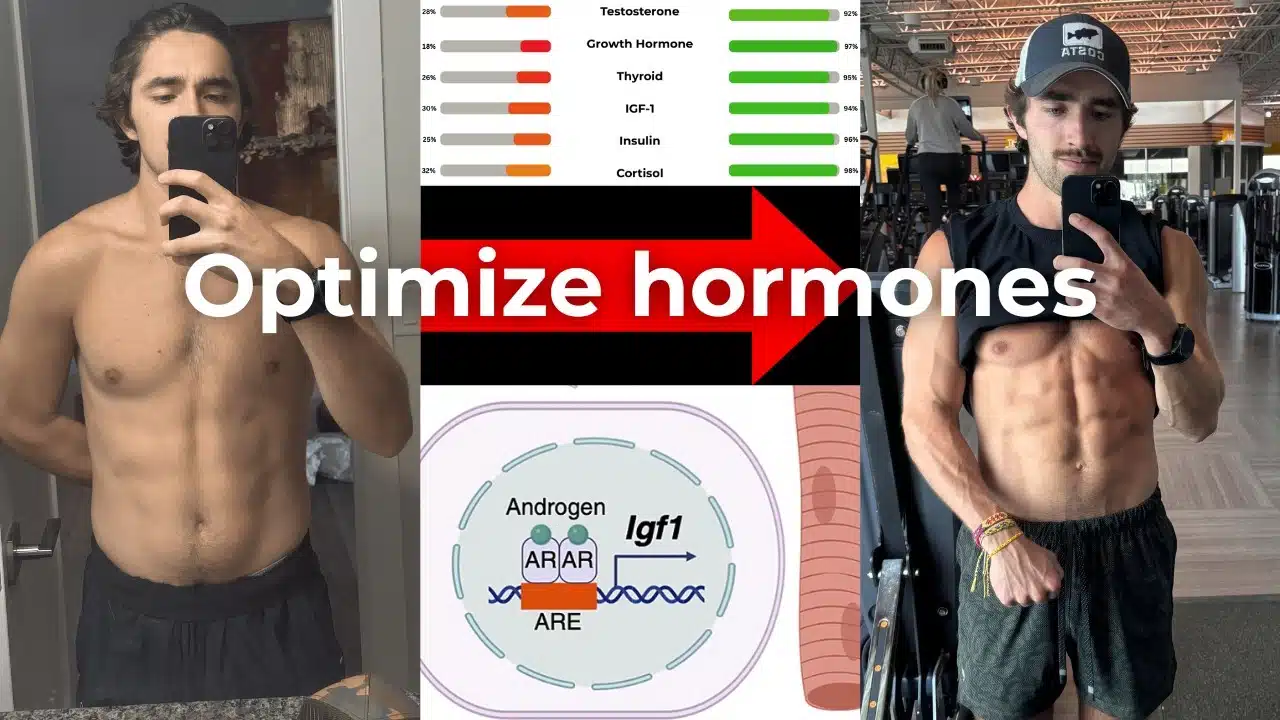
In a recent YouTube video, fitness coach and content creator discussed how endocrinology—the study of hormones—serves as the invisible amplifier behind every workout, every meal, and every recovery session.
For those struggling despite “doing everything right,” the problem might not be effort—it might be what’s happening under the hood.
Jump to:
- Why Hormones Are Your Fitness Amplifiers
- Testosterone: The Anabolic Powerhouse
- Growth Hormone: The Nighttime Fat Burner
- Thyroid: The Metabolic Thermostat
- IGF-1: The Muscle Memory Molecule
- Insulin: The Nutrient Partitioning Agent
- Cortisol: The Stress Hormone That Ruins Everything
- Don’t Let Hormones Be Your Bottleneck
Why Hormones Are Your Fitness Amplifiers
Hormones act like stats in a video game character. You can have perfect training and flawless nutrition, but if your hormonal profile is suboptimal, progress stalls.
The coach, who dealt with hypothyroidism since age 12, knows this firsthand. Low energy, poor appetite, constant fatigue—these weren’t just minor inconveniences.

If you want something simple that actually works, this is one of the most effective tools I’ve used to build strength, conditioning, and endurance without needing a full gym setup.
- Full-body training with one weight using swings, squats, and presses
- Solid cast iron build that feels stable and lasts for years
- Comfortable grip that makes high-rep workouts easier to handle
I was hypothyroid as a kid. When I was 12 years old, I started taking a medication for thyroid because my body just didn’t produce it. And it did affect me growing up. I remember just being very low energy. I was tired a lot.
That early struggle became a catalyst for deeper learning—not just about calories in versus calories out, but about the biological machinery that determines how the body responds to training and nutrition.
Testosterone: The Anabolic Powerhouse
Testosterone is often called the king of hormones for good reason. It controls muscle protein synthesis, fat storage, recovery, libido, and even motivation.
Benefits of optimized testosterone:
- Muscle protein synthesis fully activated
- Lower body fat storage
- Enhanced recovery
- Increased libido and sex drive
- Higher motivation and drive in all areas of life
But here’s the catch: total testosterone isn’t the full story. Only about 2% of testosterone is “free”—the bioavailable form that actually binds to androgen receptors and triggers results.
The rest is bound up by sex hormone-binding globulin (SHBG) and albumin, rendering it inactive. Optimization means both producing more total testosterone and freeing up what’s already there.
How to Optimize Testosterone
- Dietary fat and cholesterol: Eggs, shrimp, ground beef—cholesterol is the precursor to all sex hormones
- Zinc and magnesium: Critical micronutrients often overlooked
- Vitamin D and sunlight: Direct correlation with testosterone production
- Lower cortisol and prolactin: Both suppress testosterone when chronically elevated
- Raise dopamine: Helps lower prolactin and supports hormonal balance
- Reduce body fat: Excess fat converts testosterone to estrogen via aromatase
Getting leaner doesn’t just reveal muscle—it actively boosts testosterone, creating a positive feedback loop.
If you want something simple that actually works, this is one of the most effective tools I’ve used to build strength, conditioning, and endurance without needing a full gym setup.
- Full-body training with one weight using swings, squats, and presses
- Solid cast iron build that feels stable and lasts for years
- Comfortable grip that makes high-rep workouts easier to handle
Growth Hormone: The Nighttime Fat Burner
Growth hormone plays a starring role in fat oxidation, recovery, and muscle preservation during calorie deficits. It’s also anti-catabolic, meaning it protects muscle tissue when food intake drops.
Here’s the kicker: 75% of growth hormone is released during sleep, with the biggest pulse occurring in the first 90 minutes.
There’s a difference between knowing getting good sleep is true and then actually prioritizing it—having a system to follow to make sure you’re getting good sleep and actually function as you should as a human.
Poor sleep doesn’t just make you tired. It crushes growth hormone release, impairing fat loss and recovery.
How to Optimize Growth Hormone
- Prioritize sleep: Protect the first 90 minutes especially
- Keep insulin low before bed: High carbs at night blunt growth hormone pulses
- Intermittent fasting: Fasting windows boost GH significantly
- Sauna sessions: Heat exposure stimulates growth hormone release
- Lower body fat: Again, leaner bodies produce more GH
Post-workout carbs are fine if timed correctly, but spiking insulin right before bed is a growth hormone killer.
Thyroid: The Metabolic Thermostat
Thyroid hormones—primarily T3 and T4—regulate basal metabolic rate, fat oxidation efficiency, mitochondrial density, and body temperature. When thyroid function drops, so does nearly everything else.
Hypothyroidism symptoms include:
If you want something simple that actually works, this is one of the most effective tools I’ve used to build strength, conditioning, and endurance without needing a full gym setup.
- Full-body training with one weight using swings, squats, and presses
- Solid cast iron build that feels stable and lasts for years
- Comfortable grip that makes high-rep workouts easier to handle
- Dropped BMR
- Weakness and fatigue
- Reduced fat oxidation
- Feeling cold frequently
- Sluggish recovery
But there’s also hyperthyroidism—too much thyroid hormone—which brings its own problems. The goal is finding the sweet spot.
One complication: reverse T3. This inactive form mimics T3 but doesn’t perform its functions. Blood work might show “normal” T3 levels, but if it’s mostly reverse T3, the body isn’t benefiting.
How to Optimize Thyroid
- Selenium and iodine: Essential micronutrients for thyroid hormone production
- Adequate carb intake: Carbs stimulate insulin, which helps convert T4 to active T3
- Lower cortisol: Chronic stress impairs thyroid function
- Avoid prolonged calorie restriction: Crashing calories tanks thyroid output
Micronutrient deficiencies alone can wreck thyroid function, which is why generic meal plans often fail.
IGF-1: The Muscle Memory Molecule
Insulin-like growth factor 1 (IGF-1) is the downstream signal from growth hormone that drives muscle growth, bone density, and connective tissue repair.
There are two types: systemic IGF-1 (produced in the liver from GH) and local IGF-1 (mechano growth factor, or MGF, produced in muscle tissue from mechanical tension).
MGF is what enables muscle memory—the phenomenon where previously built muscle comes back faster after a layoff.
If you want something simple that actually works, this is one of the most effective tools I’ve used to build strength, conditioning, and endurance without needing a full gym setup.
- Full-body training with one weight using swings, squats, and presses
- Solid cast iron build that feels stable and lasts for years
- Comfortable grip that makes high-rep workouts easier to handle
How to Optimize IGF-1
- Hit leucine threshold at every meal: Minimum protein intake per meal matters
- Adequate calories: Chronic under-eating suppresses IGF-1
- Mechanical tension: Progressive overload triggers local MGF production
- Optimize growth hormone: GH stimulates systemic IGF-1 from the liver
This is why protein timing and training intensity aren’t just bro-science—they’re biological levers.
Insulin: The Nutrient Partitioning Agent
Insulin isn’t inherently good or bad—it’s all about timing and sensitivity.
When used correctly, insulin is anti-catabolic, shuttles nutrients into muscle cells, and stimulates mTOR (one of three muscle growth signals). When mismanaged, it blocks fat burning, promotes fat storage, and suppresses growth hormone.
Insulin sensitivity means the body uses less insulin to do the same job—clearing glucose and delivering nutrients. This results in cleaner nutrient partitioning and less fat spillover.
Insulin resistance is the opposite: more insulin needed, worse partitioning, more fat gain.
How to Optimize Insulin
- Time carbs post-workout: This is when insulin is most anabolic
- Follow the Randle Cycle: Don’t consistently mix high fats and high carbs
- Improve insulin sensitivity: Through training, sleep, and body composition
- Avoid spiking insulin at night: Especially before the first GH pulse
Building muscle in a deficit is possible—but only with strategic insulin management and high sensitivity.
If you want something simple that actually works, this is one of the most effective tools I’ve used to build strength, conditioning, and endurance without needing a full gym setup.
- Full-body training with one weight using swings, squats, and presses
- Solid cast iron build that feels stable and lasts for years
- Comfortable grip that makes high-rep workouts easier to handle
Cortisol: The Stress Hormone That Ruins Everything
Cortisol isn’t evil. It’s supposed to spike in the morning to wake you up, then taper off as the day progresses. The problem is chronic elevation.
When cortisol stays high:
- Muscle protein breakdown increases
- Fat storage accelerates, especially around the midsection
- Testosterone, thyroid, and growth hormone all drop
- Sleep quality tanks
- Insulin sensitivity worsens
A big reason why if you toss and turn in bed like you can’t really fall asleep consistently at the same time, it’s because your cortisol is high at night time, which is very unnatural.
Cortisol and melatonin work in opposition. When cortisol is elevated at night, melatonin can’t rise properly, destroying circadian rhythm.
How to Optimize Cortisol
- Get quality sleep: Sleep deprivation spikes cortisol
- Eat adequate calories: Chronic dieting raises cortisol
- Manage training volume: Overtraining is a cortisol bomb
- Reduce lifestyle stress: Work, relationships, environment—all matter
Cortisol is often the hidden bottleneck in fat loss and muscle retention during a cut.
Don’t Let Hormones Be Your Bottleneck
Perfect training with unoptimized hormones equals mediocre progress. But optimized hormones with solid training? That’s when everything clicks.
Energy, drive, libido, mood, and quality of life all improve when the endocrine system is firing on all cylinders. It’s not just about aesthetics—it’s about functioning as a high-performance human.
If you want something simple that actually works, this is one of the most effective tools I’ve used to build strength, conditioning, and endurance without needing a full gym setup.
- Full-body training with one weight using swings, squats, and presses
- Solid cast iron build that feels stable and lasts for years
- Comfortable grip that makes high-rep workouts easier to handle
One often-overlooked factor: endocrine disruptors. Chemicals in plastics, personal care products, and processed foods can block hormone receptors and tank production, no matter how clean the diet or training is.
The coach plans to release a second part diving into additional hormones like melatonin, prolactin, and others. For those serious about optimization, understanding these systems isn’t optional—it’s foundational.
Hormones are the invisible levers that amplify—or sabotage—every effort in the gym and kitchen. Master them, and progress becomes inevitable.