Most lifters obsess over bicep curls, chasing that coveted arm pump.
But there’s a hidden culprit behind stubbornly thin arms that no amount of traditional curling will fix.
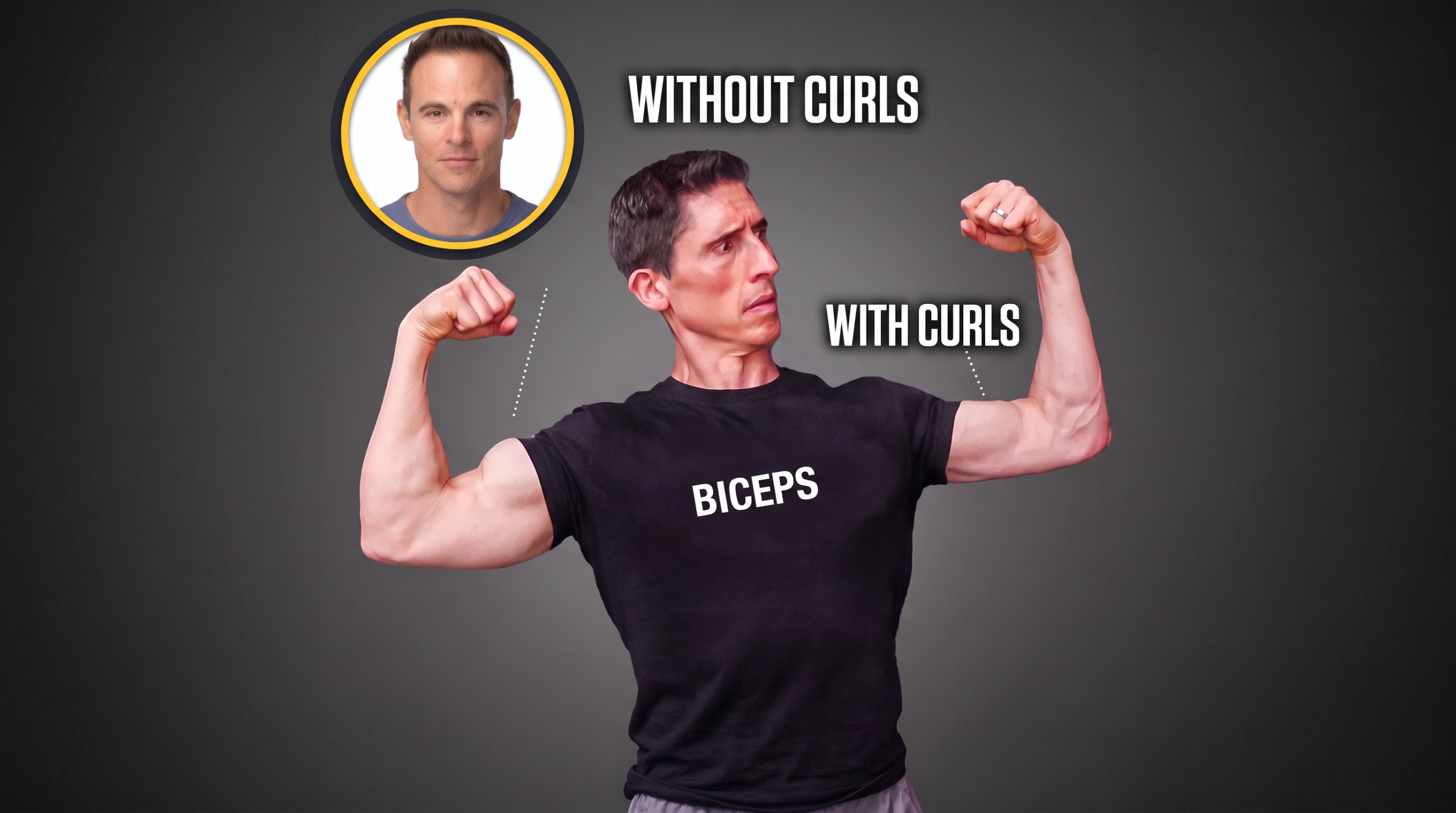
Physical therapist and strength coach Jeff Cavaliere recently revealed why standard bicep training fails to build arm width—and shared the exact exercises that transformed his own arm development after a bicep injury forced him to completely rethink his approach.
The solution lies in targeting a muscle most people completely ignore.
Jump to:
The Real Width Problem Nobody Talks About
When viewing arms from the front, the muscle responsible for width isn’t actually the bicep at all.
It’s the brachialis—a muscle that sits beneath the bicep and dramatically impacts overall arm diameter. Cavaliere explains that this overlooked muscle can be easily located by placing fingers over the top of the bicep where it starts to drop, with the brachialis being the muscle that pops out just beyond.
When you grow them this way, this muscle will also hypertrophy and push the biceps up as well to help you to fill up that shirt sleeve, no matter what angle people are looking at.
After tearing his bicep while holding his son on ice, Cavaliere was forced to modify his training. This unfortunate injury became an unexpected learning opportunity that revealed the true path to building arm width.
Why Hammer Curls Aren’t Enough
Many lifters believe hammer curls solve the brachialis problem. They’re only half right.
While hammer curls do engage the brachialis more than standard curls, they still involve significant bicep activation. The neutral forearm position used in hammer curls naturally recruits the bicep, making it difficult to truly isolate and overload the brachialis.
Cavaliere demonstrates that simply rotating from a pronated (palm-down) to neutral position activates the bicep considerably, meaning traditional hammer curls can’t completely minimize bicep involvement during elbow flexion.
The Cross-Body Hammer Curl: A Superior Alternative
The key difference lies in maintaining a fully pronated forearm throughout the movement.
Instead of keeping the dumbbell parallel to the body, the cross-body hammer curl involves dragging the weight up close to the torso while keeping the forearm pronated. This positioning delivers significantly more workload directly to the brachialis.
When I get in this position here and I drag my arm up close to my body, you’re going to much more intense workload being delivered to the brachialis, which is again exactly that muscle that you’re trying to build.
Cavaliere incorporated this variation into every bicep workout—whether training arms directly, during pull days, or in dedicated bicep sessions.
Narrow-Grip Pull-Ups for Brachialis Overload
Traditional chin-ups place excessive stress on the biceps, particularly problematic for anyone dealing with bicep issues or simply wanting to shift focus to the brachialis.
The solution: narrow-grip, overhand pull-ups.
This grip variation minimizes bicep contribution while forcing heavy overload through elbow flexion, directly targeting the brachialis. Using an assistance band is perfectly acceptable for those who cannot yet complete 10-12 repetitions with bodyweight alone.
The narrow hand placement combined with pronated grip creates forced elbow flexion while decreasing bicep involvement—exactly what’s needed for brachialis development.
The Accidental Discovery: Calm Curls
While rehabilitating his torn bicep, Cavaliere stumbled upon an exercise variation that proved remarkably effective for building arm width.
Standard cable curls create minimal stress on the bicep at full extension—beneficial when working around injury. However, Cavaliere modified this further by shortening the range of motion and adjusting the movement pattern entirely.
The “calm curl” involves starting with cables positioned to the sides, maintaining pronated forearm positioning, and curling until the hand meets the chest. This is not a cable crossover.
Performing this exercise in alternating fashion reduces bicep stress at the extended position in two ways: the arm remains in line with the cable (decreasing tension), and the pronated position naturally decreases bicep involvement.
What I found was that the thickness of the arm started to come back much faster than even when I had done workouts that didn’t include this.
Drop Curls: Maximizing Time Under Tension
This exercise bridges the gap between brachialis-focused training and traditional dumbbell curls.
Drop curls never reach full supination, keeping focus distributed between the brachialis and bicep rather than allowing the bicep to dominate. The real magic lies in execution speed and strategic pauses.
Key execution points:
- Move very slowly and deliberately during the first half of the curl
- The brachialis performs most work before reaching 90 degrees
- Past 90 degrees, the bicep begins taking over, especially with shoulder flexion
- Stop at the mid-position between reps
- While one arm curls concentrically, the other holds isometrically at mid-range
Reduce weight significantly to maintain proper tempo. Both arms work intensely—one through concentric movement, the other through isometric hold.
Programming for Maximum Width Development
Building substantial arm width requires direct, dedicated brachialis work—not just hoping standard curls will eventually do the job.
Cavaliere recommends substituting one or two curl variations in current routines with brachialis-specific exercises. For accelerated results, dedicate an entire weekly session to brachialis training in addition to regular arm or pull workouts.
As the brachialis develops, it creates a dual effect: increasing arm diameter while simultaneously pushing the biceps upward. This combination delivers both width and height, creating fuller, more impressive arms from every angle.
If you have to substitute one or two of those extra variations of curls that you’re doing right now for a brachialis exercise or two, and I promise you you’ll be on the right path.
The brachialis lies deep beneath the biceps, making it impossible to see directly. Yet its impact on overall arm appearance cannot be overstated. Skipping direct brachialis work means accepting permanently thin arms, regardless of how many standard curls fill training programs.
For lifters frustrated with stubborn arm development despite consistent training, the solution isn’t more volume—it’s smarter exercise selection targeting the actual muscle responsible for width.