Two of the fitness world’s most influential mobility experts recently sat down for an unprecedented collaboration that’s changing how people think about flexibility training.
Ben Patrick, known globally as “Knees Over Toes Guy,” joined forces with mobility specialist from Strength Side to create what they’re calling a complete full-body mobility checklist.
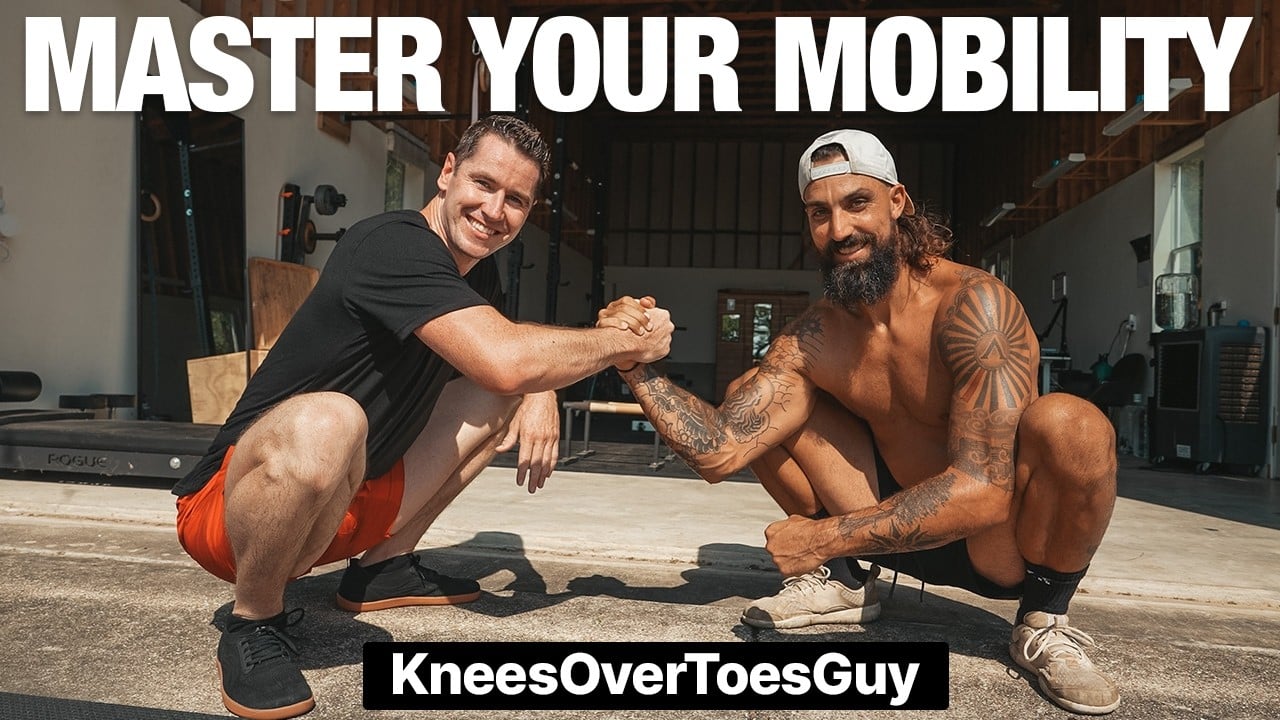
What started as a simple comparison of mobility tools evolved into an in-depth session covering everything from ankles to wrists.
The best part? Everything they demonstrated requires minimal equipment and can be done at home.
Jump to:
Starting From Ground Zero: Foot and Ankle Mobility
Both experts agree that foot and ankle work provides a crucial foundation for total body mobility.
The Strength Side coach emphasized starting every session with foot activation, explaining that nerve endings concentrated in feet help prime your entire body for movement. He demonstrated sitting on ankles to stretch shin muscles, then transitioning to a toes-down position.
I think it’s perfect starting with foot and ankle because I think like getting your feet warmed up for anything like it’s it’s where all our nerve endings are, right? Like it really gets the body primed.
Patrick’s approach stems from his background recovering from severe knee injuries. His method involves pushing through toes using sled work or wall-based calf raises—both straight-leg and bent-knee variations taken to burnout at 20+ reps.
The Horizontal Squat: A Primal Alternative
Strength Side introduced what he calls a “horizontal squat” that mimics sled-pushing mechanics without equipment. Starting on hands and knees, practitioners rock hips backward while keeping hands planted, creating a dynamic stretch through calves, big toes, and quads simultaneously.
Patrick immediately recognized value in this approach, calling it “a primal sled” that delivers similar benefits to his preferred tools.
This is like if someone said, “Could I do this instead of the sled?” I would say, “Yes.”
Patrick’s wall-based bent-knee calf raise creates an isometric hold for quads while simultaneously stretching calves and big toes. Progression happens naturally—start on two legs, advance to one leg, increase range of motion gradually.
Unlocking Squat Mobility Without Traditional Stretching
Both trainers emphasized that squat mobility isn’t something to “add” but rather something not to lose in the first place.
I think like number one for squat mobility is like just don’t remove your squat mobility from your life before saying like you must do this.
Patrick pointed out that children naturally squat deep until schooling forces them into chairs for hours daily. His solution for his own kids? Providing mats next to desks so they can read and work in natural positions like deep squats.
Two Essential Squat Mobility Exercises
Patrick breaks squat mobility into ankle and hip components, addressing each separately:
For ankle mobility: Full range-of-motion split squats on a slant board. Unlike regular squats where your body moves vertically, split squats create diagonal movement that loads ankle flexibility more intensely. Progress from higher surfaces to lower ones, eventually reaching floor level.
For hip mobility: Weighted adductor stretches using dumbbells. Sitting with legs wide, hold dumbbells and use their weight to pull yourself into a deeper inner thigh stretch. This addresses hip capacity needed for deep squatting.
The Seated Deadlift: A Hidden Gem
Patrick’s “seated deadlift” (essentially a seated good morning) serves multiple purposes. Sitting with legs extended and feet together, practitioners grab dumbbells from floor, retract shoulder blades, then hinge forward.
This movement stretches adductors while strengthening lower back muscles through full available range. Patrick uses this foundational exercise even with 80-year-old clients before progressing to standing deadlifts.
Strength Side added crucial context about ankle versus hip contributions to squatting. Despite having only half normal dorsiflexion in one ankle from an old injury, he can still achieve deep squats by compensating with hip mobility.
Personal anecdote that dorsiflexion helps a lot for getting a deep squat, but it’s not completely necessary.
Hip Rotation: The Missing Link
Strength Side revealed that internal hip rotation dramatically improved how his hips felt overall, even more than external rotation work.
His 90/90 position progression starts simple: sitting with one leg bent at 90 degrees in front, another at 90 degrees to the side. Many beginners can’t even achieve this basic position.
Regression: Simply sit and move knees side to side, gradually improving until touching knees to ground becomes possible.
Progression: From 90/90 position, push front knee into ground, lift hips, then eccentrically lower while maintaining knee pressure. This strengthens internal rotators that activate during deep squatting.
If you look at Olympic lifters, you’ll see when you get to that deep squat, a lot of us internally rotate at the bottom. So internal rotation I view as kind of that one that a lot of people aren’t training, but has like potential to really facilitate like some nice smooth moving hips.
Rethinking Back Training: Flexion Isn’t the Enemy
Patrick dropped a controversial technique that challenges conventional wisdom about spinal rounding.
While he previously advocated Jefferson curls, Patrick now prefers Romanian deadlifts (RDLs) combined with back extension machine work. His RDL focus emphasizes stretching upper hamstrings without allowing back rounding—until fatigue sets in.
So, you don’t lift with a round, you come out of a round.
His back extension protocol intentionally incorporates spinal flexion. Rather than maintaining a neutral spine throughout, Patrick rounds his back at the bottom, then actively extends out of that rounded position for 20-30 reps.
For standing good mornings without a back extension machine, Patrick employs the same principle: resist rounding on the way down, but once unable to resist further, intentionally round, then come out of that rounded position.
This approach requires proper coaching and shouldn’t be attempted by beginners without guidance.
Side Body Work: The Forgotten Core Component
Patrick considers side-lying back extensions on a back extension machine among his most valuable exercises, particularly for aging populations.
Cross top leg over bottom leg, position body sideways on machine, then perform lateral flexion movements. Starting with hands at hips makes the movement easier; hands behind head increases difficulty; holding weight advances it further.
This targets the quadratus lumborum, a deep muscle attaching directly to lower spine vertebrae.
I mean, your lower back is in the middle. So, everything around it is there to protect it.
One set to burnout weekly maintains this area effectively. Patrick credits this exercise as key to remaining lower back pain-free for over a decade.
Upper Body Mobility: Shoulders, Chest, and Wrists
Both experts emphasized that upper body mobility work doesn’t require complicated protocols.
Hip Flexor Strength Over Stretching
Patrick shifted focus from stretching hip flexors to strengthening them, particularly through L-sit progressions on push-up bars.
Beginner: Both knees tucked to chest
Intermediate: One leg extended, one tucked
Advanced: Both legs extended parallel to ground
Even holding a tucked position for 30 seconds provides significant hip flexor strengthening benefits.
Shoulder Extension Through Bridging
Strength Side uses crab position progressions to load shoulders into extension—a range most people never train.
Starting position involves sitting, placing hands behind body, then pushing hips forward. This creates moderate shoulder extension with minimal difficulty. Advanced practitioners elevate hips higher, dramatically increasing load on shoulders, chest, and biceps.
Patrick contributes dumbbell pullovers, emphasizing the combination of weight moving backward while hips drop down. This dual action creates a loaded stretch unavailable through bodyweight alone.
Wrist Mobility for Ground-Based Movement
Strength Side addressed a common limitation for people attempting floor exercises or handstands: weak, inflexible wrists.
His simple solution involves finger push-ups, lifting heel of hand while driving fingers into ground. This strengthens wrists in extension.
For wrist flexion, he demonstrated fists-down position with palms gradually pressing upward. Both movements scale easily by adjusting how much bodyweight loads the wrists.
What people figure out a lot like ankles is that it just takes kind of weekly dedication for months, you know, and you’ll start to see some results over time.
The Philosophy: Options, Not Dogma
Throughout their session, both experts emphasized that multiple paths lead to the same destination.
Rather than criticize each other, just share to you that there’s different ways to get to the same mountaintop.
Patrick’s approach stems from severe knee injuries that prevented him from playing basketball. His progressions accommodate people with pain or mobility restrictions, gradually building capacity.
Strength Side developed his system through martial arts, gymnastics, and working with diverse populations. His methods often incorporate more dynamic, whole-body movements.
Both have maintained injury-free training for over a decade—Patrick specifically knee and back pain-free for 10+ years.
Their shared recommendation? Choose exercises from each category that work for your body, equipment access, and goals. Consistency matters more than perfection.
- Foot/ankle: Wall calf raises, horizontal squats, or sled work
- Squat mobility: Split squats, seated deadlifts, or counterbalanced squats
- Hip rotation: 90/90 positions or simply sitting on floor while reading
- Posterior chain: RDLs, good mornings, or single-leg hinges
- Spine: Back extensions with flexion, side-lying variations
- Upper body: L-sits, deep push-ups, pullovers, or crab positions
- Wrists: Finger push-ups and loaded flexion holds
The collaboration revealed that effective mobility training doesn’t require expensive equipment, hours of daily stretching, or extreme flexibility goals. Simple, consistent work across fundamental movement patterns keeps bodies resilient and pain-free.
Both trainers promised a follow-up session focused on youth development and family-oriented mobility training, proving their commitment to making this information accessible across all age groups.