New research shows that older adults with advanced cancer can safely participate in combined exercise and nutritional programs—even while undergoing chemotherapy.
The findings challenge common assumptions about physical activity during cancer treatment in elderly patients.
Published in Frontiers in Physiology, the study demonstrates that structured interventions can help preserve muscle mass during one of the most vulnerable periods in a cancer patient’s journey.
Perhaps most importantly, participants reported improvements in quality of life—a critical outcome often overlooked in traditional cancer care.
Jump to:
- The Hidden Crisis: Muscle Loss During Cancer Treatment
- Exercise During Chemo: Testing What’s Possible
- Preserving Muscle While Undergoing Treatment
- Quality of Life Improvements Beyond Survival
- Overcoming Barriers in Real-World Settings
- Addressing the Evidence Gap in Older Adults
- Limitations and Future Research Directions
- Practical Implications for Clinical Care
- The Bigger Picture: Physiological Resilience in Aging Populations
- What This Means for Older Adults With Cancer
The Hidden Crisis: Muscle Loss During Cancer Treatment
Sarcopenia—the progressive loss of skeletal muscle mass and function—affects nearly half of older adults diagnosed with cancer, particularly those with gastrointestinal malignancies.
Prevalence rates range from 47–60% before treatment even begins.

If you want something simple that actually works, this is one of the most effective tools I’ve used to build strength, conditioning, and endurance without needing a full gym setup.
- Full-body training with one weight using swings, squats, and presses
- Solid cast iron build that feels stable and lasts for years
- Comfortable grip that makes high-rep workouts easier to handle
Age-related muscle decline accelerates dramatically when combined with cancer’s metabolic effects and chemotherapy’s catabolic stress. This convergence creates what researchers call “profound physiological vulnerability.”
Clinically, sarcopenia translates to tangible harm: reduced chemotherapy tolerance, dose reductions, treatment delays, and shortened survival. Conventional nutritional support alone cannot reverse cancer-associated muscle wasting, which is why researchers explored multimodal interventions.
Exercise During Chemo: Testing What’s Possible
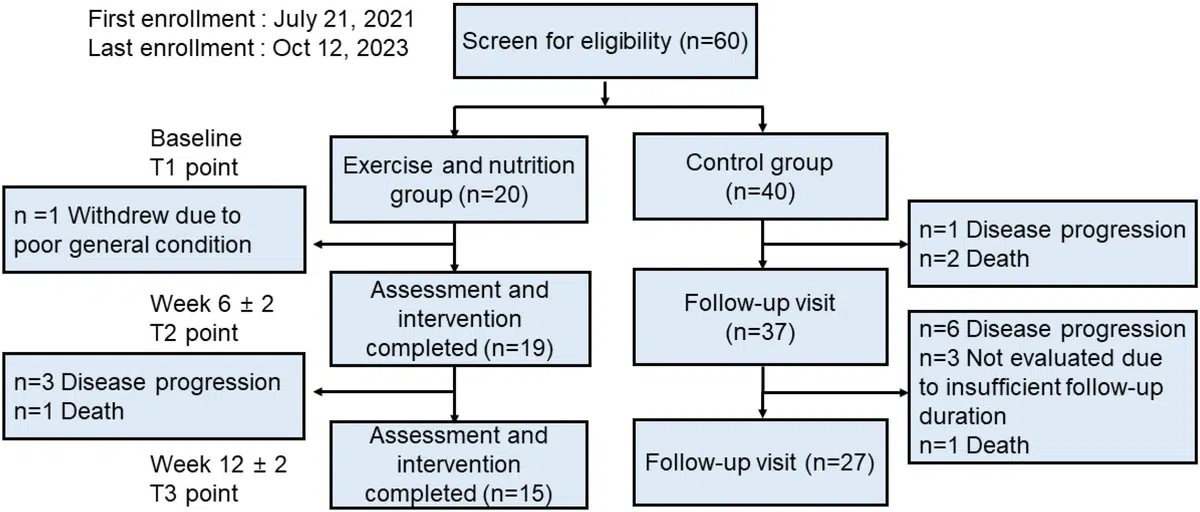
Between 2021 and 2023, researchers at Chung-Ang University Hospital enrolled 60 patients aged 65 and older with advanced cancer.
Twenty participants joined a 12-week intervention combining structured exercise with protein supplementation, while 40 comparable patients received usual care.
The exercise protocol included both resistance and aerobic components—dumbbell work, resistance bands, treadmill walking, and stationary cycling. Sessions lasted 30–40 minutes and were calibrated across three intensity levels based on each participant’s tolerance and physical capacity.
Nutritional support targeted 1.2 grams of protein per kilogram of body weight daily. Clinical dietitians assessed baseline intake through detailed dietary recalls, then prescribed whey protein supplementation tailored to individual deficiencies.
If you want something simple that actually works, this is one of the most effective tools I’ve used to build strength, conditioning, and endurance without needing a full gym setup.
- Full-body training with one weight using swings, squats, and presses
- Solid cast iron build that feels stable and lasts for years
- Comfortable grip that makes high-rep workouts easier to handle
Adherence Exceeded Expectations
Despite concerns about feasibility in elderly patients undergoing chemotherapy, adherence rates surpassed benchmarks.
- Exercise compliance: 65% (13 of 20 participants)
- Nutritional compliance: 75% (15 of 20 participants)
- Attrition rate: Only 5% (1 patient withdrew)
- Adverse events: Zero intervention-related complications
Participants completed a median of 28 exercise sessions over six weeks, averaging just over 50 minutes per session. Seven participants (35%) maintained more than 80% adherence to the exercise protocol.
Notably, exercise participation declined during later chemotherapy cycles—a pattern researchers attributed to cumulative treatment fatigue rather than intervention tolerability.
Preserving Muscle While Undergoing Treatment
The physiological outcomes revealed striking differences between intervention and control groups.
At six weeks, control participants experienced significant declines in skeletal muscle index (SMI)—a validated measure of whole-body muscle mass. In contrast, the intervention group maintained stable muscle mass despite ongoing chemotherapy.
The intervention was associated with relatively stable skeletal muscle mass, reductions in subcutaneous fat, and improvements in patient-reported quality of life.
Body composition changes extended beyond muscle preservation. Subcutaneous fat decreased significantly in the intervention group, with particularly pronounced reductions among women.
If you want something simple that actually works, this is one of the most effective tools I’ve used to build strength, conditioning, and endurance without needing a full gym setup.
- Full-body training with one weight using swings, squats, and presses
- Solid cast iron build that feels stable and lasts for years
- Comfortable grip that makes high-rep workouts easier to handle
Visceral fat—the metabolically active adipose tissue surrounding internal organs—showed reduction trends overall and significant decreases among men specifically.
Sex-Specific Metabolic Responses
The differential fat loss patterns between men and women suggest sex-specific metabolic adaptations to combined exercise and nutritional interventions.
Men demonstrated greater visceral fat reduction, while women showed more substantial decreases in subcutaneous adipose tissue. These findings highlight potential value in tailoring intervention approaches based on biological sex and baseline body composition.
Physical function parameters—including hand grip strength and gait speed—remained stable throughout the 12-week period, indicating that overall functional capacity was preserved during systemic therapy.
Quality of Life Improvements Beyond Survival
While muscle preservation matters physiologically, subjective well-being matters profoundly to patients navigating cancer treatment.
Quality of life assessments revealed meaningful improvements across multiple domains:
If you want something simple that actually works, this is one of the most effective tools I’ve used to build strength, conditioning, and endurance without needing a full gym setup.
- Full-body training with one weight using swings, squats, and presses
- Solid cast iron build that feels stable and lasts for years
- Comfortable grip that makes high-rep workouts easier to handle
- Fatigue: Decreased significantly from 52.2 at baseline to 15.9 at 12 weeks
- Appetite loss: Improved from 45.0 to 11.9
- Nausea: Reduced from 51.7 to 30.9
- Pain scores: Dropped markedly from 59.2 to 7.1
Overall quality of life showed progressive improvement throughout the intervention period, with the most substantial gains observed at 12 weeks.
These symptom improvements occurred without any intervention-related adverse events—no hepatic or renal toxicity, no injuries, no treatment complications.
Overcoming Barriers in Real-World Settings
The study design deliberately reflected real-world constraints rather than idealized research conditions.
Supervised exercise sessions occurred only during the first three days of the initial chemotherapy cycle—an intentional limitation. Subsequently, participants exercised independently at home, in parks, or at local facilities.
This pragmatic approach tested whether elderly cancer patients could sustain exercise behaviors without continuous professional supervision. The 65% adherence rate suggests that many can, though structured follow-up and behavioral reinforcement likely enhance long-term sustainability.
Protein supplementation strategies also prioritized practicality. Participants mixed whey protein powder into beverages, yogurt, or soft foods based on personal preference—simple adaptations that overcame taste-related barriers without requiring specialized meal preparation.
If you want something simple that actually works, this is one of the most effective tools I’ve used to build strength, conditioning, and endurance without needing a full gym setup.
- Full-body training with one weight using swings, squats, and presses
- Solid cast iron build that feels stable and lasts for years
- Comfortable grip that makes high-rep workouts easier to handle
Performance Status Matters
Not all patients demonstrated equal intervention feasibility. Those with preserved functional status (ECOG performance status 0–1) generally adhered well when provided adequate support.
However, one participant with more significant functional impairment (ECOG 2) discontinued due to physical limitations.
These patterns suggest that while structured interventions are feasible for older adults with maintained function, those with greater impairment may require more flexible, closely supervised, and individually adapted approaches.
Addressing the Evidence Gap in Older Adults
Despite older adults representing the demographic most vulnerable to cancer-related muscle loss, they remain dramatically underrepresented in exercise oncology research.
A recent meta-analysis revealed that fewer than 25% of participants in oncology exercise trials were aged 65 or older—a striking evidence gap given this population’s elevated risk.
This study deliberately focused on adults 65 and older, with a median age of 72 years. Nearly 42% had baseline sarcopenia, and all were undergoing palliative chemotherapy for advanced cancer.
If you want something simple that actually works, this is one of the most effective tools I’ve used to build strength, conditioning, and endurance without needing a full gym setup.
- Full-body training with one weight using swings, squats, and presses
- Solid cast iron build that feels stable and lasts for years
- Comfortable grip that makes high-rep workouts easier to handle
Despite concerns about feasibility in elderly patients undergoing chemotherapy, adherence rates surpassed benchmarks.
The study cohort represented precisely the population excluded from many trials—elderly, systemically ill, and exposed to substantial physiological stress. Yet this vulnerable group demonstrated that structured physiological interventions remain achievable with appropriate support.
Why Previous Studies Missed Older Adults
Historical exclusion of elderly participants from exercise trials stems from multiple factors: concerns about safety, assumptions about adherence capacity, logistical challenges with transportation and supervision, and hesitancy among both clinicians and patients.
This study’s safety profile—zero adverse events—directly challenges safety concerns. The adherence data addresses capacity assumptions. Together, these findings support broader inclusion of older adults in future intervention research.
Limitations and Future Research Directions
Several constraints temper interpretation of these findings.
The intervention group was younger and had better performance status than controls—baseline imbalances that may have provided greater physiological resilience to catabolic stress. Although statistical adjustments were performed, residual confounding remains possible.
Cancer type heterogeneity and modest sample size limited statistical power for subgroup analyses. The 2:1 control-to-intervention ratio reflected pragmatic recruitment challenges rather than optimal study design.
If you want something simple that actually works, this is one of the most effective tools I’ve used to build strength, conditioning, and endurance without needing a full gym setup.
- Full-body training with one weight using swings, squats, and presses
- Solid cast iron build that feels stable and lasts for years
- Comfortable grip that makes high-rep workouts easier to handle
Exercise adherence declined during later chemotherapy cycles—a pattern requiring additional investigation. Simple monitoring strategies, scheduled check-ins, or digital engagement tools might enhance long-term participation, but these approaches weren’t systematically tested.
Future adequately powered randomized controlled trials should incorporate longer follow-up periods, assess survival outcomes, and identify patient subgroups most likely to benefit from combined interventions.
Practical Implications for Clinical Care
These findings carry immediate relevance for oncology practice.
Combined exercise and nutritional interventions represent feasible adjunctive strategies to standard cancer care in older adults. Safety concerns should not automatically preclude elderly patients from structured physical activity programs during chemotherapy.
Key implementation considerations include:
- Initial professional guidance followed by supported home-based exercise
- Individualized protein supplementation based on dietary assessment
- Progressive intensity levels accommodating variable functional capacity
- Regular monitoring and behavioral reinforcement to sustain adherence
- Sex-specific considerations for body composition goals
Performance status assessment should guide intervention intensity and supervision requirements. Patients with preserved function (ECOG 0–1) can typically participate with standard support, while those with greater impairment may need adapted protocols.
If you want something simple that actually works, this is one of the most effective tools I’ve used to build strength, conditioning, and endurance without needing a full gym setup.
- Full-body training with one weight using swings, squats, and presses
- Solid cast iron build that feels stable and lasts for years
- Comfortable grip that makes high-rep workouts easier to handle
The symptom improvements—particularly reduced fatigue, enhanced appetite, and decreased nausea—suggest that exercise and nutrition interventions address concerns highly relevant to patients’ daily experiences during cancer treatment.
The Bigger Picture: Physiological Resilience in Aging Populations
Beyond cancer-specific applications, this research illuminates broader principles about physiological interventions in vulnerable elderly populations.
Aging does not automatically preclude meaningful adaptation to exercise and nutritional stimuli—even under severe catabolic stress. The skeletal muscle preservation observed in this study demonstrates retained anabolic responsiveness despite advanced age and systemic illness.
This adaptive capacity challenges therapeutic nihilism sometimes applied to elderly patients with serious illnesses. Physiological resilience persists, though it may require targeted support to manifest.
The quality of life improvements carry particular significance. Survival remains the primary endpoint in most cancer trials, but lived experience during treatment profoundly matters to patients and families.
Interventions that enhance well-being without compromising safety deserve consideration alongside traditional medical therapies—particularly in palliative contexts where quality often supersedes quantity of life.
If you want something simple that actually works, this is one of the most effective tools I’ve used to build strength, conditioning, and endurance without needing a full gym setup.
- Full-body training with one weight using swings, squats, and presses
- Solid cast iron build that feels stable and lasts for years
- Comfortable grip that makes high-rep workouts easier to handle
What This Means for Older Adults With Cancer
For older adults diagnosed with cancer, these findings offer both reassurance and actionable guidance.
Physical activity remains safe and beneficial during chemotherapy when appropriately structured. Maintaining adequate protein intake—potentially through supplementation—supports muscle preservation during treatment.
Simple, practical strategies implemented consistently over time can produce meaningful physiological and subjective benefits. Professional guidance during initial phases helps establish sustainable routines, but perfect adherence isn’t required for meaningful outcomes.
Perhaps most importantly, advanced age and cancer diagnosis don’t preclude taking active steps to preserve strength, function, and quality of life during treatment. The evidence increasingly supports engagement rather than resignation.