Most lifters are approaching deadlifts completely wrong, and it’s costing them both gains and long-term back health.
The misconception? Thinking of it as a lift rather than a push.
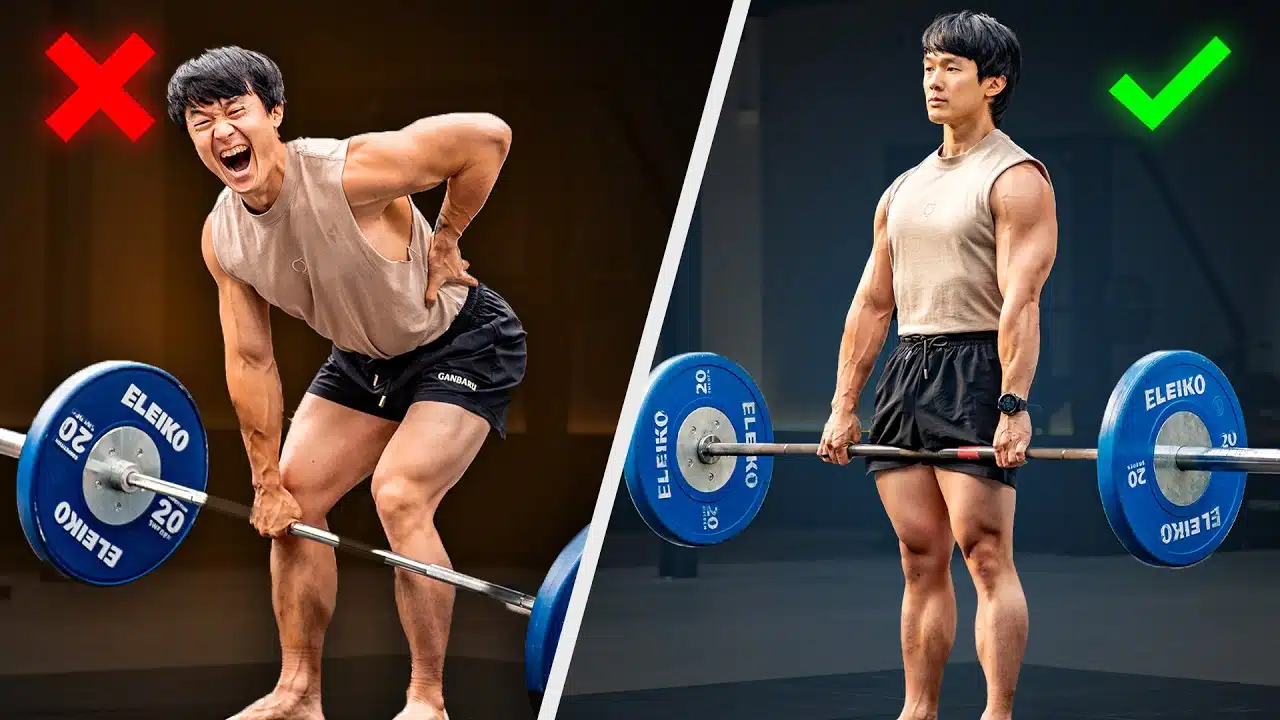
According to technique experts, this single shift in mindset can mean the difference between building bulletproof strength and chronic lower back pain.
Here’s everything you need to know about proper deadlift form—and the simple adjustments that unlock serious strength gains.
Jump to:
Deadlifts Are a Push, Not a Pull
If deadlifts consistently hurt your lower back, you’re likely pulling too much and pushing too little.
The problem stems from trying to pick weight up with arms and back instead of leveraging leg power. Think of deadlifts more like a leg press than an upper body pull.
Don’t pick the weight up with your arms and back. Lock yourself in and push the world away from you.
Your arms should function as hooks attaching weight to your body—nothing more. Once you’re braced and locked in, all that’s left is standing up.
No need to pinch shoulder blades back, exaggerate chest position, or yank weight off the ground.
The Pull-Back Problem
Another common error is pulling the bar up and back to squeeze back muscles.
This dramatically increases range of motion and places you in a weaker, more vulnerable position. Your lower back takes unnecessary stress while your legs—your strongest muscle group—sit underutilized.
Fix Your Form With Strategic Exercise Selection
Rather than drowning in cues, smart programming can force better positions naturally.
If you struggle with excessive pulling, try these variations:
- Deficit deadlifts: Increase range of motion and force more ground push
- Trap bar deadlifts: With or without deficit, immediately shift emphasis to legs
- Snatch grip deadlifts: Wider grip creates flared upper body position that prevents arm pulling
I personally like the idea of coaching without coaching. So, instead of giving you a thousand cues to remember, I’d rather you picked an exercise that forced you into better positions.
These variations retrain your brain and body mechanics without conscious thought.
Bar Placement Changes Everything
Even perfect execution means nothing if your setup is wrong.
Three factors determine whether deadlifts hurt your back: bar placement, body position, and the pull-versus-push ratio.
Bar placement is critical. For every inch the bar moves forward away from you, lower back stress increases by approximately 10 to 20%.
When the bar sits too far forward, your hips rise early, legs contribute less, and load dumps into your lower back. Even thinking “push” won’t save you from a flawed setup.
Finding Your Ideal Bar Position
Body proportions vary, so here’s how to find your perfect placement:
- Lift the bar and hold at midshin height
- Find your balance point where you feel stable
- Weight should distribute through midfoot
- Practice pause reps: hold at midshin, set down, then complete full rep
This quarter-rep-then-full-rep method ingrains proper positioning. Three to five sets of three to five reps nail this position permanently.
If timed correctly, the bar shouldn’t smash knees or shins on the way up.
Body Position Over the Bar
Perfect bar placement over feet doesn’t guarantee proper body positioning over the bar.
If hips sit too low with the bar directly under or slightly in front of shoulders, knees obstruct the bar path. You might feel balanced, but you’ll be weak.
The universal rule: barbell should sit directly under shoulder blades at the start.
This applies across all people and all deadlift variations. Whether it’s sumo, deficit, trap bar, snatch grip, long legs, or short legs. We are all at our strongest, most efficient start point when the shoulder blades are directly over the bar.
Two Approaches to Find This Position
Bottoms up: View yourself from the side and raise hips until shoulder blades align over the bar.
Top down: Push hips back with straight legs from standing. You’ll feel hamstrings tension like a drawn bow. Once you hit hamstring limit, bend knees until you can grab the bar.
Romanian deadlifts and touch-and-go deadlifts reinforce this positioning beautifully. Use them as accessories for two to four sets of 6 to 12 reps to build core strength and endurance while training automatic positioning.
Master the Wedge Technique
This brings everything together into one seamless motion.
Just like a bar jack uses leverage against the floor to lift weight easily, you need to wedge yourself into position. Your body becomes a lever to break the bar off the ground with maximum efficiency.
With light weight, the bar literally floats off the ground. With heavy weight, the bar might not move during the wedge, but you’ll feel total body tension required to generate maximum force.
The Bracing Protocol
Proper bracing makes or breaks the wedge. Here’s the exact sequence:
- Exhale completely through pursed lips—abs will tense naturally
- Maintain ab tension while taking a slow, deep breath through nose only
- Lock down midsection as if bracing for a punch
- Engage lats by reaching arms down, then pulling slightly behind you
Now approach the bar, positioned over midfoot. With body in ideal position over the bar, wedge yourself in and push the world away.
Putting It All Together
Deadlift mastery isn’t about complexity—it’s about precision.
Focus on these fundamentals: push instead of pull, find proper bar and body positioning, and create maximum tension through the wedge technique. These adjustments transform deadlifts from a back-breaking grind into a full-body strength builder.
The difference between dangerous deadlifting and resilient strength comes down to these technical details. Master them, and you’ll build not just bigger numbers, but a bulletproof lower back and total body power that lasts.