Lower leg pain doesn’t always need a shotgun approach with foam rollers and lacrosse balls.
A physical therapist recently shared a precise method for releasing specific points in the shin, foot, and ankle that could transform how people address movement restrictions and discomfort.
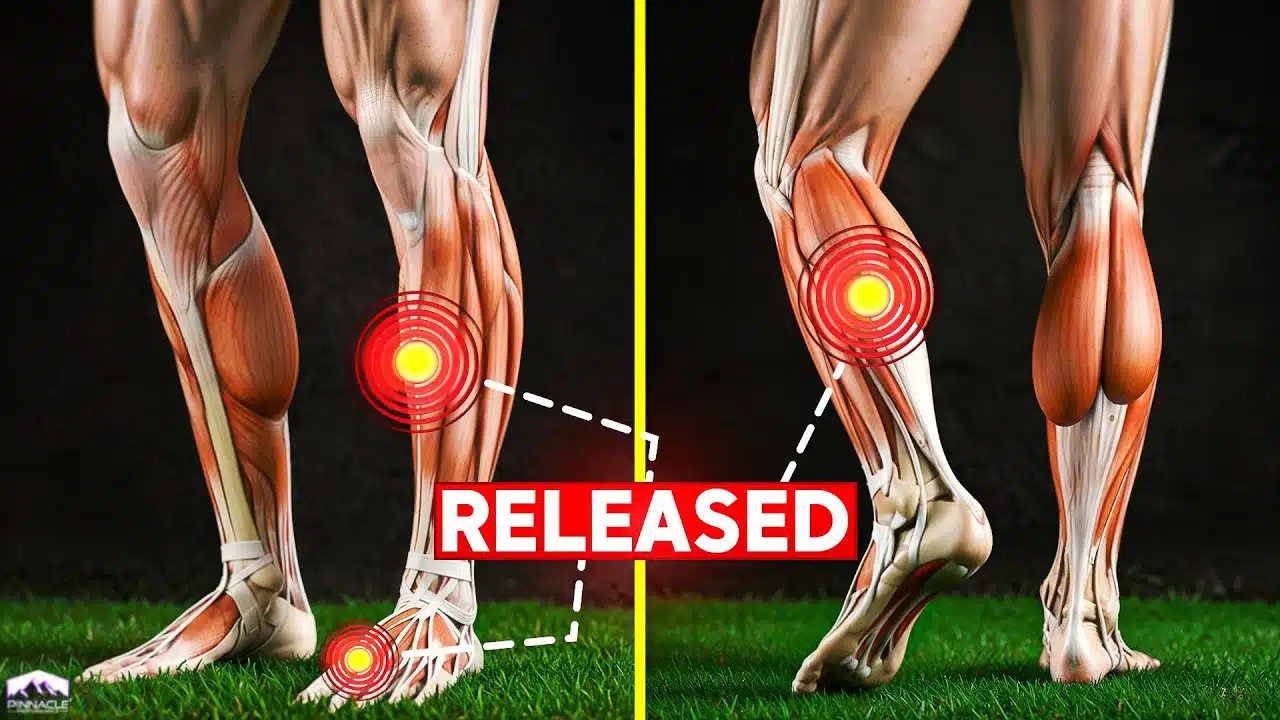
Instead of randomly searching for muscle knots, this approach targets what Italian researcher Luigi Stecco called “centers of coordination” — highly specific points where multiple fascial vectors converge to coordinate movement.
The technique requires patience and precision, but the results speak for themselves.
Jump to:
Understanding Centers of Coordination
Most people understand trigger points as sensitive knots within muscles that respond to pressure from foam rollers or massage tools. But centers of coordination represent something fundamentally different.
Stecco proposed decades ago that fascia — the connective tissue wrapping muscles and organs — actively participates in movement rather than serving as passive packaging. Muscles don’t work in isolation; fascia helps transmit tension throughout the body, allowing different areas to work together coordinately.
Every movement in a given plane requires coordination between specific fascial planes. Raising an arm overhead, pulling a leg up, or flexing an ankle all depend on this coordinated system.
When fascial sliding becomes disrupted through injury, inflammation, or poor movement patterns, receptors embedded within fascia begin working less efficiently. Input and output signals can become hypersensitive or dull, resulting in pain or altered movement patterns over time.
Centers of coordination are points where multiple vectors converge, responsible for coordinating movement in specific planes. When these centers become tight or densified, they disrupt natural movement coordination in that plane.
The Self-Release Protocol
Traditional Stecco methodology involves practitioners manually releasing these points on patients. However, self-release of specific points — particularly in the lower leg — can produce remarkable results.
The technique requires using knuckles to apply sustained pressure to exact locations. It won’t feel comfortable initially, but somewhere between two to five minutes later, the same pressure feels significantly less sensitive.
That sensitivity decrease signals successful release of the center of coordination.
What to Expect During Release
During the first two minutes, sensitivity might actually increase. This is normal and expected.
The pressure should create discomfort and make you squirm slightly, but never push through actual pain. There’s a crucial distinction between productive discomfort and harmful pain.
After releasing these points, expect an interesting healing response. Between 24 to 48 hours later, inflammation will increase as the body initiates repair. The treated area may feel tighter and worse the next day or two.
This represents a normal healing process, not a setback. Around 72 hours post-treatment, genuine release should become apparent. Wait three to five days before working the same area again, allowing complete tissue healing.
Three Critical Points for Lower Leg Relief
Outside Calf: The Plantar Flexion Point
The first center of coordination sits on the bottom outside portion of the calf, responsible for backward ankle motion (plantar flexion).
To locate it, flex the calf by pushing the ankle downward. Find where the calf muscle flexes off to the side — that’s the target area.
Position the foot and leg on a bench, or let the ankle hang off the edge for easier access. Take a knuckle and gently begin applying pressure.
Experiment with different directions:
- Up and down
- Side to side
- Diagonally
Most people find diagonal pressure most sensitive. Start with gentle pressure — around three out of ten — and gradually build intensity over time.
Keep the range of motion small. This is a highly specific point requiring concentrated attention, not broad sweeping movements across the entire calf.
Between the Toes: The Dorsiflexion Point
This center coordinates upward and forward toe movement (dorsiflexion), and many people find it surprisingly sensitive.
Locate the space between the first and second toes, slightly higher up on the foot. Pull toes upward to identify the tendons between these digits, then find the space between them.
Never press directly on tendons — work only in the space between them. Use a knuckle to apply pressure in an up-and-down motion.
The point between the first and second toes typically proves most sensitive. After addressing that area, move to the space between the second and third toes, working slightly higher up.
Staying off tendons becomes trickier between the second and third toes, but this location also harbors significant sensitivity for many people.
Under the Metatarsal Head: The Internal Rotation Point
The final center sits underneath the metatarsal heads on the inside portion of the foot, responsible for internal rotation and inward motions.
Use a finger to locate the bone of the metatarsal head on the inside foot. It feels like a ridge with soft tissue underneath.
Position a knuckle just below that bone at a 45-degree angle — not straight in, not straight down, not straight up. This angle is critical for accessing the correct tissue layers.
Explore anywhere in this region to find the most sensitive spot. Once located, maintain that 45-degree angle and apply sustained pressure for two to five minutes.
Key Technical Considerations
Success with this technique depends on precision and patience. Unlike broad foam rolling, these releases require pinpoint accuracy maintained over several minutes.
Small movements produce better results than large sweeping motions. The goal is sustained pressure on a specific point, not massage across a general area.
Timing matters significantly. Don’t expect immediate dramatic improvements. The real transformation occurs 72 hours post-treatment after the inflammatory healing response completes.
Frequency requires restraint. Wait three to five days between sessions on the same point. Overworking these centers before healing completes can create more problems than it solves.
Beyond the Lower Leg
While the shin, foot, and ankle contain centers of coordination particularly amenable to self-release, similar points exist throughout the body.
Many require a practitioner’s assistance due to location or the angles needed for effective release. But understanding these principles opens possibilities for addressing movement restrictions and pain patterns with unprecedented precision.
This approach represents a fundamental shift from symptom chasing to root cause resolution. Rather than randomly searching for tight spots, it targets the specific coordination centers controlling movement in affected planes.
The difference between traditional trigger point work and centers of coordination parallels the difference between treating individual trees and managing entire forest ecosystems. One addresses isolated problems; the other transforms underlying coordination systems.
For those struggling with chronic lower leg tightness, restricted ankle mobility, or foot discomfort that hasn’t responded to conventional stretching or foam rolling, these three points offer a scientifically-grounded alternative worth exploring.
Just remember: precision over intensity, patience over frequency, and healing time over immediate gratification.