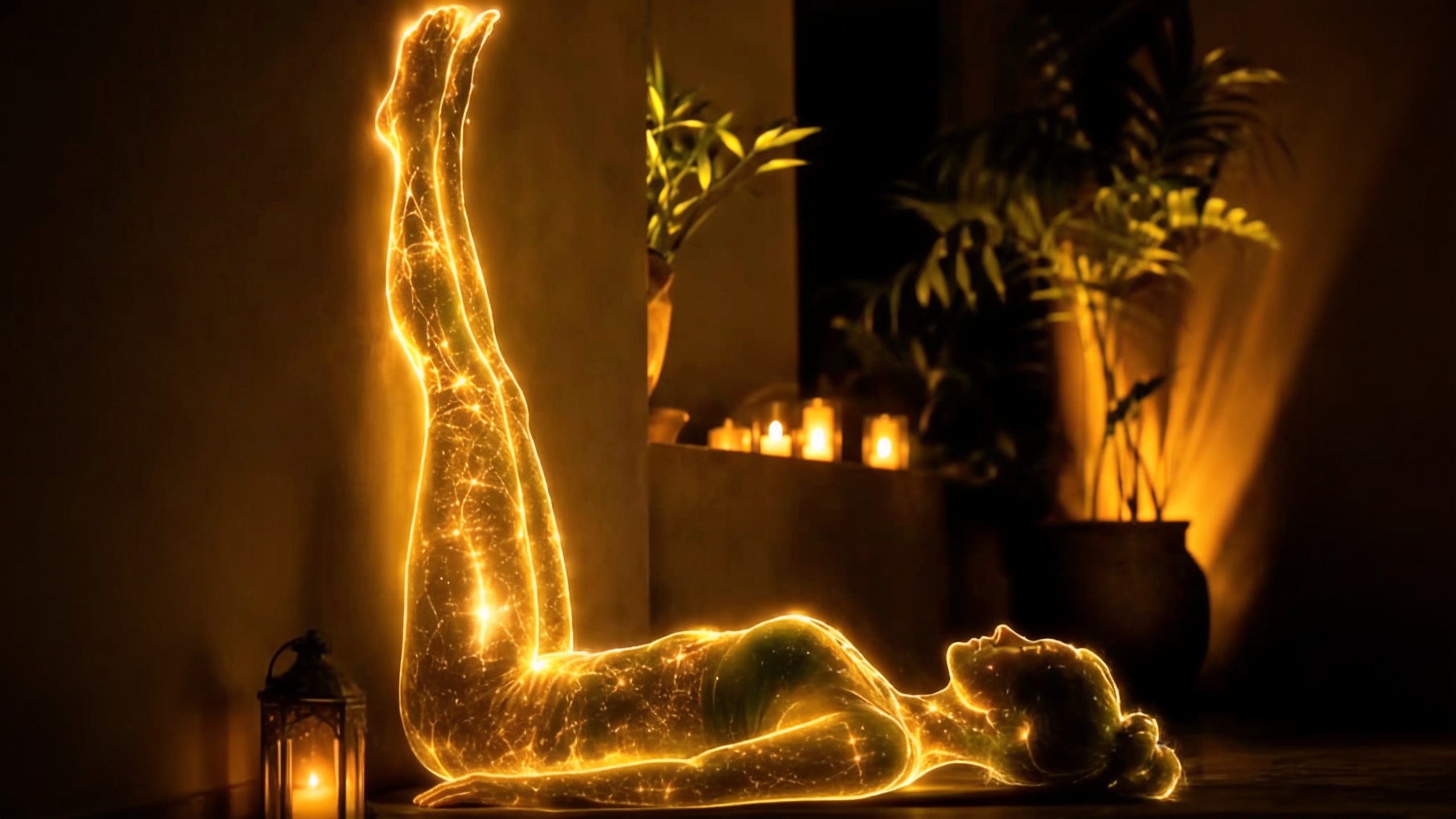
Scrolling through wellness content, you’ve probably seen it: legs propped against a wall, serene face, the promise of perfect sleep.
But does a single yoga pose really unlock longevity?
According to wellness account @stretch.strengthen and sleep optimization experts, the answer is more nuanced than you might think.
Legs-up-the-wall—known in Sanskrit as Viparita Karani—isn’t a magic bullet, but when woven into a broader system of sleep, stress management, movement, and metabolic health, it becomes a powerful tool in your longevity arsenal.
Jump to:
What Makes Legs-Up-the-Wall Different From Other Poses
This restorative yoga posture has roots stretching back centuries in traditional yogic practice. Unlike active stretches or strength-building poses, it requires zero muscular effort.
You simply lie on your back with legs extended vertically against a wall, creating a mild passive inversion. In yogic tradition, practitioners consider it both a mudra (energetic seal) and restorative posture.

If you want something simple that actually works, this is one of the most effective tools I’ve used to build strength, conditioning, and endurance without needing a full gym setup.
- Full-body training with one weight using swings, squats, and presses
- Solid cast iron build that feels stable and lasts for years
- Comfortable grip that makes high-rep workouts easier to handle
Modern wellness has embraced it as recovery gold: athletes use it post-run, desk workers combat lower-body swelling, and sleep-seekers incorporate it into their wind-down routine.
The Physiological Magic Behind the Position
What makes this pose particularly compelling is its triple-threat mechanism. First, it activates your parasympathetic nervous system—the “rest and digest” response that counteracts chronic stress.
Second, it improves venous blood return from lower extremities, essentially giving your circulatory system a passive assist. Third, it supports lymphatic drainage while reducing cortisol levels.
Adding slow diaphragmatic breathwork while holding the pose significantly deepens the relaxation effect compared to the pose alone.
Ana Marie Schick, writing for sleep optimization platform Chilipad, emphasizes that pairing proper breathing with position is what transforms a simple stretch into a nervous system reset.
How Long Should You Actually Hold It?
Here’s where many people get it wrong: rushing through or holding too briefly.
Experts recommend 5 to 20 minutes for meaningful sleep and relaxation benefits. Longer holds—particularly in that 10 to 20-minute range—produce deeper parasympathetic activation and more noticeable circulatory effects.
If you want something simple that actually works, this is one of the most effective tools I’ve used to build strength, conditioning, and endurance without needing a full gym setup.
- Full-body training with one weight using swings, squats, and presses
- Solid cast iron build that feels stable and lasts for years
- Comfortable grip that makes high-rep workouts easier to handle
Think of it like brewing tea: steeping for 30 seconds gives you colored water, but waiting the full time extracts actual flavor and benefit.
Why Daily Practice Works (And Is Safe)
Unlike intense workouts requiring recovery days, legs-up-the-wall can be practiced daily without concern. Because it’s entirely passive, muscles don’t need repair time.
Daily repetition actually conditions your nervous system to recognize this position as a pre-sleep cue, strengthening its effectiveness over time. Your body learns: “Legs up, time to wind down.”
The “Longevity as a System” Framework
This is where @stretch.strengthen’s messaging gets interesting—and where isolated health hacks start to crumble.
Wellness influencers increasingly echo what longevity researchers like Peter Attia and neuroscientist Andrew Huberman have been preaching: single habits don’t move the needle on healthspan.
Instead, interconnected lifestyle pillars must work together:
If you want something simple that actually works, this is one of the most effective tools I’ve used to build strength, conditioning, and endurance without needing a full gym setup.
- Full-body training with one weight using swings, squats, and presses
- Solid cast iron build that feels stable and lasts for years
- Comfortable grip that makes high-rep workouts easier to handle
- Sleep quality affects metabolic health and stress resilience
- Stress management influences inflammation and recovery capacity
- Movement patterns impact circulation and nervous system regulation
- Recovery practices determine how well you adapt to life’s demands
- Metabolic health underpins insulin sensitivity and cellular function
Legs-up-the-wall fits into this system as a recovery practice that bridges stress management and sleep optimization. It’s not standalone magic—it’s one thread in a tapestry.
Where Science Meets Persuasion
Here’s what sports medicine physicians and physical therapists caution: while mechanistic support for legs-up-the-wall is strong and anecdotal reports flood wellness communities, formal peer-reviewed clinical trials remain limited.
Skepticism about the pose’s claims appeared in yoga communities as early as 2016. The physiology makes sense—gravity assists venous return, inversion calms the nervous system—but robust randomized controlled trials? Sparse.
That doesn’t invalidate the practice. It simply means we’re working with mechanistic plausibility and centuries of traditional use rather than double-blind studies.
Practical Implementation: Beyond the Pose Itself
If you’re ready to try this, skip the Instagram-perfect setup. Focus on consistency and integration.
Setting Up for Success
- Position hips 3-6 inches from wall (closer creates more stretch, further back is gentler)
- Use a folded blanket under hips if you want slight elevation
- Keep arms relaxed at sides or resting on belly
- Set a timer for 10-15 minutes minimum
- Practice diaphragmatic breathing: inhale for 4 counts, exhale for 6-8 counts
Breathing Protocol That Amplifies Benefits
Breath transforms this from passive position to active nervous system intervention.
If you want something simple that actually works, this is one of the most effective tools I’ve used to build strength, conditioning, and endurance without needing a full gym setup.
- Full-body training with one weight using swings, squats, and presses
- Solid cast iron build that feels stable and lasts for years
- Comfortable grip that makes high-rep workouts easier to handle
Slow, deliberate diaphragmatic breathing—where your belly rises on inhale and falls on exhale—signals safety to your brain. Combined with the pose’s physical effects, you’re essentially hacking your way into parasympathetic dominance.
This matters because chronic sympathetic activation (fight-or-flight) is linked to poor sleep quality, elevated inflammation markers, and accelerated aging.
Who Should Proceed With Caution
While generally safe, certain populations need medical clearance first:
- Uncontrolled hypertension—inversion may temporarily elevate blood pressure
- Elevated intraocular pressure or glaucoma—inversions increase eye pressure
- Serious spinal conditions—though mild, position still alters spinal loading
- Late-stage pregnancy—circulation changes require physician guidance
If you experience dizziness, tingling, or discomfort, exit the pose immediately. Restorative doesn’t mean forcing through warning signals.
The Instagram Lead-Magnet Strategy Behind the Post
Let’s address what’s actually happening when @stretch.strengthen tells you to “Comment CODE.”
This is textbook social media lead-generation. Comments boost algorithmic reach, triggering Instagram to show content to more users. Automated bots then send direct messages to commenters, delivering a guide, course, or coaching offer.
If you want something simple that actually works, this is one of the most effective tools I’ve used to build strength, conditioning, and endurance without needing a full gym setup.
- Full-body training with one weight using swings, squats, and presses
- Solid cast iron build that feels stable and lasts for years
- Comfortable grip that makes high-rep workouts easier to handle
Wellness creators monetize audiences through digital products, and this tactic works exceptionally well. It’s not inherently problematic—many legitimate experts use it—but understanding the mechanism helps you evaluate whether what follows is evidence-based or sales-focused.
Integrating This Into Your Actual Life
The real question isn’t whether legs-up-the-wall “works.” It’s whether you’ll actually do it and whether it fits into a broader health system.
Start with three nights weekly, 10 minutes before bed. Pair it with reduced screen time in the final hour before sleep. Track how you feel after two weeks—not just sleep quality, but daytime stress resilience and physical recovery.
If you notice improvements, consider what else supports your sleep: consistent wake times, morning light exposure, afternoon movement, evening temperature regulation.
Legs-up-the-wall becomes powerful when it’s part of a system that addresses multiple longevity pillars simultaneously. Isolate it as a cure-all, and you’ll likely feel disappointed.
Embed it within intentional sleep hygiene, stress management, and metabolic health practices, and you might find it’s exactly the missing piece your evening routine needed.
If you want something simple that actually works, this is one of the most effective tools I’ve used to build strength, conditioning, and endurance without needing a full gym setup.
- Full-body training with one weight using swings, squats, and presses
- Solid cast iron build that feels stable and lasts for years
- Comfortable grip that makes high-rep workouts easier to handle