Running 400 meters straight up a ski jump might sound like a fever dream dreamed up by someone who hates their legs.
But it’s real.
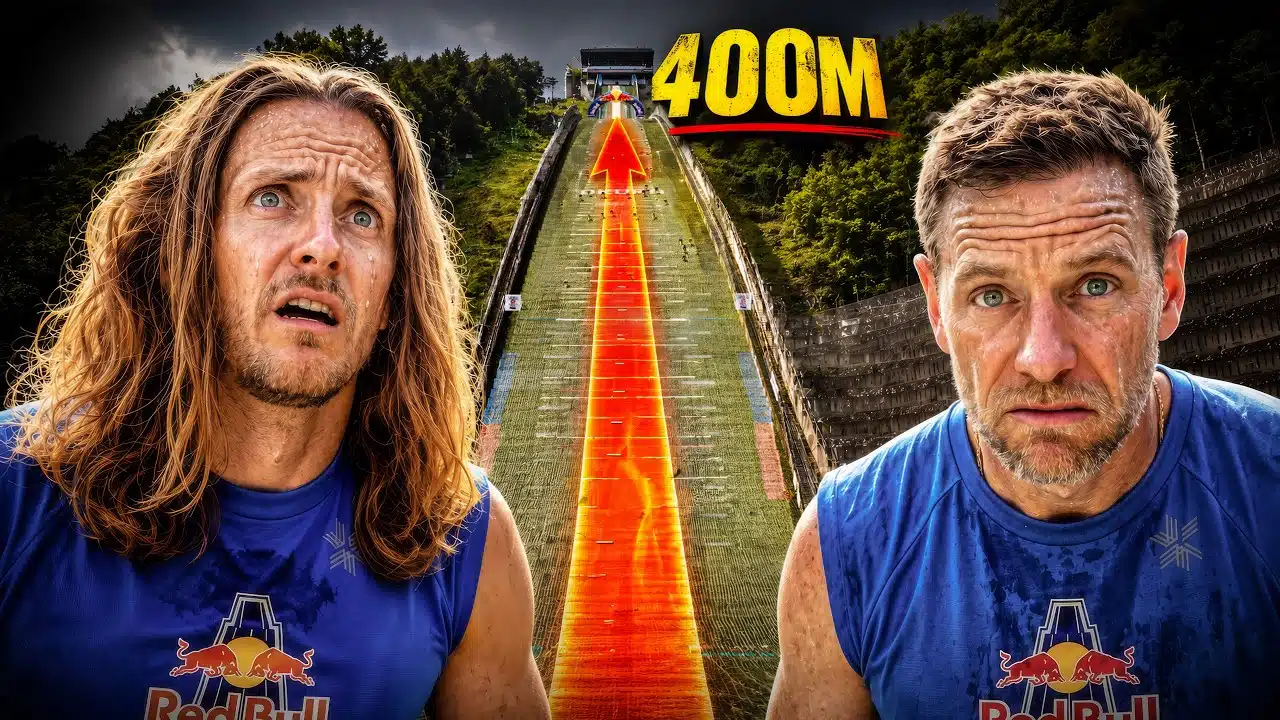
It’s called the Red Bull 400, and it’s exactly as brutal as it sounds—a savage sprint up a slope that hits 37 degrees, climbing 130 vertical meters that leaves even elite athletes gasping for air at the finish line.
In a recent video documenting the first-ever Red Bull 400 Creator Challenge in Sapporo, Japan, fitness content creators from around the globe faced this monstrous ascent not once, but three times in a single day.
Jump to:
- What Makes the Red Bull 400 So Impossibly Hard?
- 28 Creators, Seven Teams, One Insane Competition
- Team Building Through Parkour and Japanese Culture
- Challenge One: When Reality Hits Harder Than Expected
- Challenge Two: Adding Insult to Injury
- The Final Showdown: Winner Takes All
- What Makes This Challenge Different
- Team Yellow’s Three-Challenge Sweep
- Key Takeaways for Aspiring Competitors
- The Physical and Mental Toll
- Why Athletes Keep Coming Back
What Makes the Red Bull 400 So Impossibly Hard?
The Red Bull 400 isn’t your typical uphill run.
Picture a ski jump—the kind Olympic athletes launch themselves off at terrifying speeds. Now imagine running up it instead of flying down it.
The course gains 130 vertical meters over 400 meters of distance, with sections hitting gradients up to 37 degrees. For context, that’s steep enough that looking up feels discouraging, and many competitors resort to crawling on all fours just to keep moving forward.
I’ve never felt so out of shape in my life.
That sentiment echoed among participants who regularly crush brutal workouts but found themselves humbled by this unique challenge.
28 Creators, Seven Teams, One Insane Competition
Red Bull flew in 28 content creators from around the world and randomly divided them into seven teams of four.
The competition featured three progressive challenges, each more difficult than the last.
Challenge One: The Speed Test
Every competitor ran individually to the top. Each team’s combined time determined the rankings. Simple in concept, absolutely devastating in execution.
Challenge Two: The Strength Challenge
Teams divided 40 kilograms of weight among members and climbed together. Strategy became crucial—the team’s time was only as good as their slowest member.
Challenge Three: The Team Relay
Only the top three teams advanced to this final showdown featuring a three-legged race, a weighted carry, and an all-out sprint to the finish.
Team Building Through Parkour and Japanese Culture
Before the suffering began, Red Bull dedicated an entire day to team building.
Competitors trained with legendary parkour athlete Jason Paul, learning trust exercises that would prove essential for the team challenges ahead.
The stuff you did today took me probably two, three years to learn. So you guys are really fit or I’m an amazing coach, but probably you’re really fit.
The day included a 5K shakeout run through Sapporo, ending at a beautiful traditional Japanese garden where reverence replaced the usual competitive banter.
That evening brought Japanese delicacies and team bonding—though some culinary adventures proved nearly as challenging as the hill itself.
Challenge One: When Reality Hits Harder Than Expected
The first 100 meters descends slightly—a deceptive warm-up before the real punishment begins.
Competitors quickly discovered that traditional running form becomes impossible on such steep terrain.
I decided to go on all fours. So I was like, I’m going to use my hands.
The netting covering the slope created additional challenges. Foot placement became critical—midfoot strikes on the rope prevented catching toes in the gaps.
Looking up proved psychologically devastating. Most competitors kept their eyes down, focusing on one step at a time.
Just when legs began screaming for mercy, a wooden ladder appeared, requiring competitors to haul themselves up near-vertical rungs.
The Pain Doesn’t Stop at the Finish
Crossing the finish line brought no immediate relief.
Competitors experienced intense “Fran lung”—that desperate, burning sensation familiar to CrossFit athletes after maximum-effort workouts. Coughing fits persisted for hours.
One competitor finished third overall out of over 350,000 participants in the Wings for Life run just days earlier, yet still found the Red Bull 400 uniquely brutal.
Challenge Two: Adding Insult to Injury
Hours after finishing the first ascent—same afternoon, no recovery time—teams faced the strength challenge.
The 40-kilogram weight distribution became a critical strategic decision. Strong teams with capable female athletes could spread the load more evenly. Others concentrated weight on their strongest members.
Weight distribution examples varied dramatically:
- Balanced approach: 12kg, 12kg, 8kg, 8kg
- Heavy concentration: 15kg+, 15kg+, 5kg, 5kg
Strategy extended beyond weight distribution. Teams could swap loads at the 300-meter mark—a gamble that cost time but potentially saved energy for the final push.
We’re going to swap weights.
That bold move by the red team created drama, but ultimately couldn’t overcome the yellow team’s consistent pace.
Yellow Team’s Dominant Performance
Team Yellow’s captain MK set an aggressive pace from the start.
Her teammate Riyota crushed the heavyweight carry, maintaining position against larger competitors. Their coordination and pacing proved superior, securing another first-place finish.
Meanwhile, some teams struggled with pacing. One teammate admitted taking off “like a bat out of hell” despite carrying the lightest load—a tactical error that nearly cost her team.
The Final Showdown: Winner Takes All
Only the top three teams advanced to the relay finale.
The leaderboard reset completely—previous performance meant nothing. Victory hinged entirely on this final challenge combining three distinct elements.
The Three-Legged Race (First 200 meters)
Teams paired their most coordinated members, calling out cadence to maintain rhythm on the steep, uneven terrain.
We were saying one, two, one, two, all the way to the car. I ran out of breath, so we just felt it. We went off vibes and energy.
The Weighted Carry (Next 100 meters)
Teams handed off to their strongest member who tackled the weight solo through the steepest section.
The All-Out Sprint (Final 100 meters)
Anchor runners received the baton and sprinted to glory—or defeat.
Drama at the Handoff
Team Orange’s last-minute strategy change put their fastest runners on the three-legged race, building an early lead of several meters.
The slope’s severity meant teams at the top couldn’t see their teammates below. Uncertainty reigned.
When runners finally emerged into view, Orange maintained their lead through the weighted section. Their anchor, KKC, received the baton ahead of Yellow’s MK.
A Disney moment seemed possible—the underdog holding off the favorites.
But MK turned on the afterburners.
She’s a lioness.
The athlete who placed third among 350,000 runners days earlier unleashed her speed, closing the gap and surging past Orange for the victory.
What Makes This Challenge Different
Veteran fitness content creators compared the Red Bull 400 to other notoriously difficult challenges.
One competitor referenced the infamous sandbag carry workout—beloved and feared in equal measure—but concluded the ski jump ascent made it look easy by comparison.
- Gradient intensity: 37-degree slopes eliminate normal running mechanics
- Sustained vertical gain: 130 meters with no reprieve
- Technical obstacles: Netting, wooden ladders, uneven surfaces
- Psychological warfare: The finish remains invisible for most of the climb
- Respiratory assault: Thin air at elevation plus maximum exertion
The unique combination creates suffering that even elite athletes find humbling.
Team Yellow’s Three-Challenge Sweep
Team Yellow’s victory didn’t come from individual dominance alone.
Their success stemmed from balanced strength across all members, smart weight distribution, and MK’s closing speed when it mattered most.
The team maintained composure through three progressively difficult challenges, never letting early success create complacency.
We’re feeling good. We’re feeling fresh.
That confidence—backed by genuine fitness and tactical intelligence—carried them through to a clean sweep of all three events.
Key Takeaways for Aspiring Competitors
Several strategic lessons emerged from watching elite athletes tackle this unique challenge:
- Pacing matters more than raw speed: Going all-out early led to spectacular crashes
- Technique adaptation is essential: Successful competitors quickly abandoned traditional running form
- Mental focus prevents burnout: Looking down rather than up preserved psychological energy
- Team composition requires balance: One weak link determines overall performance in team events
- Recovery nutrition counts: Smart athletes fueled with carb gels, electrolytes, and quick-digesting foods between rounds
Perhaps most importantly, competitors needed mental toughness to return to the hill hours after experiencing unprecedented suffering.
The Physical and Mental Toll
Post-race symptoms included:
- Persistent coughing lasting hours
- Severe quadricep and calf burning
- Abdominal cramping from respiratory stress
- Cardiovascular system maxed beyond typical thresholds
One competitor coughed so violently at the finish that he developed ab cramps—a testament to the respiratory demands.
The psychological challenge matched the physical one. Knowing another ascent waited just hours away created anticipatory dread that tested mental resilience as much as leg strength.
Why Athletes Keep Coming Back
Despite the suffering—or perhaps because of it—the Red Bull 400 creates memorable experiences that transcend typical competitions.
The combination of stunning location, unique challenge design, and team dynamics creates bonds and stories that outlast the pain.
We do this stuff because we love it. We love to suffer.
That statement captures the essence of extreme fitness challenges—the voluntary pursuit of discomfort that reveals character and builds resilience applicable far beyond athletic competition.
The Red Bull 400 Creator Challenge in Sapporo proved that even fitness professionals accustomed to brutal workouts can find their limits tested by creative course design and relentless elevation gain.
Team Yellow’s sweep demonstrated that balanced team composition, intelligent strategy, and clutch performance under pressure trump individual heroics in team-based suffering.