Modern fitness treats bodies like machines: up, down, push, pull.
Humans, though, evolved to throw spears and swing clubs.
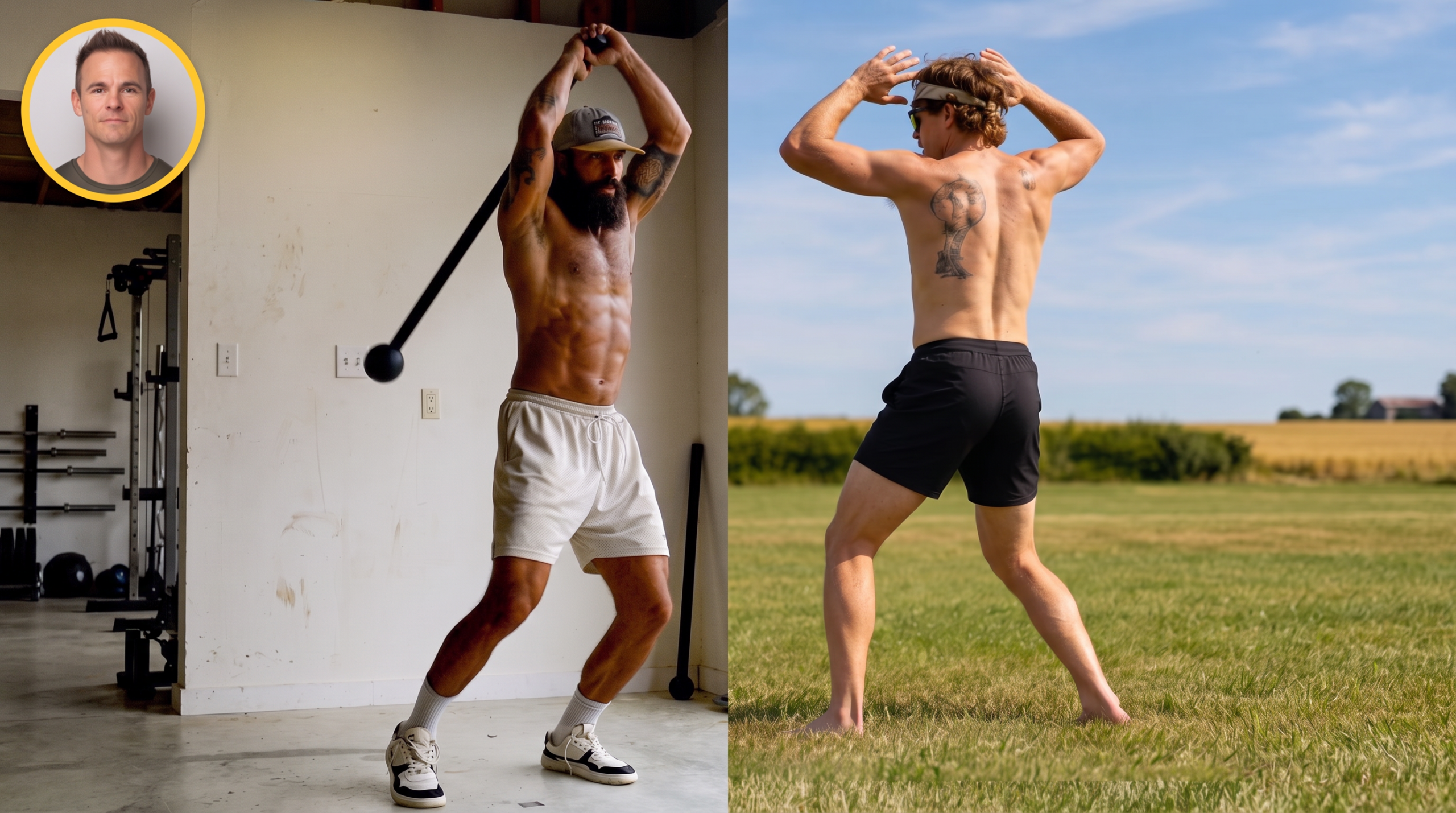
In a recent YouTube video, host Josh teamed up with parkour world champion Tim Shieff to make a case for bringing rotation back.
Their toolkit spans ropes, clubs, kettlebells, and a mace bell.
One option requires nothing fancier than a household hammer.
Which swing fits your body best?

If you want something simple that actually works, this is one of the most effective tools I’ve used to build strength, conditioning, and endurance without needing a full gym setup.
- Full-body training with one weight using swings, squats, and presses
- Solid cast iron build that feels stable and lasts for years
- Comfortable grip that makes high-rep workouts easier to handle
Jump to:
Why Swinging Feels So Natural
There’s an art to swinging objects. It’s extremely natural for human beings.
Kids swing things for fun. Adults often master a racket or bat, then quietly stop.
Shieff knows the cost of stopping. Once a parkour champion, ninja warrior competitor, and ultra-distance runner, he piled up injuries like any elite athlete.
His healing journey led somewhere surprising: swinging objects helped him most.
Tool One: Rope Flow
Weighted rope is the lightest tool here, yet Shieff insists it hits hard. Each swing cycles through repeating patterns, some overhand like throwing, others underhand like batting.
Every pattern drives the spine through a figure-eight path, blending side bends, rotation, flexion, and extension. In Shieff’s view, this reaches end ranges that lifting and calisthenics often miss.
Each new pattern you learn is a problem you solve with the whole body, including the brain.
Momentum flows from one pattern into the next, hence the name. That flow packs hundreds of repetitions into minutes.
If you want something simple that actually works, this is one of the most effective tools I’ve used to build strength, conditioning, and endurance without needing a full gym setup.
- Full-body training with one weight using swings, squats, and presses
- Solid cast iron build that feels stable and lasts for years
- Comfortable grip that makes high-rep workouts easier to handle
Shieff also describes success stories among people with back and shoulder injuries, stroke survivors, and those living with Parkinson’s. Those are firsthand observations, not controlled trials, so treat them as encouraging rather than proven.
Beginner Drill: No Rope Required
- Grab a resistance band, the heavier the better.
- Swing it underhand in one hand.
- As it rises, pass it to the other hand and swing on that side.
- Add a step, syncing the figure eight with a single-leg step-up.
- Complete 15 reps per leg for three rounds.
Shieff promises you will feel something unique the next day. He calls this single underhand pattern paired with a step-up the way to get the most from the least.
Tool Two: Indian Clubs
Club swinging has deep roots in India and Persia, where wrestlers and warriors trained for battle. British soldiers spotted those jacked men, then carried the practice home, and it spread through schools, gyms, and military training across Europe and America.
As the weight swings away, it creates leverage, putting a powerful pull on your body.
Shoulders redirect that momentum, strengthening at angles rarely trained in gyms. Grip, spine, and core join in, with obliques, abs, lats, and delts all working.
Josh says viewers of his last club video flooded comments with stories of healed shoulders. A shoulder surgeon even emailed him, reporting that swinging clubs eased his own shoulder pain.
Compelling, yes. Still anecdotal, so anyone with a shoulder injury should check with a professional first.
If you want something simple that actually works, this is one of the most effective tools I’ve used to build strength, conditioning, and endurance without needing a full gym setup.
- Full-body training with one weight using swings, squats, and presses
- Solid cast iron build that feels stable and lasts for years
- Comfortable grip that makes high-rep workouts easier to handle
The clubs deserve a comeback.
Try the Reverse Throw With a Hammer
- Hold the hammer in front of you.
- Reach it behind your back.
- Throw it out to the side.
- Ride momentum back to your chest.
Josh says this move strengthens areas humans tend to get weak.
Tool Three: Kettlebell
Just the basic two-legged kettlebell swing on its own is one of the most bang for your book exercises in the gym that you could do.
Why? Shieff points to posterior chain dominance, something like a squat-deadlift hybrid, with force driving forward rather than up. That forward drive, he says, relates to acceleration and athleticism.
Explosive power recruits fast-twitch fibers, while controlled landings add rhythm. Forearms and grip get a workout too.
The Beginner Mistake to Dodge
Biggest mistake I see beginners make is they fold their body too early and they put loads of pressure in the back when they do this.
Fix: wait until the last second to fold, then explode back out.
Three Levels of Progression
- Two-handed swing: the foundation.
- One-handed swing: more core rotation and deeper hip and glute work, usually with lighter weight.
- Outside-the-knee swing: a woodchopper-style path that loads one leg fully, setting a coil to spring from.
Shieff considers that last variation his biggest carryover to athleticism. His warning: master basics first, then start light.
Tool Four: Mace Bell
Related to clubs, the mace bell has won fans for simplicity. Drop it behind one shoulder, let momentum carry it back, then pull it up the other side.
If you want something simple that actually works, this is one of the most effective tools I’ve used to build strength, conditioning, and endurance without needing a full gym setup.
- Full-body training with one weight using swings, squats, and presses
- Solid cast iron build that feels stable and lasts for years
- Comfortable grip that makes high-rep workouts easier to handle
Since the mace tries to pull you backward, your front core must resist. Shoulder and opposite hip work together, training contralateral movement while adding shoulder mobility.
If any of the other tools intimidated you, this is maybe one of the easiest ways to start feeling some swing in your body.
The Real Takeaway: Play
No single tool wins here. Shieff’s closing advice is wonderfully simple.
There’s a certain freedom of motion that comes when it comes to using any swinging tool that allows us to unlock a bit of creativity and playfulness with them.
Just to swing something and let yourself have fun with it.
Start with a band, a hammer, or a light bell. Keep it playful, keep it light, and let rotation back into your routine.