Eric Janicki might weigh 285 pounds and be built like a mountain, but his real strength lies in how he thinks. This isn’t just another gym bro tossing weights around. Janicki, a longtime student of biomechanics, has taken classic chest training and evolved it—creating fly variations that deliver more hypertrophy, less joint stress, and better long-term results.
“People say, ‘You’re gonna mess your shoulders up!’” laughs Mike Israetel, sport scientist and co-founder of Renaissance Periodization. “No, you’re already messing your body up by doing sloppy pressing with too much weight and zero control. What Eric does is smarter—and much more effective.”
From cable station tweaks to bodyweight hacks, Janicki’s methods are built on one idea: maximize stretch, minimize risk, and stimulate growth with surgical precision.
Jump to:
1. The Decline Dumbbell Fly (with an Arch)
Most lifters are familiar with the dumbbell fly. What they haven’t seen is the version Eric Janicki performs—a highly exaggerated stretch on a slight decline bench, with scapular retraction and a full chest expansion that borders on shocking.
Janicki recommends setting the decline at around 20 to 30 degrees—just enough to allow the chest to open, but not so steep that it shifts emphasis away from the pectorals.
“What this angle gives you is space,” explains Janicki. “It lets your scapula pull back, gives your chest room to stretch, and lets you train the muscle at a long length—which is where real hypertrophy lives.”
Once in position, Janicki drops into a controlled fly, reaching far behind the body and arch-driving the stretch deep into his chest. The trick is to avoid turning the movement into a press. Instead, he keeps tension in the pecs throughout by pushing forward and up, rather than straight out.
Israetel reinforces the point: “This isn’t about lifting heavy. Go lighter, pause at the bottom, and load the stretch. That’s where the magic is.”
Pro tip: Start with 1–2 sets using a much lighter weight than you’d typically fly with. The intense range of motion will leave you sore—toothbrush-struggling sore.
2. The Low Cable Fly With Bench Support
Cable flies are nothing new, but Janicki takes a rarely seen angle to target the mid-to-upper chest with incredible efficiency. He positions the cables just below shoulder height, sits on a flat bench, and creates a stable base that focuses all tension into the pecs.
Key technique cues:
- Slight bend in the elbows throughout.
- Scapula pulled down and back.
- Hands rotated slightly up at the bottom of the rep to increase stretch.
- Finish the rep just short of lockout to keep tension on the chest, not the shoulders.
“When I get to that deep stretch, I don’t just hold the weight,” says Janicki. “I milk the stretch. That’s where I live.”
He also cautions against letting the weight snap back: “Control the eccentric—from the very top to the very bottom.” The goal is not only to build tissue but to build resilient tissue that holds up over time.
At the end of a working set, Janicki sometimes adds Bailey reps—short partials in the most stretched position—to squeeze out even more tension before failure.
Israetel adds, “This kind of fly is biomechanics 101, but executed at a PhD level. Most people skip the stretch. Eric lives in it.”
3. Elevated Deficit Push-Ups for Upper Chest Activation
What if you don’t have access to machines, benches, or even an incline station?
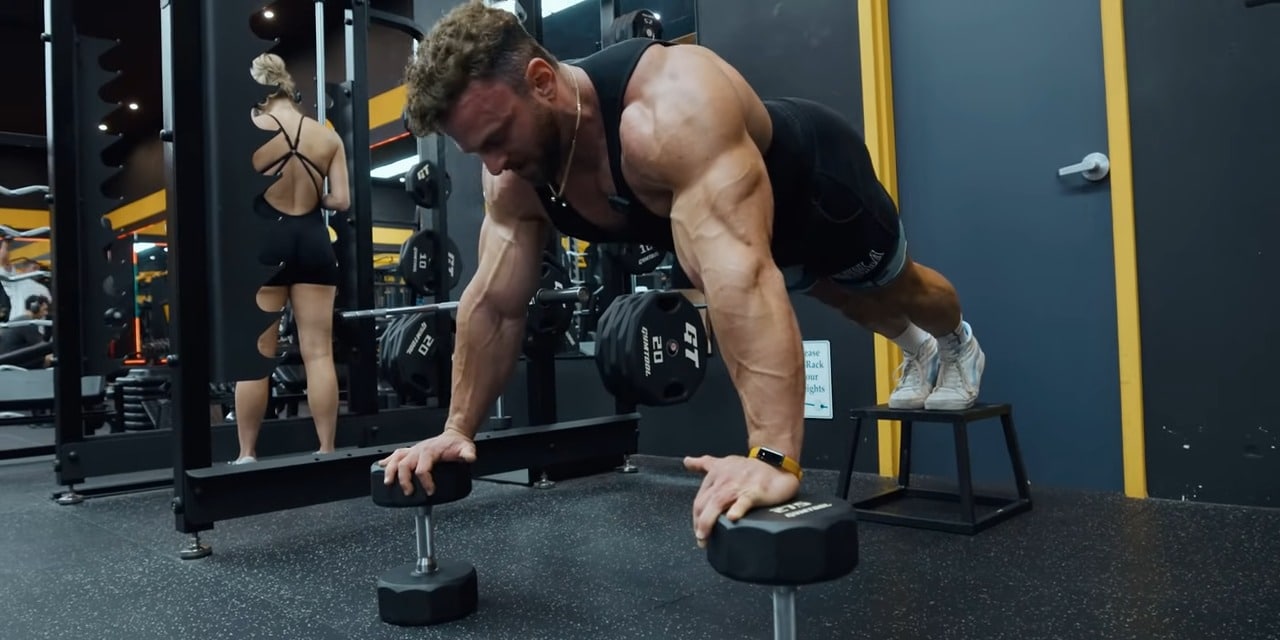
Janicki’s answer is simple: elevated deficit push-ups, a bodyweight move that requires only dumbbells and something to prop up your feet. The beauty of this variation lies in its angle and accessibility—you can do it anywhere, but the stimulus is far from basic.
To target the upper chest, Janicki emphasizes two things:
- Tuck the pelvis under to avoid turning it into a decline press.
- Keep elbows at a 45° angle, pushing up and back rather than just straight up.
The key cue here is stretch, pause, push forward, then rise. That subtle forward press before moving upward dramatically intensifies the stretch in the pecs.
“I want to wrap my hands slightly inside the dumbbells so my elbows naturally fall into the right angle,” Janicki explains. “Then I crunch my core, reach the stretch, and move with control.”
No equipment? No excuse. This variation hits the same hypertrophic triggers as a machine press, minus the wait in a crowded gym.
4. The Yoga Block Hack for More Range of Motion
In many of Janicki’s bench-based movements, there’s one consistent prop you might not expect: a simple yoga block.
Placed between the shoulder blades on the bench, the block pushes the chest even higher and forces the scapula into a deeply retracted position. This adds an extra 2–3 inches of range at the bottom of every rep—without increasing load or risking joint strain.
“I don’t stretch. I just train like this,” Janicki jokes. “Seriously, this is loaded stretching. My mobility is great because I’ve trained in these extreme positions for years.”
Israetel agrees: “Guys always complain they can’t pose or open up during back doubles. Well, this kind of loaded stretching builds that mobility—and that show-quality shape—over time.”
It’s Not About Fancy vs. Basic—It’s About Effective
One of the most important points Janicki and Israetel hammer home is this: there are no magical movements—only effective ones. Whether it’s a classic decline fly or a modern cable tweak, the success of an exercise comes down to stimulus, intent, and execution.
“You write ‘decline fly’ in a program and think, ‘basic move.’ But you see Janicki do it? That’s next level,” says Israetel. “He’s not just lifting. He’s sculpting muscle with precision.”
That’s the power of smart variation. You don’t need to abandon the fundamentals—you just need to execute them smarter. Janicki’s methods give lifters options—fresh angles to hit stubborn muscle groups and avoid stagnation.
More importantly, they offer something essential: ways to grow without breaking down.
Final Thoughts: Build Bigger, Train Smarter
Eric Janicki is a lifter who talks the talk, walks the walk, and flies the fly—literally and biomechanically. His chest is massive, but it didn’t come from piling on plates and hammering bench presses. It came from understanding his anatomy, loading the muscle properly, and mastering stretch-based stimulus.
Even elite lifters like Mike Israetel and Jared Feather say they’ve borrowed techniques from Janicki and added them to their routines. Because it works.
“If we end up a third as jacked as Eric,” Israetel laughs, “we’ve done pretty damn well.”
Try these exercises. Keep what fits. Rotate what works. Throw out what doesn’t.
But most importantly—train with intent.
Your pecs will thank you.