Immunologist and aging researcher Dr. Derya Unutmaz recently sat down for a podcast interview and dropped a jaw-dropping prediction.
His survival advice for the coming decade is disarmingly simple: try not to die.
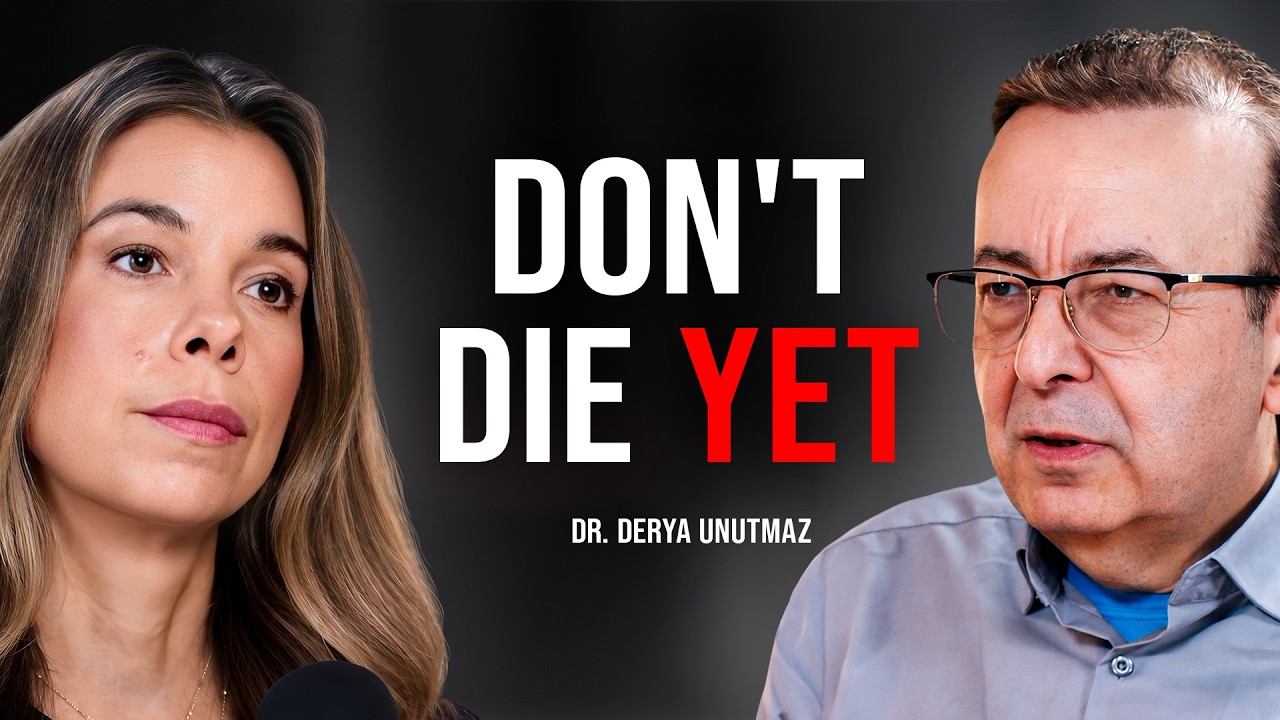
Unutmaz, one of a handful of scientists who has collaborated with OpenAI, believes artificial intelligence will cure cancer, reshape medicine, and eventually reverse aging.
Why does he sound so certain?
Keep reading for his reasoning, his boldest timelines, and the places where his optimism runs ahead of the evidence.
Jump to:
- The “Try Not to Die” Prediction
- How AI Is Already Compressing Years of Lab Work
- Digital Twins: Clinical Trials in Weeks?
- Cancer: “100% Curable” in Under a Decade?
- Predicting Disease Before It Strikes
- Should Doctors Be Using AI?
- Reversing Aging: Prevention First, Repair Second
- The Real Danger: Humans, Not Machines
- What You Can Do Today
The “Try Not to Die” Prediction
This is probably the most critical time in human history. So try not to die for the next 10 years.
His logic hinges on one idea: technology is advancing exponentially, while human intuition is stuck in a straight line.

If you want something simple that actually works, this is one of the most effective tools I’ve used to build strength, conditioning, and endurance without needing a full gym setup.
- Full-body training with one weight using swings, squats, and presses
- Solid cast iron build that feels stable and lasts for years
- Comfortable grip that makes high-rep workouts easier to handle
We think that the next 10 years is going to be as much advanced as the last 10 years or the last 15 years. But that’s not what’s going to happen.
Unutmaz invokes “longevity escape velocity,” a term coined by researcher Aubrey de Grey. That is the point where each year lived adds more than a year to remaining life expectancy.
His timeline? Roughly eight to ten years to reach that tipping point, then 15 to 20 years at most before aging itself can be reversed.
A Reality Check on the Timeline
These are forecasts, not findings. No therapy has yet been shown to rewind aging in people, and his claim that GLP-1 drugs add 5 to 10 years of life for people with obesity is his own estimate rather than a settled result.
Unutmaz himself leaves room for error.
Of course I might be wrong, but I’m pretty sure I’m going to be right.
How AI Is Already Compressing Years of Lab Work
Unutmaz describes tests with OpenAI’s reasoning models that already feel startling to him.
- Data analysis: He uploaded millions of RNA sequencing data points and received a 40-page report after roughly 112 minutes of model “thinking.”
- Experiment design: AI can sift 100 possible experiments and flag the two best, shrinking a year of trial and error into a few weeks.
- Outcome prediction: Given a two-week experiment he had already completed, the top model matched his results almost perfectly.
So that automatically contracts months sometimes years of analytic work into matter of minutes or hours.
His “98% correct” figure comes from a single example he tested personally. Treat it as an intriguing anecdote, not a benchmark.
If you want something simple that actually works, this is one of the most effective tools I’ve used to build strength, conditioning, and endurance without needing a full gym setup.
- Full-body training with one weight using swings, squats, and presses
- Solid cast iron build that feels stable and lasts for years
- Comfortable grip that makes high-rep workouts easier to handle
Digital Twins: Clinical Trials in Weeks?
Testing drugs on humans remains the biggest speed bump. Unutmaz’s proposed fix is the digital twin, a full computer simulation of your genetics, metabolism, immune system, and microbiome.
Literally we can cut down clinical trial time from years to a matter of months or even weeks.
He pictures “treatment on demand”: AI analyzes your genome, orders a custom molecule, and delivers it next week.
Unutmaz admits “we’re not there yet” and bets on a five-to-ten-year horizon. He compares trust in such systems to self-driving cars, which had to prove themselves again and again before people relied on them.
Cancer: “100% Curable” in Under a Decade?
Cancer is going to be 100% curable probably less than a decade.
Context matters here. Cancer is not one disease but hundreds of different diseases, and some, like certain childhood leukemias, are already close to fully curable.
The hard part, he explains, is that tumor cells are part of the body. Chemotherapy hits healthy dividing cells too.
The Tools Driving Progress
- Immunotherapy: Teaching or unleashing immune cells to recognize cancer.
- Smart drugs: Small molecules aimed at one specific mutation.
- CAR-T therapy: Engineered immune cells that hunt a chosen marker.
- Personalized mRNA vaccines: Custom shots built from a patient’s own tumor mutations.
He points to an Australian computer scientist who used AI to design an mRNA vaccine for his dog’s melanoma, after which the tumor began to regress. That story is compelling but is a single case, not a clinical trial.
If you want something simple that actually works, this is one of the most effective tools I’ve used to build strength, conditioning, and endurance without needing a full gym setup.
- Full-body training with one weight using swings, squats, and presses
- Solid cast iron build that feels stable and lasts for years
- Comfortable grip that makes high-rep workouts easier to handle
Here, Unutmaz envisions hundreds of new drugs emerging monthly, matched to each patient’s mutations and cancer stage.
Predicting Disease Before It Strikes
We say health care, we don’t have health care, we have sick care.
He highlights UK Biobank research, in which AI trained on data from 500,000 people predicted about a thousand diseases before they appeared. Cancer and neurodegenerative conditions can show warning signs years ahead.
Unutmaz wears a glucose monitor even though he isn’t diabetic. His goal is catching insulin resistance early.
He imagines everyone having an AI health coach that tracks hormones, proteins, and metabolites continuously instead of only when illness hits.
Should Doctors Be Using AI?
Unutmaz first called skipping AI “unethical” after OpenAI’s first reasoning model arrived. Now he goes further.
It is truly going to be considered malpractice in my opinion. It’s not legally so, but eventually it will be.
He cited a recent Google study in which an early reasoning model outperformed the average doctor at diagnosis. He also repeated the figure of 12 million annual misdiagnoses in the US, a number he recalled loosely from memory.
If you want something simple that actually works, this is one of the most effective tools I’ve used to build strength, conditioning, and endurance without needing a full gym setup.
- Full-body training with one weight using swings, squats, and presses
- Solid cast iron build that feels stable and lasts for years
- Comfortable grip that makes high-rep workouts easier to handle
His Practical Advice
- Choose reasoning models: Use top-tier “thinking” or “pro” versions rather than instant ones for complex cases.
- Keep updating: Models improve every few months, so yesterday’s hallucination horror stories may be outdated.
- Keep human judgment: He frames AI as a “co-physician,” not a replacement.
Worth noting: he says he has seen almost no hallucinations lately. Even rare errors matter in medicine, so verification remains essential.
Reversing Aging: Prevention First, Repair Second
Aging, in his view, is a loss of information and resilience. Biology actively fights aging through DNA repair, cell cleanup, and regeneration, until that program breaks down.
When a damage happens it’s harder to fix a damage than prevent it.
For people in their 20s and 30s, he expects prevention of aging to arrive first. Those already old will need more complex repair.
He points to elephants, whose extra copies of the p53 gene appear linked to rare cancers, and naked mole rats, who live decades. He also flags that Yamanaka factors can regenerate cells but may cause tumors if active too long. That complexity is exactly why he thinks AI is essential.
What is good about those people? Why can’t we take what’s good about all of those people and then re-engineer those that are not so lucky?
The Real Danger: Humans, Not Machines
There’s only one existential threat to humanity and that’s humanity.
He dismisses “Terminator” fears, arguing that AI is an enabler that gives people superpowers. Even his 86-year-old mother, he says, found it life-changing.
The key risk, he says, is misuse. Humans must keep agency.
If you want something simple that actually works, this is one of the most effective tools I’ve used to build strength, conditioning, and endurance without needing a full gym setup.
- Full-body training with one weight using swings, squats, and presses
- Solid cast iron build that feels stable and lasts for years
- Comfortable grip that makes high-rep workouts easier to handle
What You Can Do Today
- Ask your doctor whether AI tools support their diagnostic process.
- Track key biomarkers such as glucose, with your physician’s guidance.
- Prioritize prevention through diet, movement, and regular checkups.
- Protect your sleep. Unutmaz admits he sleeps less now, adding “which is not a good thing by the way.”
Whether or not his timelines hold, staying healthy now is the surest way to be around for whatever comes next.