Building powerful legs doesn’t require choosing between weights and calisthenics.
According to physiotherapist Daniel Vadnal from Fitness FAQs, combining both training methods creates the ultimate approach for lower body development.
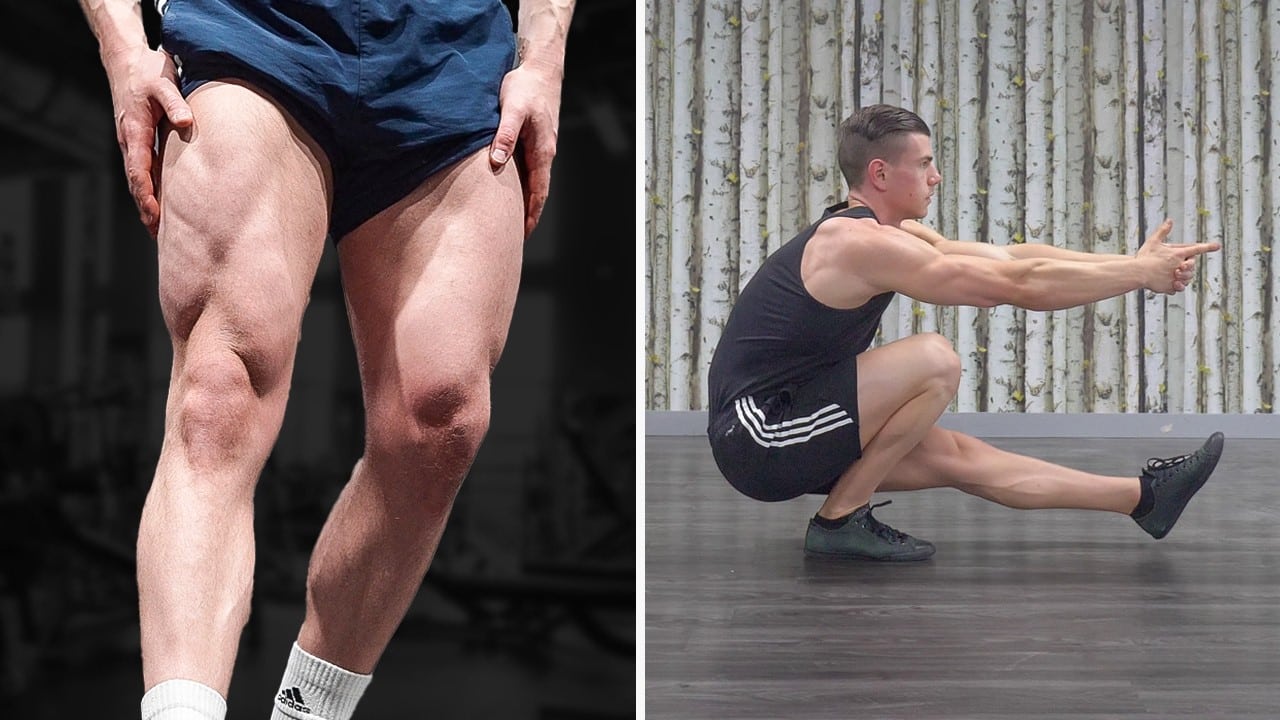
In a recent comprehensive guide, Vadnal breaks down the most effective leg exercises from both worlds, explaining when to use each and how to maximize results.
Whether training at home or in a gym, these strategies will transform how you build strength and size in your legs.
Jump to:
- Deadlifts vs. Back Extensions: Building Your Posterior Chain
- Barbell Squats vs. Pistol Squats: Quad Dominance
- Leg Extensions vs. Sissy Squats: Quad Isolation
- Hamstring Curls vs. Nordic Curls: Complete Hamstring Development
- Calf Training: No More Excuses
- Lunges vs. Step-Ups: Unilateral Leg Builders
- The Hybrid Training Advantage
Deadlifts vs. Back Extensions: Building Your Posterior Chain
For developing hamstrings, glutes, and lower back muscles, Vadnal considers Romanian deadlifts ideal for packing on serious size. The exercise demands eccentric control, with lifters lowering the weight over 3-5 seconds followed by a pause at maximum stretch.
I don’t care how strong your grip is, your forearms are tiny muscles compared to your legs. Without straps you won’t be able to go as heavy or do as many reps.
Vadnal recommends using lifting straps for heavier deadlifts to ensure grip strength doesn’t become a limiting factor. This allows lifters to fully stress their posterior chain muscles without forearm fatigue cutting sets short.
Technique remains paramount. Maintaining a fixed knee bend keeps tension on hamstrings throughout the movement. Depth should be determined by individual flexibility—lower until feeling maximum hamstring stretch while preserving neutral spine position.
The very fact that deadlifts are exhausting is a reason most people skip them. Doing hard exercises is uncomfortable. The average person wants shortcuts.
Back Extensions: Lower Fatigue, Higher Volume
Back extensions offer a strategic alternative for targeting posterior chain muscles without the axial loading that makes deadlifts so taxing. Recovery becomes significantly easier.
The trade-off requires increased volume—more sets and reps taken closer to failure to match the stimulus provided by heavy deadlifts. Long lever mechanics mean less weight is needed, leaving substantial room for progressive overload.
If you’re after a sickening lower back pump, the back extension is unmatched. Expect to feel like you’ve got two rods holding up either side of your spine after your workout.
Vadnal warns about dizziness from repeated inversion during back extensions. He’s experienced close calls with fainting, advising lifters to stand up slowly after intense sets.
Barbell Squats vs. Pistol Squats: Quad Dominance
Barbell squats remain popular because they work the entire lower body through extensive range of motion while allowing heavy loading. Vadnal emphasizes choosing a variation—front squat, back squat, high bar, low bar, wide or narrow stance—that suits individual anatomy.
Just squat as deep as your body allows, aiming for ass to grass. This way of squatting is humbling as it’s hard. Have faith knowing that this big stretch does wonders for hypertrophy.
Deep squatting improves flexibility as a byproduct. Gaining strength in end ranges allows lifters to relax comfortably in deep squat positions.
The mental challenge never disappears, regardless of experience level. Vadnal notes that feeling dread before a squat set indicates working at appropriate intensity to force growth.
Pistol Squats: Unilateral Strength and Mobility
Single-leg squats reduce muscle and strength asymmetries between limbs while uniquely targeting hip rotator muscles that standard barbell squats miss.
Pistol squats demand considerable balance, strength, and mobility. Vadnal recommends using an elevated heel and holding counterbalance weight to overcome ankle and hip mobility restrictions.
Holding onto support increases stability, allowing lifters to push muscles to failure without balance limitations. The key is maintaining all tension on working muscles without excessive arm assistance.
People talk trash about pistols saying they’re a party trick and they’re not practical to progress. However, pistol squats are still a good option to challenge your legs with minimal equipment and minimal weights.
Leg Extensions vs. Sissy Squats: Quad Isolation
Leg extensions target the rectus femoris—the middle thigh muscle that squats don’t fully address. The exercise proves most challenging at peak contraction with legs straight, strengthening lockout range.
When combined with compound lifts, leg extensions create complete quad development. Machine isolation allows safely working muscles to their limit without balance or skill requirements.
Vadnal dismisses the myth that leg extensions damage knees, calling it stupid for healthy individuals. Sensible progression makes bodies bigger and more resilient over time.
Sissy Squats: Bodyweight Quad Isolation
Sissy squats function as bodyweight leg extensions, isolating quad muscles. Maximum challenge occurs at the bottom in deep stretch—ideal for bodybuilding adaptations.
Hold onto something for support as you work out the movement. You’re not limited by balance or technique, you just have to embrace the burn and push yourself hard.
Critical technique involves squeezing glutes and keeping hips forward so quads bear the burden. If 20-30 slow, continuous reps become too easy, add deficit training or external weight.
Hamstring Curls vs. Nordic Curls: Complete Hamstring Development
Machine hamstring curls shouldn’t be skipped despite out-of-sight, out-of-mind tendencies. Hamstrings dramatically impact physique quality.
Hip hinges like deadlifts don’t target all hamstring aspects. One major hamstring head only crosses the knee joint, requiring knee flexion exercises for complete development.
You wouldn’t skip bicep curls for your arms, why skip hamstring curls for your legs?
Seated curls surpass lying variations by placing hamstrings on greater stretch for superior growth stimulus. The burn remains isolated to working muscles with minimal systemic fatigue.
Nordic Curls: Eccentric Hamstring Strength
Nordic curls create tremendous eccentric tension as hamstrings stretch to end range. Lifters resist the lowering phase, fighting gravity throughout the descent.
Commonly used for bulletproofing athletes against deceleration-related muscle strains, Nordics prove extremely difficult with steep learning curves. Vadnal recommends using resistance bands to train full range of motion and build strength progressively.
Nordic curls are an exercise which feel impossible at first, but with patience and consistency you’ll be surprised at what your body is capable of.
Calf Training: No More Excuses
For those with stubborn calf development, Vadnal delivers tough love: stop blaming genetics and poor muscle insertions.
Standing calf raises require slow, deep stretches with pauses at the bottom—not bouncing that merely works the Achilles tendon through stretch reflex. Calves handle bodyweight all day, demanding plenty of weight and volume for growth.
Seated calf raises target the soleus muscle. Proper execution means letting heels drop completely before squeezing calves maximally on the ascent.
Vadnal’s prescription for calf growth:
- Train three times weekly to optimize stress, rest, and growth cycles
- Start leg workouts with calves when energy is highest
- Use heavy weights for low reps and super high reps for complete development
- Include stretch partials to fully exhaust muscles
Lunges vs. Step-Ups: Unilateral Leg Builders
Lunges build big, strong legs while feeling deceptively heavy since the front leg performs most work. This creates favorable stimulus-to-fatigue ratios.
Stance width and torso angle determine whether quads or glutes receive emphasis. Vadnal notes the mental challenge intensifies suddenly mid-set as pain and pump accumulate dramatically.
For lifters experiencing lower back pain during squats, lunges provide relief. Lighter loads and pelvic-friendly positioning allow working around discomfort.
Step-Ups: Underrated Leg Developer
Step-ups deliver results proportional to effort invested. Vadnal emphasizes avoiding bouncing off the ground and keeping toes up to reduce cheating.
Choose a height of step up that you can actually control through full ROM. We want our leg muscles acting as brakes on the way down and doing all the work to drive us up from the ground.
Step-ups integrate strength, balance, and motor control while exposing non-dominant limb weaknesses. Hip stabilizers fire intensely, demanding complete focus for proper technique.
The Hybrid Training Advantage
Vadnal champions mixing calisthenics and weights as super effective hybrid training that provides the best of both worlds.
For muscle growth, any exercise proves effective when applying proper bodybuilding principles. For strength development, specificity matters—strength transfers primarily to movements actually trained.
The physiotherapist’s comprehensive approach demonstrates that building powerful legs doesn’t require choosing one training method. Combining weighted exercises with bodyweight movements creates diverse stimuli that challenge muscles through different angles, ranges, and intensities.
Whether accessing a fully-equipped gym or training at home with minimal equipment, effective leg development remains achievable through intelligent exercise selection and consistent effort.