Struggling with running pain that just won’t quit? Maybe you’ve already given up on running altogether, convinced your body simply can’t handle it anymore.
One fitness coach has spent years helping hundreds of people reclaim their ability to run completely pain-free, and his methods might surprise you.
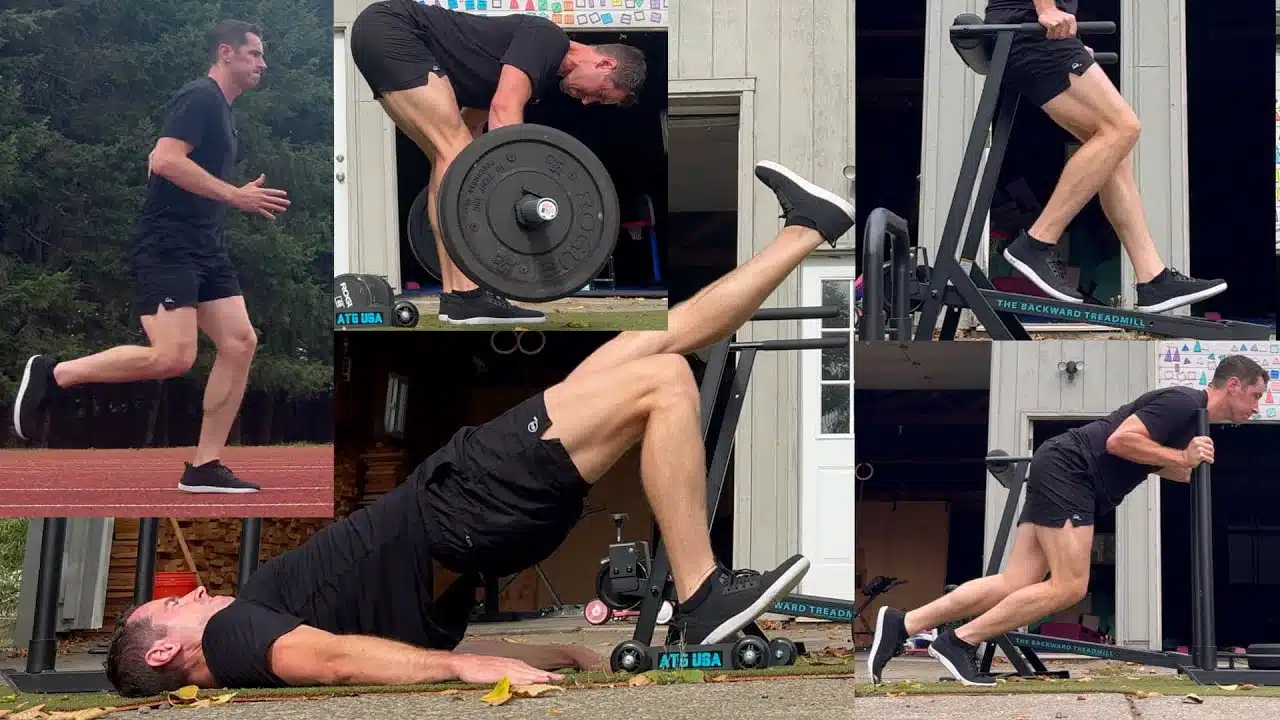
The secret isn’t found in expensive physical therapy sessions or complicated rehabilitation protocols.
Instead, it starts with understanding one critical concept: the relationship between what your body can do versus what you’re asking it to do.
Jump to:
- The Backward Solution That Sounds Crazy But Works
- Sled Training: The Original Game-Changer
- The Home Solution: Band Exercises That Replicate Sled Benefits
- The Knee Magic: Downhill Progression Training
- From Running to Sprinting: The Manual Treadmill Advantage
- Hamstring Protection: The Number One Sprinting Injury Prevention
- Hip Flexor Preparation: Lessons From Gymnastics and Olympic Lifting
- Stopping and Jumping: Training Below Sport Demands
- Head-Over-Foot Running: Rethinking Natural Mechanics
- Demand Versus Ability: The Foundation of Everything
- Real-World Application: Maintaining Functional Sprinting Into Advanced Age
The Backward Solution That Sounds Crazy But Works
According to the coach, who has trained everyone from elite athletes to grandparents, the simplest intervention he’s witnessed involves literally running backward.
Hundreds of people reporting that having given up forward, can’t do it anymore, all they did was work backward, progressing from, let’s say, walking to jogging to running backward.
The concept is straightforward: backward movement trains your body’s ability to handle forward demands. Forward running creates speed, but backward training builds the capacity to handle that speed safely.
The main considerations? Finding a safe surface where you won’t slip or encounter traffic. Beyond that, the progression is remarkably simple.
Sled Training: The Original Game-Changer
In his original gym facility, sled work became the cornerstone of his rehabilitation approach. One piece of equipment could accommodate athletes, grandparents, and everyone between by simply adjusting weight and pace.
Pushing forward strengthens areas needed for acceleration. Pulling backward builds capacity for deceleration and braking forces.
He incorporated sled work into circuits combining full-body strength and flexibility exercises. Within 30-45 minutes, clients received cardio conditioning, strength training, flexibility work, and rehabilitation—all simultaneously.
The Home Solution: Band Exercises That Replicate Sled Benefits
When pandemic lockdowns closed his gym in 2020, adaptation became necessary. He developed resistance band protocols that mimicked sled training effects.
Straight Leg Progressions
Starting with both legs, the straight-leg band exercise scales beautifully. Backing closer to the anchor point makes movements easier; stepping farther away increases difficulty.
- Begin with 20 reps using both legs
- Progress to single-leg variations
- Focus on achieving good range at the bottom position
- Hold briefly at the top for maximum benefit
Then reverse the movement pattern by flexing upward, training opposite muscle groups for another 20 repetitions.
Building Athletic Position Tolerance
Without ever working through pain, gradually build capacity in athletic positions. Single-leg work becomes particularly valuable here.
Notice I’m trying to have everything in my body like a statue except that positioning.
This approach proved remarkably effective over five years of observation and refinement.
The Knee Magic: Downhill Progression Training
When knee issues created major barriers, adding downhill ability progressions made all the difference. This technique has been the closest thing to “knee magic” for regaining lost function.
You can simulate downhill angles using bands and adjust difficulty through multiple factors:
- Angle adjustment: Just like steeper hills increase difficulty
- Assistance levels: Similar to using railings or canes on actual hills
- Step length: Shorter steps provide greater safety and control
- Foot positioning: Start flat-footed before progressing
Aim for high repetitions—around 20 reps—focusing on controlled lowering. This eccentric control builds tremendous functional capacity.
From Running to Sprinting: The Manual Treadmill Advantage
Transitioning from comfortable running to actual sprinting creates enormous challenges. Space requirements, safety concerns, and deceleration demands make outdoor sprinting impractical for many.
Enter manual treadmills—the non-motorized versions where you pull the belt yourself. Approximately 60 million exist worldwide, and they’re significantly cheaper than motorized versions.
Manual treadmill sprinting trains posterior chain muscles—hamstrings, glutes, even lower back—differently than motorized belts. Forward sprinting builds acceleration capacity while backward work develops deceleration strength.
I am wrecked, pumped, lungs, but so painfree. So, this isn’t for the track athlete. I don’t know if this will make a track athlete faster. I just want to basically play basketball, play with my kids, never break down.
Hamstring Protection: The Number One Sprinting Injury Prevention
Hamstring strains dominate sprinting injuries. As speed increases, hamstring involvement escalates dramatically.
The key lies in building hamstring strength specifically in lengthened positions. Regular deadlifts relate well to running initiation, but Romanian deadlifts (RDLs) address high-speed demands.
RDL Progressions for Everyone
Barbells allow heavier loading, but dumbbells provide accessibility and stability advantages. Start with minimal range and gradually expand as capacity builds.
This training develops both strength and flexibility simultaneously. It’s also remarkably beneficial for lower back resilience.
Since hamstring injury history often reveals side-to-side imbalances, incorporate single-leg variations. Progress from two legs up, one leg down, then full single-leg RDLs to identify and correct asymmetries.
Hip Flexor Preparation: Lessons From Gymnastics and Olympic Lifting
Sprinting places significant strength and flexibility demands on hip flexors—muscles connecting lower back to legs.
Simple progressions borrowed from gymnastics include:
- Lifting legs off the ground from a support position
- Straightening one leg while suspended
- Advancing to both legs straight simultaneously
Split squat variations with front foot elevation provide loaded flexibility work. Assistance and elevation height offer scalable progression factors.
Staircases function as nearly perfect regression tools—handrails provide assistance while steps offer natural elevation options.
Stopping and Jumping: Training Below Sport Demands
Sports like soccer and basketball add stopping and jumping to running demands. The number one coaching observation? Most athletes never train below their sport-specific positions.
Standard squatting typically involves partial depth or bouncing from the bottom. What’s missing? Actually owning positions below sport demands, pausing, and returning with control.
Over 99% of trained athletes initially lack this capacity. Yet virtually everyone can develop it using heel elevation and counterbalance assistance.
- Plates provide excellent counterbalance
- Heel elevation improves accessibility
- Progress by reducing counterbalance weight
- Kettlebells or dumbbells serve as intermediate steps
- Barbells remain optional based on actual demands
Head-Over-Foot Running: Rethinking Natural Mechanics
An article about Usain Bolt suggested he could run even faster with straighter posture, eliminating lateral movement. Initially dismissed, this concept gained credibility through basketball coaching experience.
Athletes with stiffer movement patterns consistently showed less effective techniques. Meanwhile, elite performers like Michael Jordan demonstrated fluid, deep positions.
Drills requiring ground touches with head positioned over feet created better biomechanical alignment. Preparation exercises address the demands this positioning creates.
Some experts now suggest head-over-foot running might actually feel more natural for many people, potentially distributing forces more effectively.
Demand Versus Ability: The Foundation of Everything
The coach emphasizes that patience with demand management could theoretically build running capacity without specific exercises. However, bodies don’t possess infinite adaptation capacity.
Strategic ability-building through targeted exercises accelerates progress while minimizing injury risk. The methods outlined create comprehensive preparation addressing:
- Forward and backward movement patterns
- Acceleration and deceleration forces
- Lengthened-position strength
- Deep-range mobility and control
- Single-leg stability and balance
Real-World Application: Maintaining Functional Sprinting Into Advanced Age
The coach’s mother exemplifies these principles beautifully. Now with grandchildren who move quickly, she maintains sprinting ability as practical necessity.
Imagine she’s watching one of these kids. They’re getting pretty quick. they take off, she could sprint after them and get them.
She doesn’t overdo training volume but maintains consistent practice with sled work, backward walking or running, and split squats as part of a sensible regimen. Her goal? Maintaining sprint capacity until age 100.
Above all else, personal observation trumps any study or expert advice. Your body provides the most important feedback. If struggling with natural-feeling running, perhaps head-over-foot positioning will distribute pressure more effectively for your individual mechanics.
The journey back to pain-free running requires patience, strategic progression, and respect for the delicate balance between what you demand of your body and what abilities you’ve actually developed.