Anterior shoulder pain during lifting or everyday movements is frustratingly common among gym-goers and active individuals.
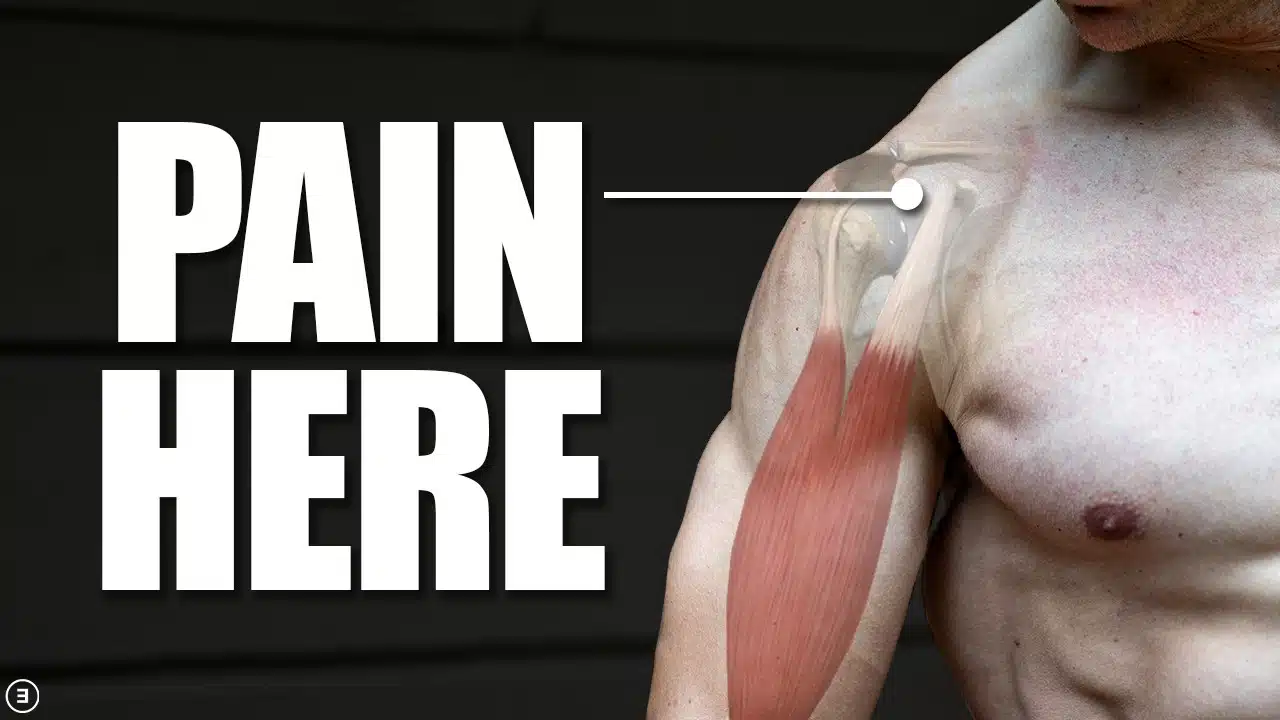
Often labeled as “biceps tendonitis,” this nagging discomfort typically flares up during pressing movements, reaching behind your back, or even holding a barbell during squats.
But here’s what most people don’t know: inflammation probably isn’t driving your pain.
Understanding what’s really happening—and how to properly manage it—could be the difference between chronic shoulder issues and getting back to training pain-free.
Jump to:
Understanding Biceps Anatomy and Function
The biceps brachii muscle consists of two distinct heads that work together to control arm movement.
The short head originates at the coracoid process of the shoulder blade, while the long head originates at the supraglenoid tubercle. Both heads merge and attach to the radial tuberosity of the forearm.
Because this muscle crosses both elbow and shoulder joints, it contributes to multiple actions. At the elbow, it helps flex (bend) the arm and supinate the forearm (rotating palm upward).
Surprisingly, even in 2024, experts still debate the biceps’ exact function at the shoulder. Research suggests it likely plays a small role in shoulder flexion—but only when the shoulder is extended and up to about 30 degrees of flexion.
The long head may also act as a secondary shoulder stabilizer due to its unique tendon path and attachment point.
Why “Biceps Tendonitis” Is Actually a Misnomer
Front-of-shoulder pain is routinely attributed to the long head of the biceps tendon based purely on location.
Healthcare providers traditionally called this “biceps tendonitis,” implying inflammation drives symptoms. However, inflammation is likely not the primary culprit.
A 2015 paper by Strait and colleagues clearly states that anterior shoulder pain attributed to the biceps tendon does not appear to be due to an inflammatory process in most cases.
Biceps tendonopathy is now the preferred term. This simply refers to pain and impaired function secondary to gradual overload of the tendon—no inflammation required.
The Diagnosis Dilemma
Isolating the long head of the biceps tendon as the sole source of shoulder pain is remarkably difficult.
Two major issues complicate accurate diagnosis:
- Clinical examination procedures like palpation and special orthopedic tests are not reliable for accurately diagnosing biceps tendon conditions
- Imaging studies such as MRIs overwhelmingly show that biceps tendon issues rarely happen in isolation—simultaneous rotator cuff pathology is extremely common
This overlap makes it challenging to pinpoint exactly what’s causing pain.
Who Should Follow This Protocol?
This management approach works for individuals with non-traumatic pain in the front of their shoulder that worsens with loading of the long head of the biceps tendon.
Common aggravating activities include:
- Reaching behind your back
- Bottom position of bench press
- Triceps dips
- Pec flies
- Barbell back squats (due to bar position)
As long as symptoms aren’t related to frozen shoulder, osteoarthritis, SLAP tears, or another condition requiring specific medical management, these strategies can help.
Step One: Modify Aggravating Activities
Managing biceps tendonopathy follows a straightforward two-step process. Simple, but not necessarily easy.
Step one involves modifying aggravating exercises and activities to calm symptoms down, especially early on when things may be more irritable or severe.
Four Key Variables to Adjust
When it comes to tendon rehabilitation, focus on these four modifiable factors:
- Volume: Total amount of work you’re doing in a given day, week, or month
- Range of motion: Minimize or avoid provocative positions such as end-range shoulder extension
- Speed: Quicker movements typically load tendons more; slower movements allow better control and feedback
- Intensity: How heavy or hard something is
Modifying Pressing Movements
Pressing movements are generally most problematic for biceps tendon pain.
For barbell bench press or flat dumbbell press, you can consciously reduce range of motion, use physical blocks like safety spotter arms, or perform floor presses instead. Alternatively, swap the movement for push-ups and modify range as needed.
Triceps dips and regular dips can be especially aggravating for newer trainees because they require more shoulder extension than most people use in daily life.
Dumbbell flies, cable flies, and pec machines may also need modification. For overhead pressing with a barbell, avoid bringing the bar all the way down to your shoulders.
Technique adjustments matter too. Try a slow tempo, particularly during the eccentric (lowering) portion, or use pauses at the bottom of movements.
Adjusting Pulling Exercises
For dumbbell rows, focus on engaging your back and shoulder blade while stopping the movement when your arm is in line with your trunk.
If pull-ups are an issue, try chin-ups or use a neutral grip instead.
Modifying Barbell Back Squats
Barbell back squats may also need adjustment. You can use a wider grip, a thumbless grip where your thumbs aren’t wrapped around the bar, or choose a different leg exercise altogether.
The core principle remains consistent: minimize time spent in aggravating positions and modify volume and intensity so you can recover and adapt from training appropriately.
In some cases, you may need to temporarily stop an activity altogether in order to move forward with rehabilitation.
Step Two: Gradual Progressive Overload
Once you’ve managed to calm symptoms down to a reasonable level, step two is remarkably straightforward.
It requires gradually progressing back to normal function over time. If you modified any of the variables mentioned above, slowly reintroduce them into your routine and make adjustments if flare-ups occur along the way.
Regain your range of motion first, then add intensity, volume, and speed as needed.
It’s not perfect science, and ups and downs will happen. But many people could stop here and succeed by simply applying these principles consistently.
Supporting Exercises for Shoulder Stability
Since biceps tendonopathy rarely happens in isolation and the long head of the biceps tendon may act as a secondary shoulder stabilizer, strengthening surrounding muscles provides additional support.
External Rotation Strengthening
Shoulder external rotation exercises are often associated with rotator cuff strengthening.
Options include:
- Sideline external rotation
- Standing external rotation with cable or band
- External rotation with elbow on knee
Pick one option to perform slowly within tolerable symptoms for 2-3 sets of 10-15 repetitions, 2-3 times per week.
External rotation strengthening can also be done isometrically by pulling a band apart and holding for 30-45 seconds. Your arms can be at your side, at shoulder height, or moving between the two positions.
Posterior Shoulder Strengthening
The second category involves posterior shoulder strengthening through A’s, T’s, and Y’s with or without resistance.
These can be performed isometrically on the floor or through full range of motion on an elevated surface. Again, pick one for 2-3 sets of 10-15 repetitions or 30-45 second holds, 2-3 times per week.
Since most of these exercises shouldn’t load the biceps tendon much, they likely can be performed at the same time you’re modifying aggravating activities.
Direct Biceps Tendon Loading (Advanced)
Exercises that purposely load the biceps tendon should only be performed when symptoms are at a much more reasonable level—and only if they’re necessary for your goals.
Elbow Flexion Progression
Start with your shoulder in a flexed position, preferably supported. Examples include preacher curls and one-arm dumbbell curls over an incline bench.
Spider curls are another option but remain unsupported. From there, progress to curls with your arms down by your side.
Final progression involves curls with shoulders extended, such as dumbbell curls while seated on an incline bench or cable curls.
Shoulder Flexion Loading
For shoulder flexion, emphasize the stretched position of the long head of the biceps tendon starting with light loads.
Front raises can be done while seated on an incline bench with dumbbells or while standing with cables.
For any of these movements, 2-3 sets of 8-15 repetitions, 2-3 times per week is a safe starting point. Keep them slow, controlled, and tolerable.
Work on very gradual progressions over several months. Proper rehabilitation and long-term changes take time and consistency—there are no shortcuts.