It’s one of the simplest exercises you can do for knee pain — and it just might be a game-changer, especially if you’re over the age of 50.
This low-impact movement specifically strengthens the muscle most responsible for stabilizing and protecting your knee joint.
Whether you’re recovering from an injury, dealing with off days, or simply want healthier knees as you age — this exercise can help.
And it only takes a resistance band, a few minutes, and a bit of your attention.
In a recent tutorial, fitness coach Gavin — co-owner of a New Zealand studio designed for clients over 40 — broke down the exact move he teaches to clients with chronic knee discomfort.
He swears by it for a good reason: after eight knee surgeries, this movement has been central to his rehab and his return to triathlon training.
Jump to:
Why Strengthening the VMO Muscle Is Crucial for Knee Health
The focal point of this exercise is the vastus medialis oblique (VMO) — a part of the quadriceps that plays a pivotal role in knee stability and patellar alignment.
“This is one of the first muscles to weaken after injury or inactivity,” says Gavin. “And unfortunately, it’s notoriously hard to rebuild once it’s gone.”
The VMO connects to the inner portion of the knee and helps extend the leg while keeping the kneecap properly aligned — critical for walking, squatting, and navigating stairs pain-free.
Weakness in this area has been linked to a range of common issues, including patellofemoral pain syndrome and general instability.
Strengthening this muscle can help ease discomfort, improve mobility, and reduce the risk of further injury.
The Exercise: Banded Terminal Knee Extension (TKE)
What You’ll Need
- A loop resistance band (often called a power band)
- A sturdy anchor point (like a squat rack, pole, or door anchor)
- Optional: towel or pad for comfort behind the knee
Step-By-Step Setup
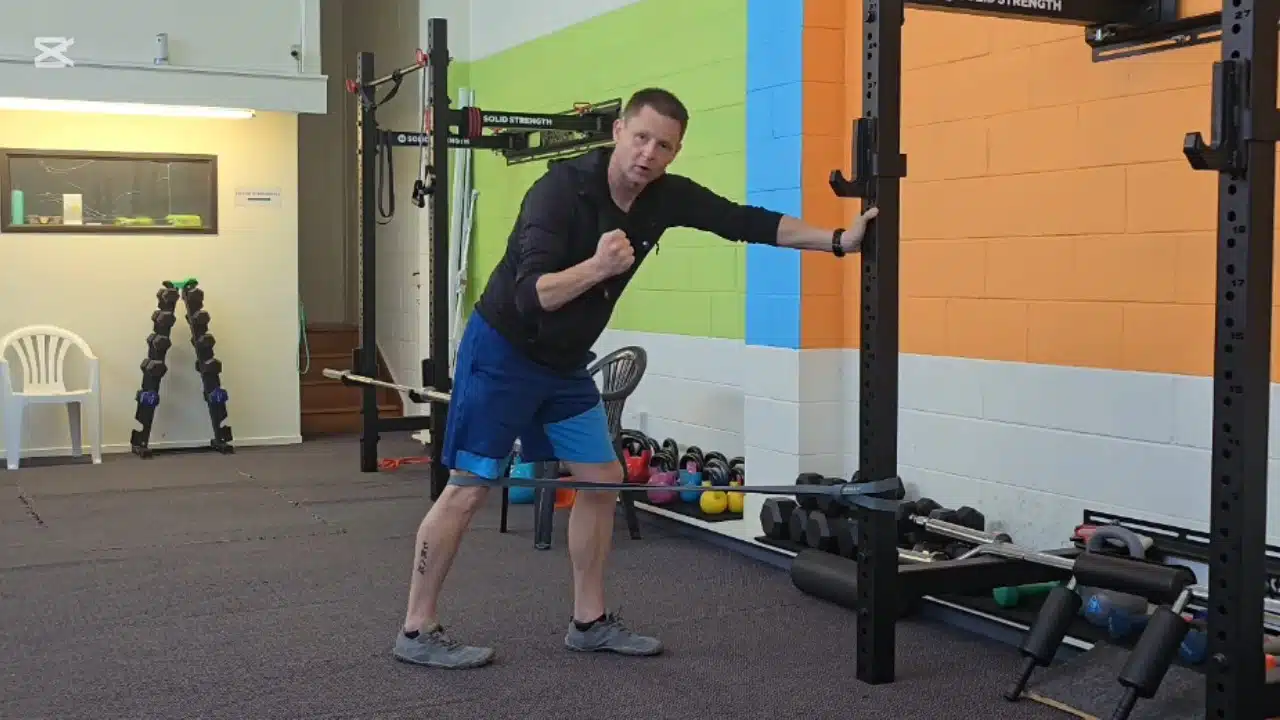
- Anchor the band: Loop it around a stable object at roughly knee height. If using a door anchor, slide the anchor between the door and frame, then thread the band through it.
- Create the loop: Pull one end through the other to make an adjustable loop that can sit securely behind your knee.
- Insert your leg: Place one leg inside, positioning the band right behind the knee joint. The foot should remain flat on the floor throughout.
How To Perform the Motion
- Start by gently stepping back to create some tension in the band. Place the ball of your foot on the ground, so you’re just lightly leaning into the stretch.
- Support yourself using a nearby post or surface if needed.
- Now, press your heel down and straighten your knee forcefully as if trying to “stamp” the foot into the ground.
- You should feel the quadriceps — especially around the inner knee area — kick in strongly.
- Hold for 1-2 seconds, then slowly let the knee bend slightly forward again, maintaining control.
- Repeat for 12–15 reps per leg, rest, and complete 2–3 sets total.
This controlled stamping motion activates the VMO muscle dynamically while protecting the joint due to the grounded foot — what’s often called a “closed kinetic chain” movement.
Modifying for Different Needs and Comfort Levels
Not every knee is built the same, especially if you’ve dealt with chronic issues, arthritis, or Baker’s cysts (fluid-filled sacs behind the knee).
If It Feels Too Painful:
- Add a towel or soft pad between the band and your knee joint.
- Lower the band slightly if pressure behind the knee aggravates it.
- Use a lighter band to start, gradually increasing resistance over time.
“The key is that your heel stays on the ground and the knee motion is slow and deliberate. That’s how we get the quad firing without irritating the joint,” notes Gavin.
Why This Exercise Is So Effective (Even After Injury)
After multiple knee operations, Gavin credits TKEs as a key component of his recovery — now training for endurance events like Ironman triathlons.
“Even though my knee isn’t perfect, it’s strong enough to let me run,” he shares.
This exercise requires no jumping, has minimal joint strain, and can be adapted for almost any mobility level.
The Benefits of Terminal Knee Extensions Include:
- Improved knee tracking and alignment
- Reduced discomfort when walking or climbing stairs
- Enhanced knee stability for daily movement and weight training
- Preventative strength for future injury avoidance
Not Just for Rehab — But Preventative Strength Too
Even if you’re not currently dealing with knee pain, TKEs are an excellent exercise to incorporate into your warm-ups or strength sessions to keep your knees durable as you age.
The muscle activation helps counteract the atrophy that accelerates past age 40 — particularly in the quadriceps and glutes, which play a vital role in lower-body health.
Plus, for those who don’t lift heavy weights or want a joint-friendly alternative, this move bridges the gap beautifully.
How to Get Started Today
Gavin suggests searching for “power bands” online — most retailers offer sets in varying strengths (light, medium, strong). This allows gradual progression as your strength improves.
And if you’re looking for a complete resistance band routine, he offers a free full-body plan designed specifically for people over 40. Simply comment or message “bands” to receive it.
At-home exercisers can also anchor these bands behind their door using a standard door attachment, making it incredibly accessible.
Final Thoughts
When it comes to sustainable joint-friendly strength training, small consistent actions bring big results.
Strengthening the VMO through banded terminal knee extensions can help rebuild your confidence in movement, reduce pain, and reintroduce ease to everyday life.
“Strong knees change everything,” Gavin emphasizes. And that strength starts with this one simple yet powerful exercise.