Most people have no idea what their body fat percentage actually is.
Some overestimate their leanness by a wide margin, while others are far too critical of themselves.
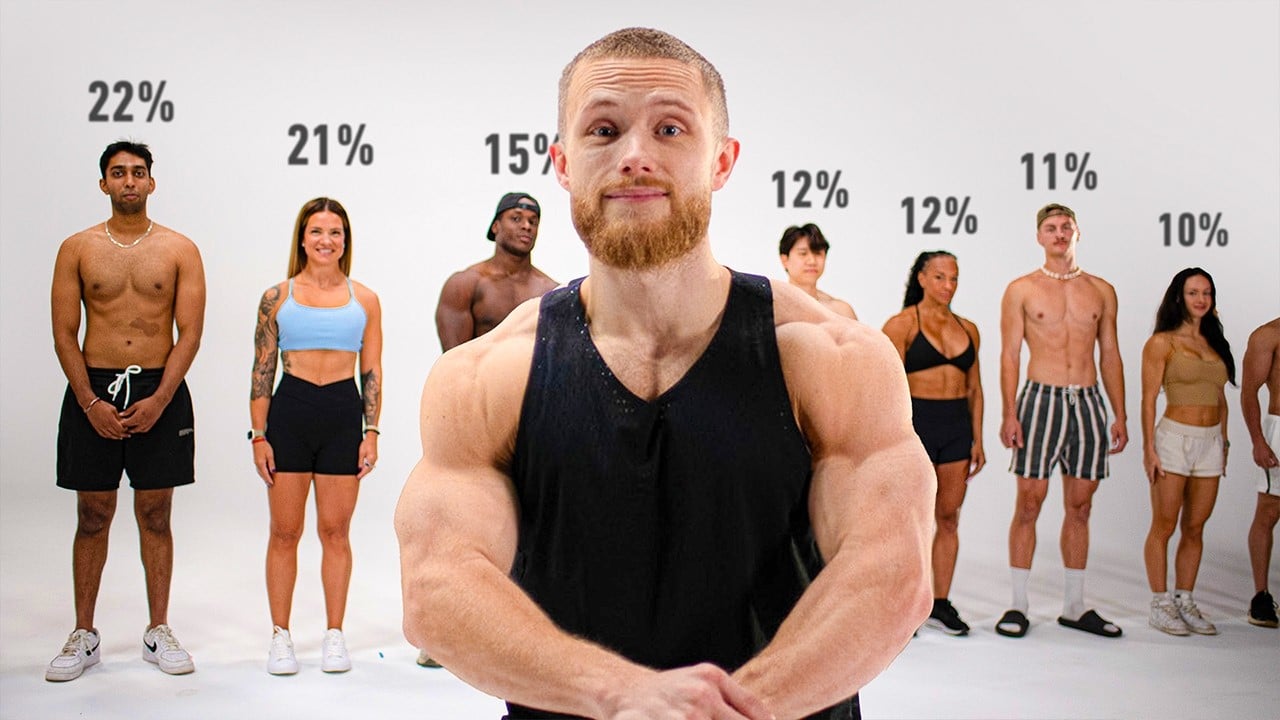
Search online for body fat comparison charts and you’ll find wildly inconsistent images—many based on inaccurate measurements like calipers or handheld devices, or worse, pure guesswork.
In a recent YouTube video, fitness expert Jeff Nippard set out to change that by measuring real people across the entire spectrum—from 50% body fat all the way down to 5%—using DEXA scans, considered the gold standard for body composition analysis.
Jump to:
Why Body Fat Percentage Actually Matters
Body fat percentage isn’t just about aesthetics. It influences energy levels, sleep quality, athletic performance, mental health, and long-term disease risk.
Understanding where you fall—and where you want to be—can help you set realistic goals based on your lifestyle, genetics, and priorities.
The Reality of 40–50% Body Fat
At the higher end of the spectrum, daily life can feel like a struggle. Joe, a 36-year-old dad, measured 45.3% on DEXA after dealing with low testosterone and chronic fatigue.
I had low testosterone. Like my free testosterone was like 90. It kind of made sense of my lack of motivation, my lack of ambition.
Alexis, a 19-year-old university student at 48.2% body fat, said she still felt relatively good in the gym but wanted to regain the confidence she’d lost over her first year at school.
I want to go back to where I was like comfortable and confident every single day leaving my house. I almost don’t recognize myself.
At this level, simple tasks like tying shoes or climbing stairs can feel exhausting. Sleep apnea, joint discomfort, and persistent fatigue are common.
Interestingly, many subjects at this level assumed that getting ultra-lean would solve all their problems—but as Nippard reveals later, extreme leanness brings its own set of serious issues.
30–40%: The Average American Range
Based on 2017–2018 NHANES data, the average American woman sits around 39% body fat, and the average American man around 27%.
At 30% body fat, men often exhibit what’s popularly called the “dad bod”—some muscle definition in the arms and legs, but no visible abs or separation. How you feel at this level depends heavily on sleep, nutrition, and activity habits.
For women, 30% body fat is considered healthy and sustainable by the American College of Sports Medicine. Once you account for essential female fat stores, 30% on a woman is roughly equivalent to 20% on a man.
Breen, who measured 28.4% on DEXA, reported high energy and solid gym performance.
I feel like I wake up with a lot of energy, especially compared to my partner who I live with.
If you’re a woman at 30% body fat in the U.S., you’re leaner than 90% of the female population.
20% Body Fat: Leaner Than You Think
Most people dramatically underestimate what 20% body fat looks like on men. Online charts often show abs and deep cuts—but in reality, 20% is softer.
Jay measured 20.8% on DEXA. He had some arm and shoulder definition and could see his abs when flexed under good lighting, but he wasn’t shredded.
Nippard himself bulked to 20.6% body fat and said it felt uncomfortable—sluggish and bloated. But that’s highly individual. Your genetic “set point” plays a huge role in where your body feels best.
For some men, 20–25% is sustainable and healthy. For others, like Nippard, 10–15% feels far more comfortable.
Only about 12% of American men are leaner than 20%.
For women, 20% body fat is exceptionally lean. Christina, a 10-year training veteran, measured 21.4% on DEXA. At this level, you’ll see visible muscle shape and abdominal definition.
But here’s the reality: less than 1% of American women are leaner than 20%. It’s a level typically seen only in serious athletes.
15% Body Fat: The Discipline Zone
At 15%, men display clear muscle separation, visible vascularity, and a defined six-pack even under normal lighting. This level is realistic and maintainable year-round for many men—but it requires consistent training and mindful eating.
Shamar, who lost 25 pounds, came in at 15.3% on DEXA.
I feel way better. My energy is better. Mental clarity is better.
Still, reaching 15% often takes more effort than people expect. Only about 2% of American men fall below this level.
For women, 15% is extremely lean. Vanessa, training for a High Rocks competition, measured 15.7% on DEXA. At this level, hormonal disruptions are common.
My period will get kind of wonky or my sleep will get kind of messed up.
Long-term maintenance at 15% can lead to bone density loss, gut issues, and loss of menstrual cycle. It’s generally only advisable for short-term athletic goals.
10–12%: Elite Leanness
At 12%, men are visibly shredded with deep ab definition and muscle striations when flexed. Jimmy measured 12.1% on DEXA and displayed a true fitness-model physique.
But here’s the reality check: out of over 9,000 American men in a recent dataset, only one person was below 12% body fat.
Maintaining this level usually requires calorie tracking, meal planning, and serious discipline. Some genetically lean individuals can sit here comfortably, but for most, it’s unsustainable long-term.
For women, 12% is near the biological minimum. Alicia, a pro bodybuilder, measured 12.2% on DEXA and reported intense food cravings and constant hunger.
I crave a lot of chocolate. I was just eating handfuls. I don’t even know why.
Single Digits: The Sacrifice Zone
At 9–10%, men display full muscle separation, visible striations, and a completely ripped midsection. Nippard himself measured 9% body fat and noted it required extreme dietary restriction and disciplined training.
Ali, also at 9%, said he felt great—but acknowledged his genetics allowed him to maintain this level more easily than most.
This is probably my default. I feel great honestly.
But for most men, 10% is not a sustainable sweet spot. It requires constant vigilance and sacrifice.
At 8% body fat, men are stage-ready. Luke, a natural physique competitor, measured 8.4% two weeks out from competition. He reported brain fog, irritability, and constant food obsession.
I’m running in slow motion at all times. The littlest of things can annoy me and agitate me so much.
Testosterone levels drop. Sleep suffers. Mental clarity declines. This level is only advisable for short-term competitive purposes.
5% Body Fat: The Extreme Edge
Lachlan, a classic physique competitor, measured 5.5% on DEXA three weeks before his show. At this level, muscle separation is dense and grainy—but the side effects are severe.
The body fat that I’m at right now is not attainable long term. The little tasks in life become the most challenging.
This level is borderline dangerous and typically requires anabolic assistance. Your body sends constant signals to eat. Sleep becomes difficult. Mood swings are common.
After filming, Lachlan had a confrontation with Ali at the gym that went viral. Lachlan later apologized, acknowledging he reacted emotionally and took responsibility.
That was not who I am. I reacted out of emotion and not logic. I feel bad. I’ll learn from it.
What’s the Ideal Body Fat Percentage?
For women, the American College of Sports Medicine recommends 20–32% as the optimal healthy range. Most women will feel their best between 20–30%.
For men, the ACSM cites 10–22% as healthy. Nippard suggests 10–20% as the sweet spot, with 10–15% for lean aesthetics and 15–20% for strength and performance.
But the precise number matters less than how you feel, how you perform, and how sustainable your lifestyle is.
Body fat percentage is just one piece of the puzzle. The real goal is finding a balance where you feel strong, healthy, and confident—not chasing a number that leaves you exhausted, hungry, and miserable.
Focus on consistent training, balanced nutrition, quality sleep, and mental well-being. That’s where true health lives.