Want to run faster without adding mileage?
You may need to look no further than your ankles.
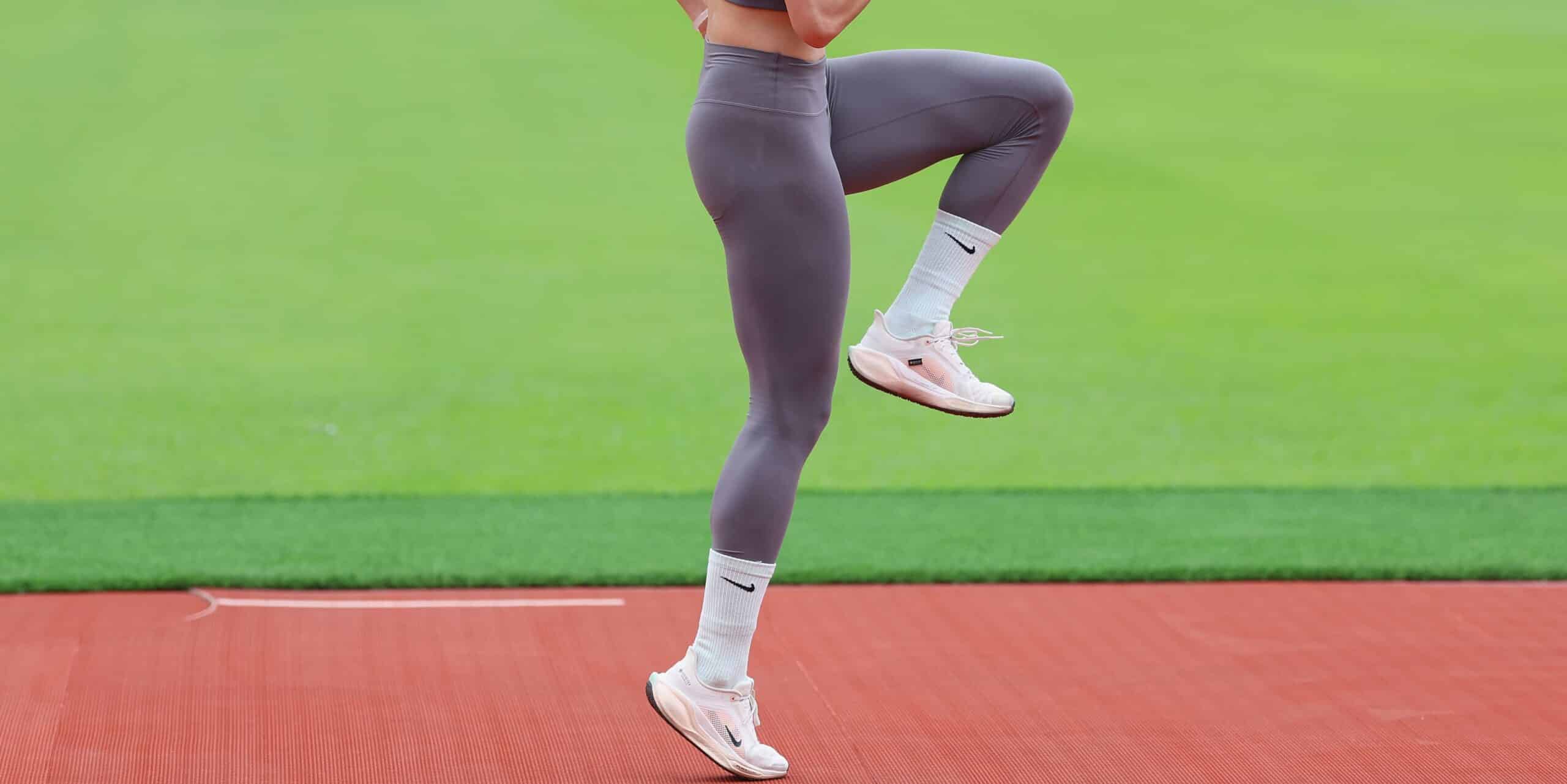
In a recent Runner’s World feature, performance expert and sports scientist Dr. Marcus Elliott revealed the critical role ankle stiffness plays in speed and injury prevention.
Building stronger ankles isn’t just about stability—it’s about creating spring-like power that launches you forward with each step.
This article breaks down the biomechanics of ankle stiffness, why it matters, and how to develop it using three simple, science-backed drills.
Jump to:
Why Ankle Stiffness Matters for Runners
At first glance, “stiffness” sounds like a bad thing. But in biomechanics, it’s a positive attribute—a sign of strong, spring-loaded tissue that efficiently absorbs and returns energy.

If you want something simple that actually works, this is one of the most effective tools I’ve used to build strength, conditioning, and endurance without needing a full gym setup.
- Full-body training with one weight using swings, squats, and presses
- Solid cast iron build that feels stable and lasts for years
- Comfortable grip that makes high-rep workouts easier to handle
Picture a rubber bouncy ball: it compresses quickly on impact, then rebounds with force. That’s the ideal. Contrast that with a deflated squash ball—it absorbs energy but gives nothing back.
Dr. Elliott, founder of P3—a high-performance training lab—says, “You need ankle stiffness to put yourself in a position that your lower and upper leg musculature can do what it’s supposed to do to propel you forward.”
This concept first gained traction back in 1996 during the World Athletics Cross-Country Championships. Elliott and other researchers observed that elite East African runners didn’t necessarily have better VO2 max or muscle composition—but they stayed bouncier for longer. Even under fatigue, their movement stayed springy, while others faltered.
How Ankle Stiffness Enhances Running Efficiency
Efficient running is all about transferring energy from the ground up through your legs and torso. Good ankle stiffness allows you to strike the ground with the ball of your foot, instantly passing the force upward into larger muscles like the glutes and hips.
Without this stiffness, that force lingers in the lower leg longer than ideal, pulling joints and smaller muscles into rotational stress and increasing injury risk.
“It’s really a dance,” Elliott explains. “It’s not just the ground hitting you. It’s about you hitting the ground back.” Timing and structure demand spring-ready ankles that can pop you up and forward, stride after stride.
If you want something simple that actually works, this is one of the most effective tools I’ve used to build strength, conditioning, and endurance without needing a full gym setup.
- Full-body training with one weight using swings, squats, and presses
- Solid cast iron build that feels stable and lasts for years
- Comfortable grip that makes high-rep workouts easier to handle
In his book, Ballistic: The New Science of Injury-Free Athletic Performance, author Henry Abbott explores these ideas in-depth, highlighting the ability of “ballistic” or bouncing motion to enhance durability and output while reducing impact stress.
Jump roping offers a great real-time test—land on the balls of your feet, keep your heels elevated, and feel the bounce. That snap upward is the result of well-trained ankle stiffness.
The Downside of Weak Ankles
Weakness in ankle-supporting muscles—like the tibialis posterior and soleus—can throw off alignment and overload connective tissue. This can lead to issues like shin splints, plantar fasciitis, or Achilles tendinitis.
Runners often overlook ankle-focused drills, opting instead for strength moves that target larger muscle groups. But as Elliott points out, “My favorite ways to improve ankle stiffness are almost all small ballistic movements.”
That means hopping, skipping, and bouncing—simple drills with powerful effects when done consistently over time.
Three Drills to Build Ankle Stiffness and Bounce
These three moves, endorsed by sports performance experts, combine isometric strength, single-leg control, and reactive movement to strengthen your lower leg, improve connective tissue integrity, and promote elastic return.
If you want something simple that actually works, this is one of the most effective tools I’ve used to build strength, conditioning, and endurance without needing a full gym setup.
- Full-body training with one weight using swings, squats, and presses
- Solid cast iron build that feels stable and lasts for years
- Comfortable grip that makes high-rep workouts easier to handle
All you need is a looped resistance band and something about four inches tall to hop over (such as towels or low hurdles). Do each exercise as directed, then repeat all for three total rounds.
1. Single-Leg Calf Isometric Hold
Why it works: Strengthens lower leg muscles responsible for stable, efficient ground contact.
How to:
- Stand facing a wall, hands relaxed on it for balance.
- Lift one foot off the floor and press up onto the toes of the standing foot, heel high.
- Keep foot aligned straight without rolling in or out.
- Hold for 30 seconds.
- Switch sides and repeat.
2. Balance Adductor
Why it works: Builds lateral and rotational stability—critical for controlling foot placement during running.
How to:
- Attach a looped resistance band to a sturdy anchor and loop it around the ankle closest to it.
- Stand upright, holding a support if needed for balance.
- Pull the banded foot behind and across your planted leg while keeping hips square.
- Engage core, return, and repeat for 10 controlled reps.
- Switch legs.
3. Hurdle March
Why it works: Trains quick, reactive push-off and rapid ground contact, mimicking running dynamics.
If you want something simple that actually works, this is one of the most effective tools I’ve used to build strength, conditioning, and endurance without needing a full gym setup.
- Full-body training with one weight using swings, squats, and presses
- Solid cast iron build that feels stable and lasts for years
- Comfortable grip that makes high-rep workouts easier to handle
How to:
- Set up two small hurdles or objects beside each foot.
- March right foot outside right hurdle as left arm rises; then return to center.
- Repeat left side with right arm rising.
- Focus on toe-strike and lifting foot quickly after each landing.
- Alternate for 30 seconds non-stop.
When (and How Often) to Train Ankle Stiffness
You don’t need to dedicate a full session to these exercises. Most runners benefit from adding them to warm-ups 2–3 times per week. Remember, frequency builds neuromuscular control better than once-a-week power sessions.
Start with one set of each exercise, then add rounds as your strength and control improve. If you’re more advanced, integrate plyometric progressions like pogo hops or bounding after mastering these basics.
Bottom Line
Speed doesn’t always come from running harder or longer. Sometimes, it starts with the smallest joints.
Training your feet and ankles could be the secret to a faster, more resilient stride. As Dr. Elliott puts it, “If you’re not ready for that dance with the ground, the ground will win.”
So start hopping today, and give yourself the strength to bounce back—literally.
If you want something simple that actually works, this is one of the most effective tools I’ve used to build strength, conditioning, and endurance without needing a full gym setup.
- Full-body training with one weight using swings, squats, and presses
- Solid cast iron build that feels stable and lasts for years
- Comfortable grip that makes high-rep workouts easier to handle