A medical doctor turned marketing agency owner claims that a simple physical practice has transformed his consciousness more in two years than two decades of meditation ever did.
His name is Yousef, and the practice he’s talking about is called Trauma Release Exercise, or TR.
But this isn’t just about recovering from trauma in the traditional sense.
According to Yousef and a growing number of practitioners, TR might be one of the most effective tools for mental clarity, emotional regulation, and even physical health that most people have never heard of.
Jump to:
- What Trauma Release Exercise Actually Is
- Why Traditional Meditation Wasn’t Enough
- The Science Behind Shaking Off Stress
- Why One Practice Affects So Many Different Problems
- One Doctor’s Two-Year Journey With Daily Practice
- Finding Your Optimal Dose
- Why Results Show Up So Differently For Different People
- The Mental Traps That Stop Progress
- How To Actually Practice Trauma Release Exercise
- Important Safety Considerations
- Redefining Trauma Beyond PTSD
- Why This Isn’t Like Social Media Releases
- The Helium Balloon Model Of Consciousness
What Trauma Release Exercise Actually Is
Trauma Release Exercise is a physical practice that involves putting yourself into specific stress positions designed to activate involuntary tremoring in the body.
Yousef describes it as activating the body’s natural “defragging system”—a mechanism mammals use to discharge accumulated tension and stress.
You layer on a bunch of crap as you go about your life through time. You kind of accumulate that as psychological and physical sediment or baggage, and it’s kind of like cardiovascular atherosclerotic plaque that you build up.
The practice targets large muscle groups in the lower body, particularly the psoas—the major hip flexor that connects upper and lower body.
There’s significant sympathetic nervous system innovation in this muscle, making it central to stored tension patterns.
Why Traditional Meditation Wasn’t Enough
Yousef spent years exploring various consciousness practices: Vipassana meditation retreats, the Sedona Method, psychedelic work, and different forms of yoga.
But something was missing.
A lot of it has been kind of neck up. I always felt I was missing out on this entire dimension of the body.
He points to Christina Gumand as a powerful example of TR’s potential.
She meditated hardcore Vipassana style for approximately 14 years, attending numerous retreats with massive volume, yet felt she’d hit a wall.
Within just two years of making TR her main practice, she reported achieving enlightenment—what she describes as persistent non-dual awareness and cessation of suffering.
I was so dissociated from my body. As we kind of work with the body, whether it’s TR or some other modality that’s getting to this repressed emotion, it just becomes a natural thing to just kind of rest in that body sense. We realize that silence that we’ve been seeking through meditation is actually always already been here. We’ve got static noise that’s covering it up.
The Science Behind Shaking Off Stress
The mechanism behind TR centers on something called mammalian discharge.
Animals naturally shake off stress and tension after threatening experiences—think of a deer trembling after escaping a predator, or a bear shaking after waking from tranquilization.
Humans possess this same neurological wiring, but we’ve learned to suppress it.
Social conditioning teaches us to override these natural discharge mechanisms in favor of appearing composed and controlled.
Yousef references footage of children in bomb shelters who shake and tremor naturally while adults sit completely still—not because they’re unaffected, but because they’ve overridden their natural stress response.
How The Body Decides What’s Actually Threatening
When you place yourself in TR stress positions, you’re recreating physical stress that travels up the spinal cord to the brain.
Your brain then evaluates: Am I actually under threat right now?
Three brain regions—the reptilian brain, limbic system, and cortex—receive this signal and route it through either the default mode network or a transcortical loop.
This loop returns a yes-or-no signal to your body about whether you’re genuinely in danger.
When you repeatedly practice in a safe environment, you’re essentially unlearning chronic defense responses and returning to baseline homeostasis.
Why One Practice Affects So Many Different Problems
People in TR forums report improvements in seemingly unrelated conditions:
- Irritable bowel syndrome
- Autoimmune disorders
- Social anxiety
- Depression
- Attachment issues
- Relationship problems
- Skin conditions like rashes
How can lying on the floor and tremoring possibly address such a wide range of issues?
Yousef explains that TR works upstream from all these symptoms by dialing up vagal tone and the parasympathetic nervous system.
This unlocks behaviors, intelligence, and capacities that were always present but suppressed because your nervous system was stuck in low-grade sympathetic overdrive.
Chronic muscle contraction—particularly around the psoas—keeps your nervous system in alert mode.
When that becomes your baseline, various dysfunctions manifest depending on individual wiring.
One Doctor’s Two-Year Journey With Daily Practice
Yousef committed to 20 minutes daily for two years after initially dismissing TR years earlier as “for traumatized people.”
His journey reveals what consistent practice actually looks like—far from the dramatic releases often portrayed on social media.
Week One: Measurable Physical Changes
Yousef’s recovery score on his Oura Ring jumped to 95% every single day during the first week.
Previously, his scores ranged from 70-85%.
Week one of doing this, my recovery score went to 95% every day. I was just like, wow, okay, this is a measurable objective thing that something’s going on in my body.
He experienced an inner feeling of spaciousness and noticed his mind becoming quieter.
This trend continued for roughly 10 weeks, with most tremors concentrated in his lower body—hip flexors and adductors.
Weeks 10-20: Mental Clarity Begins Emerging
Yousef started experiencing moments of mental clarity where previous background concepts suddenly clicked into place.
These weren’t entirely new insights but rather existing knowledge landing with greater depth and accessibility.
Tremors began moving beyond his lower body into his abdomen, shoulders, and arms.
He noticed tremor “echoes” throughout the day—spontaneous tremoring in various body parts outside practice sessions.
Interestingly, despite improved HRV and recovery scores, he developed consistent sleep disturbances—waking for two hours at a time, something he’d never experienced before starting TR.
Weeks 20-30: Emotional Texture Increases
Yousef became more emotionally raw, though not dramatically so.
He describes experiencing “more fidelity to emotional texture” in daily life.
Significantly, he found himself less attached to thoughts—not taking them as seriously, similar to insights from his Vipassana retreat experience.
Tremors predominantly moved into his abdomen and jaw during this phase.
His consistency dropped somewhat, and he noticed that skipping sessions or reducing practice time made him more reactive and more likely to “buy into” thoughts again.
The Bathtub Curve: What To Expect Long-Term
Working with Christina Gumand, Yousef learned that TR progress over three to four years follows a bathtub shape:
- Initial phase: Lots happening, potential “fireworks,” clearing surface-level backlog
- Middle phase: Long period where not much seems to happen, practice feels boring with occasional blips
- Final phase: Things pick up again as you clear out deeper patterns
Yousef currently describes himself as in the middle of the bathtub—still experiencing shifts in how he exists in his body and relates to others, but without dramatic session-to-session revelations.
Finding Your Optimal Dose
For Yousef, approximately five minutes daily feels like maintenance—keeping things stable without forward progress.
Twenty minutes or more creates tangible progress, though it’s nonlinear and takes different shapes.
However, individual tolerance varies dramatically.
Christina warned that optimal duration differs significantly between people—some might only tolerate two to three minutes if dealing with significant trauma, while others might practice for an hour.
She recommended finding your upper limit by gradually increasing duration until you notice negative effects, then pulling back slightly.
In her case, going too long made her feel overcaffeinated.
Why Results Show Up So Differently For Different People
Someone who typically fawns and struggles with boundaries might become more assertive and even slightly aggressive through TR.
Conversely, someone whose trauma response is fight-oriented might become more placid.
This happens because you’re not learning a new response pattern—you’re removing the brake that kept your nervous system stuck in chronic defense mode.
When you feel physically safer and more comfortable in yourself, that sense extends into relationships with others.
Functions previously depleted because your body felt under constant low-grade threat gradually come back online:
- Normal bowel function restoration
- Reduced skin breakouts
- Desire for social engagement in withdrawn individuals
- Ability to maintain boundaries for people-pleasers
The Mental Traps That Stop Progress
Yousef emphasizes that trying to intellectually understand every sensation can actually hinder progress.
The mind naturally wants to categorize and label experiences, but the body doesn’t operate in the realm of concepts and dictionary definitions.
The body doesn’t exist in the world of concepts and words. It’s this kind of expanse of mystery that we actually thin out the insights by trying to put words onto it.
Thoughts will constantly arise claiming you’re “not there yet,” that you’re “imagining it,” or that “maybe it works for others but not you.”
These doubt thoughts feel compelling precisely because they’re doubts—we assume skepticism equals truth.
But Yousef learned from teachers like Angelo Dilullo that doubt is just another trap, another way the mind tries to remain center stage.
What Thoughts Are Really Trying To Do
Josh Putnam from So Awake gave Yousef a crucial reframe: When thoughts arise during practice, don’t focus on their content.
Instead, ask: What is this thought trying to get me to do?
Usually, it’s trying to get you to stop the practice.
Thoughts want to be “the star of the show,” and they’ll do anything to distract you from unpicking patterns that threaten their source of identity.
Yousef notes that breakthroughs often happen precisely when you stop trying to control or analyze and simply get out of the way.
How To Actually Practice Trauma Release Exercise
TR involves a series of exercises designed to pre-fatigue large muscle groups before moving into positions that activate tremoring.
The basic protocol includes:
- One-legged standing calf raises to near-failure
- Single-leg RDL variations to fatigue hamstrings and quads
- Standing forward fold (pancake stretch)
- Wall sit (Christina recommends five minutes, which Yousef describes as “pretty savage”)
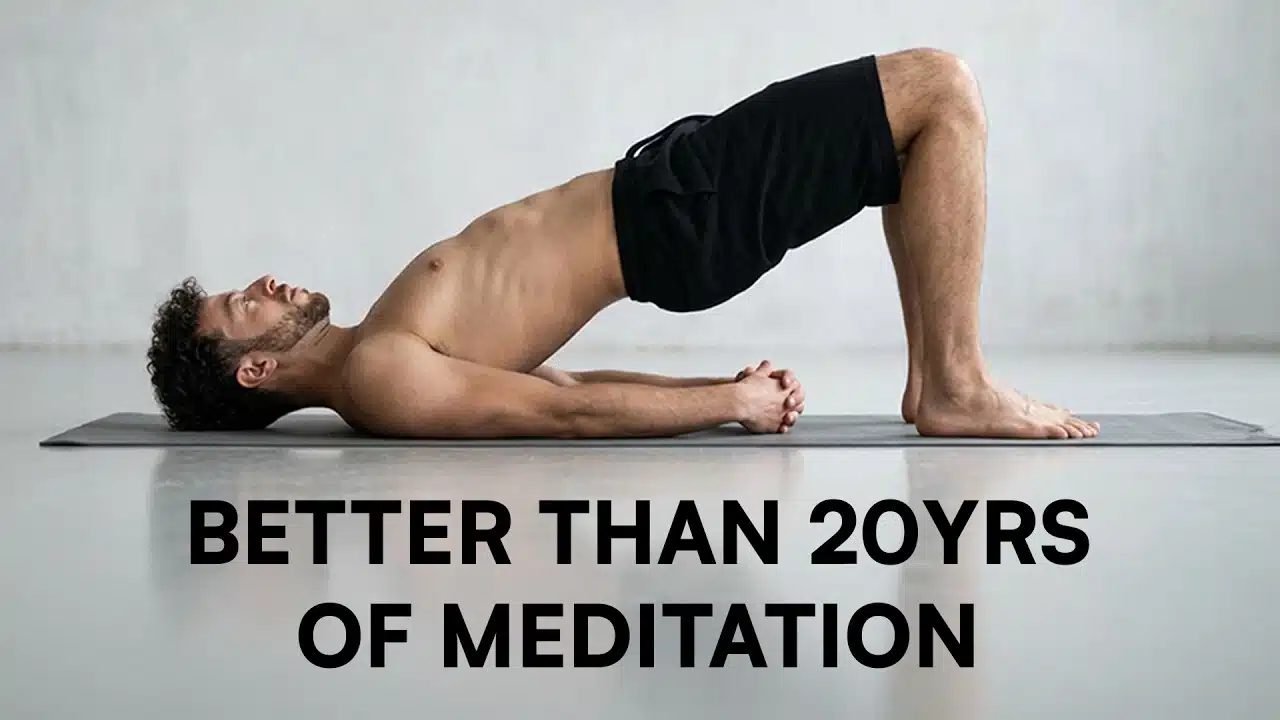
- Hip raise position on the floor where tremoring naturally activates
The practice involves subtle adjustments to leg position and hip angle to find the “sweet spot” where tremoring begins.
This tremoring is borderline voluntary-involuntary, similar to breathing—you can consciously influence it, but it can also run somewhat automatically.
Stanley Rosenberg Vagal Exercises
Christina recommended layering three additional vagal maneuvers onto standard TR practice:
- Basic exercise: Interlace fingers behind head, move eyes all the way to one side, hold until you get a vagal response (tearing up or yawning), then repeat on the other side
- Crossed low arm angle movement: Similar eye movement with arm positioning at progressively higher angles
- Salamander exercise: Combines eye movement with lateral spine tilts to open rib cage capacity for deeper breathing and enhanced parasympathetic activation
Important Safety Considerations
Yousef strongly emphasizes that if you’ve experienced significant trauma or feel uncertain about opening what he calls “Pandora’s box,” work with a trained practitioner.
Trauma responses and coping strategies exist for important reasons—they help you function day-to-day.
Releasing too much too quickly without proper support and a roadmap can be destabilizing or even dangerous.
He recommends giving the practice a fair trial—approximately two to six hours of total practice time—before deciding whether it’s working.
Individual sessions vary wildly in intensity based on what’s present that particular day.
Some sessions feel like barely anything is happening, while others involve significant activity.
Redefining Trauma Beyond PTSD
Yousef believes the name “Trauma Release Exercise” actually does the practice a disservice.
His initial objection to trying it was thinking, “It’s for traumatized people—not something I need.”
He now defines trauma much more broadly as accumulated gunk—the buildup of psychological and physical sediment over time.
This exists on a spectrum from countless micro-stressors to significant life events.
What trauma does is print past reactions onto your present without permission.
You react according to programming rather than consciously choosing how the adult version of you wants to respond.
This constant vigilance against threats that may no longer exist is extraordinarily energy-draining.
Trauma isn’t malicious—it served a protective function, instructing you how to behave when future threats appear.
But until you integrate those lessons, they continue reprinting onto daily experience even when no longer serving you.
Why This Isn’t Like Social Media Releases
Yousef directly addresses the theatrical releases often shown on social media—people in Bali or Peru having dramatic emotional releases, vomiting, or intense crying.
His experience has been nothing like that.
I think that stuff is just for social media. What happens is that creates this expectation where you see people on Reddit forums saying, ‘Hey, I did five minutes of TR and nothing happened.’ Like, yeah, of course. You do five minutes of anything and you’re not going to see much.
Real progress happens through consistency over time, not dramatic single sessions.
His two years of daily practice produced measurable changes in recovery scores, HRV, emotional regulation, and relationship to thoughts—but nothing resembling social media spectacle.
The Helium Balloon Model Of Consciousness
Michael Singer describes the human soul as a helium balloon.
As you untether yourself and clear accumulated weight, you naturally drift toward higher states of joy and freedom.
The critical insight: you’re the one who put those tethers there.
You’re blocking yourself.
TR, in Yousef’s experience, is the most effective method he’s found for clearing those accumulated blockages and letting natural capacities re-emerge.
It’s not about adding something new or learning complex techniques.
It’s about removing what’s covering up what was always there—the silence Christina described that was “always already here” beneath the static noise.
For knowledge workers, lawyers, doctors, and others who spend most of their time “in the mind-brain space,” practices focused exclusively on mental techniques may have natural limitations.
Neglecting what’s happening in the body means leaving an entire dimension of accumulated tension unaddressed.
Yousef’s two-year journey suggests that for some practitioners, this physical dimension might be exactly what’s been missing all along.