Most people attack visceral fat the wrong way.
They slash calories, skip meals, and wonder why progress stalls after a few weeks.
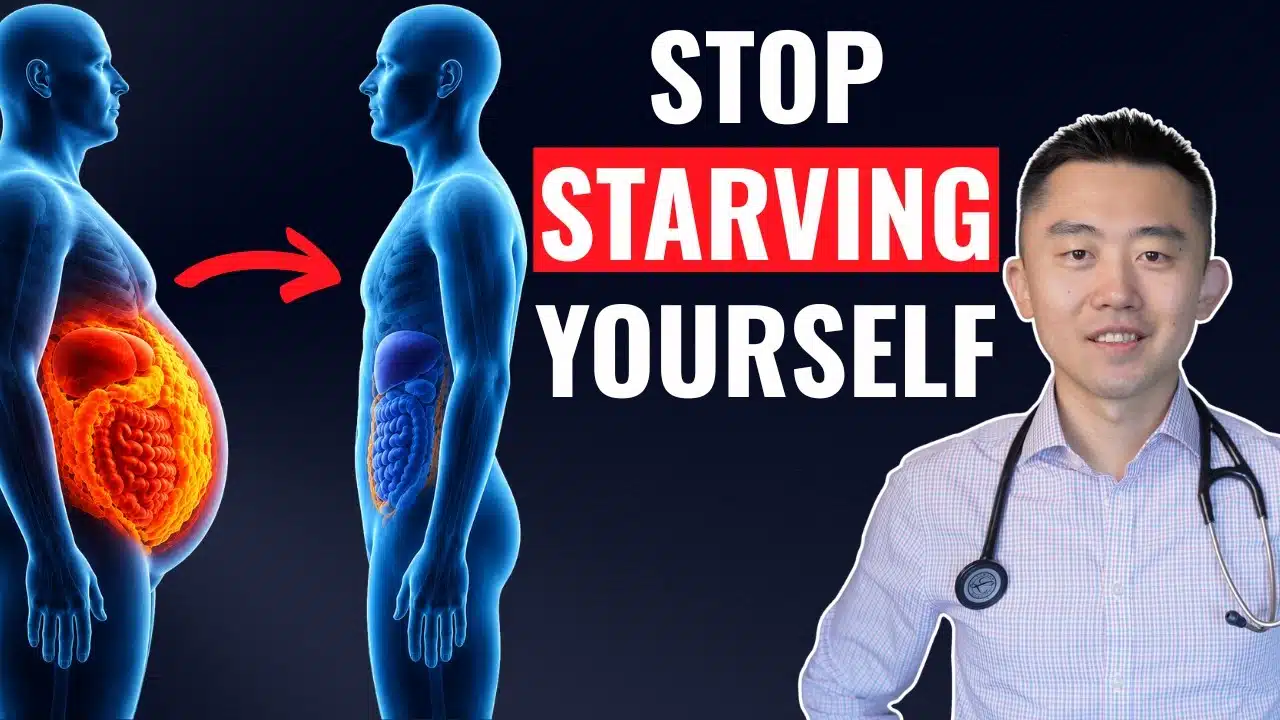
Dr. Len Kim, a double board-certified physician, explains that caloric restriction hits a ceiling—and the data proves it.
In a recent video, he revealed a protocol that targets visceral fat through three biological mechanisms, combined with strategic exercise, capable of cutting visceral fat nearly in half in just eight weeks.
Jump to:
Why Calorie Cutting Alone Fails Against Visceral Fat
Caloric restriction works initially, but your body eventually fights back.
As weight drops, metabolism slows down. Body temperature decreases. Hunger intensifies. Movement reduces without conscious awareness.
You just got to cut the calories. And that works to an extent, but the data shows something that completely flips that approach.
Dr. Kim explains this is an evolutionary survival mechanism. Your body perceives fat loss as a threat and defends against further weight loss by conserving energy.
Visceral fat differs from regular belly fat. It wraps around internal organs like the liver, pancreas, and stomach, pumping out inflammatory signals that disrupt hormones and create a self-reinforcing loop.
This type of fat contributes to type 2 diabetes, heart disease, cancer, and even dementia.
Mechanism #1: Breaking the Inflammation Cycle
Visceral fat actively inflames itself.
Fat cells release inflammatory molecules like TNF-alpha and interleukin-6, creating a feedback loop where inflammation makes fat more resistant to breakdown.
Visceral fat in a sense protects itself by staying inflamed but when you bring that inflammation down you actually break that cycle.
Lever One: Omega-3 Fatty Acids
Walnuts provide alpha-linolenic acid (ALA), a plant-based omega-3 that directly calms inflammatory signals from visceral fat.
Fatty fish like salmon, sardines, and mackerel deliver EPA and DHA, which improve insulin sensitivity and help with fatty liver.
Lever Two: Polyphenols
Walnuts also contain polyphenols that shift metabolism toward burning energy rather than storing it.
A randomized controlled trial compared three groups: a standard healthy diet, a standard Mediterranean diet, and a “greener” polyphenol-rich Mediterranean diet.
Both Mediterranean groups received a small handful of walnuts daily (about 28 grams or one-fourth cup). However, the greener version added green tea, a mankai shake, and reduced processed and red meat.
The greener group lost almost double the visceral fat compared to the regular Mediterranean group—despite eating the same number of calories.
This demonstrates that food quality changes how your body processes and stores energy, independent of calorie counts.
Since mankai (a marine plant) isn’t readily available in most places, Dr. Kim recommends pushing nutrition toward polyphenol-rich foods like leafy greens and berries while ensuring adequate protein intake elsewhere.
Mechanism #2: Reversing Insulin Resistance
Insulin resistance forces your pancreas to pump out more insulin to clear excess glucose.
Chronically elevated insulin directly promotes fat storage, especially around organs. People with insulin resistance disproportionately accumulate abdominal and visceral fat even without changing calorie intake.
Broccoli Sprouts: The Most Underrated Food
Broccoli sprouts contain sulforaphane, which activates the NRF2 pathway—an internal control center for inflammation and oxidative stress.
When NRF2 activates, it triggers genes that protect mitochondria and reduce cellular inflammation. Sulforaphane also signals the liver to slow gluconeogenesis (glucose production), improving blood sugar control from two directions simultaneously.
Why sprouts instead of regular broccoli? Broccoli sprouts contain 20 to 100 times more sulforaphane precursors than mature broccoli.
A small handful of sprouts delivers more sulforaphane than an entire head of broccoli.
Dr. Kim recommends about half a cup daily, eaten raw in salads or blended into smoothies. Since sulforaphane clears your system quickly, eating small amounts daily works better than large portions once weekly.
Some grocery stores carry broccoli sprouts near herbs and microgreens, but availability varies. They’re easy to grow at home using just a mason jar and sprouting seeds—ready in about five days at a fraction of store prices.
Other High-Yield Foods for Insulin Sensitivity
- Dark chocolate (85% cacao or higher)
- Berries of all varieties
- Fermented foods like kimchi and sauerkraut
Each works through different pathways to improve insulin signaling.
Mechanism #3: Activating Fat-Burning Pathways
Breaking inflammation and fixing insulin signaling aren’t enough. Your body needs signals to actually burn stored fat.
Extra virgin olive oil activates two critical pathways through its polyphenols.
First, the AMPK pathway—your body’s energy sensor—signals cells to pull from fat stores for fuel.
Second, the SIRT1 pathway improves mitochondrial efficiency, especially in muscles. Your body receives signals to burn fat and gets better at executing the process.
A double-blind randomized controlled trial published in the European Journal of Nutrition compared extra virgin olive oil to soybean oil.
Both groups consumed identical calories with the same deficit. The olive oil group lost 80% more body fat than the soybean oil group—with just 25 milliliters daily (about 1.5 tablespoons).
Same calories and same deficit, but completely different outcomes because olive oil was telling the body to burn more fat.
Calorie quality matters as much as calorie quantity.
The Exercise Multiplier: How to Lose Visceral Fat Nearly 50% Faster
Adding exercise compounds results dramatically.
A meta-analysis of 84 studies compared every major exercise type to identify which ones actually reduce visceral fat. Higher-intensity exercises came out on top—specifically vigorous-intensity aerobic exercise and high-intensity interval training.
A study published in Diabetes Care demonstrated the power of this approach.
Participants performed just two 45-minute cycling sessions weekly at moderate to vigorous intensity, plus one additional intermittent training session—three total sessions per week.
Results? Visceral fat reduced by 48% in just eight weeks. Subcutaneous fat dropped by 18%.
Fascinatingly, participants lost nearly half their visceral fat while the scale stayed almost the same.
We can’t live and die by the scale because it’s a pretty poor metric of progress when it comes to visceral fat.
What Intensity Should You Aim For?
Most studies examine moderate to vigorous intensity—at least 40 to 60% of maximum heart rate reserve.
Smartwatches and fitness trackers can calculate this in real time, though medications like beta-blockers may affect accuracy. Heart rate zones aren’t standardized between manufacturers either.
The talk test offers the simplest tracking method. You’re in moderate intensity if you can talk comfortably in phrases or short sentences but feel slightly winded. Another benchmark: you can talk but cannot sing.
Moderate intensity doesn’t mean sprinting. For beginners, this could be a brisk walk, walking uphill, or cycling at a steady pace.
Studies showing the best results had participants ramp up gradually over weeks or months—not jump to full intensity immediately. Gradual progression prevents injury.
Anyone with heart conditions should consult their doctor about appropriate intensity levels.
Dose-Dependent Fat Loss
A study in the British Journal of Sports Medicine revealed something game-changing about exercise and visceral fat.
With exercise, the more you do, the more visceral fat you lose—in a dose-dependent manner. But with caloric restriction, researchers saw no such response.
Caloric restriction has a ceiling. Exercise doesn’t.
You don’t need to starve yourself. Target the right foods Dr. Kim outlined and aim for a small calorie deficit. To accelerate progress, increase aerobic exercise and intensity.
Practical Exercise Protocol
- Frequency: Two to three sessions per week
- Duration: 45 minutes per session
- Type: Any exercise, as long as it incorporates intensity
- Most important: Consistency
A slow 20-minute walk done daily beats an all-out 60-minute HIIT session done once weekly.
The Complete Protocol
Dr. Kim’s approach targets visceral fat through three mechanisms simultaneously:
- Break the inflammation cycle with omega-3s (walnuts, fatty fish) and polyphenols (leafy greens, berries)
- Reverse insulin resistance with broccoli sprouts, dark chocolate, and fermented foods
- Activate fat-burning pathways with extra virgin olive oil
Layer exercise on top—moderate to vigorous intensity, two to three times weekly—and results compound rapidly.
The data shows visceral fat loss of up to 48% in eight weeks is achievable without extreme calorie restriction.
Quality matters more than quantity. The right foods send the right signals. Movement has no ceiling for visceral fat loss.
And perhaps most importantly: the scale doesn’t tell the whole story.