Bulletproof Coffee became one of the most explosive health trends of the 2010s, convincing millions to drop butter into their morning brew.
The brand rocketed to over $100 million in annual revenue, backed by venture capitalists who believed they were building the next billion-dollar empire.
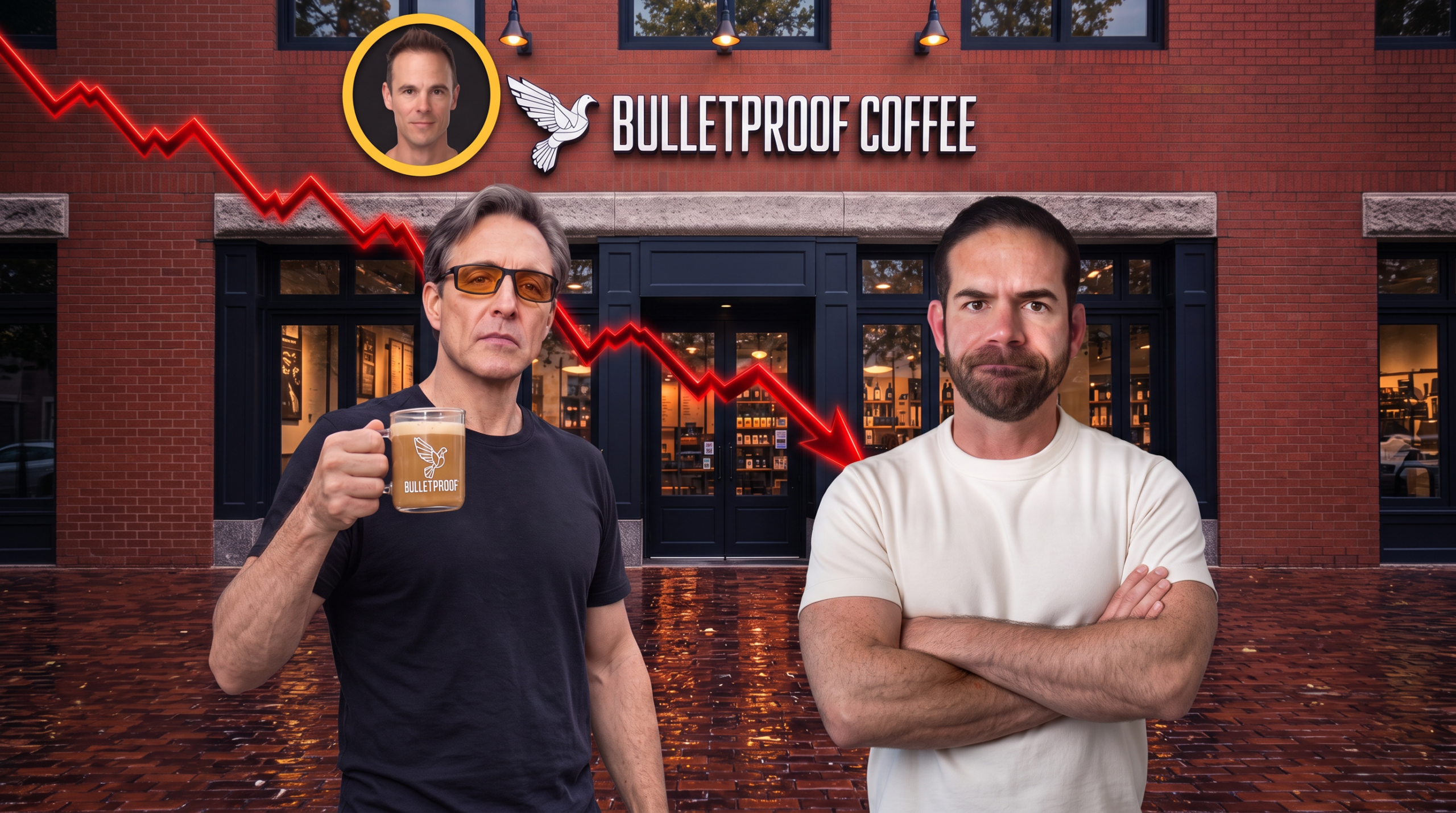
Then founder Dave Asprey was pushed out, sales tumbled, lawsuits flew, and the company was sold for an undisclosed sum that insiders won’t discuss publicly.
But the story doesn’t end there—the new owners have pulled off something unexpected, returning the brand to profitability by going back to the basics that made it great in the first place.
Jump to:
- Dave Asprey Built an Audience Before He Sold a Single Bean
- The Perfect Product for a Passionate Audience
- Big Money, Bigger Risks
- Ready-to-Drink Success and Rapid Expansion
- Too Wide, Too Fast
- Dave Steps Down—Then Gets Pushed Out
- The Unexpected Comeback
- What Entrepreneurs Can Learn from Bulletproof’s Rise and Fall
- The Bottom Line
Dave Asprey Built an Audience Before He Sold a Single Bean
You can’t understand Bulletproof without understanding its eccentric, ambitious founder.
Dave Asprey became a master at grabbing attention by making bold, counterintuitive claims that sparked debates across the wellness world.
I said, “You know, this probably isn’t a good idea if I’m going to live to 180.” So, 180? That’s my goal.
He coined the term “biohacker,” wrote two New York Times bestsellers with over 50 million copies sold, and hosted the number one health and fitness podcast.
But beyond attention-grabbing headlines, Asprey knew how to engage people and convert them into raving fans by giving them one simple action: add butter and MCT oil to your coffee and see how you feel.
That free habit hack became the gateway to a nine-figure business.
Jordan, an early employee, remembers the energy in those early days vividly.
It was, I guess, somewhat classic startup. Where it’s just everybody’s excited, the brand was on fire. It very much felt like a family. I mean, I got hired as a junior marketing assistant, kind of like a glorified paid intern. And I was like, “Dude, I’ll scrub toilets to work for that company.” I was so into it, loved the podcast, Bulletproof Coffee changed my life.
The Perfect Product for a Passionate Audience
Asprey didn’t just build buzz—he launched products his audience was already hungry for.
Three things made Bulletproof’s product strategy nearly perfect:
- Clear target person: Self-identified biohackers looking for an edge
- Obvious difference: Mold-free, lab-tested coffee beans—a problem no one knew existed until Asprey highlighted it
- Gateway to more purchases: Buy the beans, then grab the grass-fed ghee and upgraded MCT oil
Crucially, Bulletproof wasn’t taking wild risks in the early days.
Coffee is a massive market. Butter is a massive market. MCT oil was niche but growing fast.
The combination of a passionate audience and products they already wanted created explosive growth.
Big Money, Bigger Risks
In 2015, Bulletproof raised $9 million from Trinity Ventures, an early Starbucks investor.
But instead of pouring capital into scaling proven winners like coffee beans and MCT oil, the company made a pivot.
So, $9 million is enough for us to put some coffee shops in key markets just to show people how different they can feel.
Bulletproof opened cafes in Santa Monica, Seattle, and a few other locations with the vision of becoming “the Starbucks for the mind and body.”
The cafes were cool. The vibe was right. But cool doesn’t always mean profitable.
The company only ever opened three cafes total—far from the nationwide chain investors envisioned.
Fatwater: A Product Nobody Asked For
Around the same time, Bulletproof launched Fatwater, a flavored water infused with MCT oil designed to capitalize on the keto craze.
Jordan recalled the internal excitement.
It seemed like the sentiment was, “Dude, this is exciting. Like Fatwater, that’s very disruptive. It’s capitalizing on the keto movement and MCT oil.” And so, there’s a lot of excitement and a lot of optimism around it.
But excitement doesn’t always translate to sales.
Fatwater flopped. Neither the cafes nor Fatwater took off, but the core business—coffee, butter, MCT oil—kept the ship afloat.
Lesson: Money can make good ideas happen faster, but it can also accelerate bad ideas failing. Use capital to amplify what’s working, not to fund unproven experiments.
Ready-to-Drink Success and Rapid Expansion
In 2017, Bulletproof raised $19 million in a Series B led by Cavu, a beverage-focused investment group behind Vitamin Water and Poppi.
They pivoted away from Fatwater and launched a ready-to-drink Bulletproof Coffee at Whole Foods in September 2017.
This product was a smash hit.
Whole Foods founder John Mackey, a friend of Asprey’s, championed the product internally—just as he had done with Beyond Meat.
Bulletproof became the number one ready-to-drink coffee at both Whole Foods and Sprouts.
Sales soared. Investors doubled down.
In 2018, Bulletproof raised a $40 million Series C from Trinity and Cavu—this time including debt financing alongside equity.
Debt isn’t inherently bad. For a growing company, it can be rocket fuel.
But if growth stalls, debt becomes a death sentence.
Too Wide, Too Fast
By 2019, Bulletproof had expanded into over 20,000 retail stores.
They also launched a dizzying array of new products:
- Collagen protein
- Protein bars
- Gummies
- Supplements
- Cryotherapy services
- Red light therapy
- The Bulletproof Vibe—a $1,500 vibrating plate
Jordan noticed the shift.
He was so prolific in his ideas and in his desire to pump out products and to innovate, and it’s what the brand was known for. But then when you’re trying to get into retail, and that’s a lot of where my world was, it’s like, well, it’s a little all over the place. And when you’re trying to scale with 100 products versus five to 10 core products, it just gets a little convoluted.
Not every product was a bad idea—the bars were great—but spreading focus across dozens of SKUs diluted the brand’s power.
The founder couldn’t throw his full weight behind every launch. Some products thrived. Others vanished without a trace.
When a brand moves too wide too fast, that’s often the signal that decline is around the corner.
Dave Steps Down—Then Gets Pushed Out
In late 2019, Dave Asprey stepped down as CEO.
Publicly, the transition appeared friendly. Asprey helped choose his successor, a retail veteran with deep CPG experience.
It was very much a welcome transition. The brand had done just generally so well up to that point. I distinctly remember the call where Dave announced the new CEO, and he seemed like a great guy. It felt like a very positive experience. It didn’t feel like it had any level of Dave doesn’t want to leave, but he feels like he has to.
But shortly after, things started to unravel.
A Timeline of Trouble
- March 2020: Bulletproof received an FDA warning letter over claims made about their supplement line
- Spring 2020: The FTC sent Dave Asprey a warning letter about statements he made during the pandemic
- September 2020: Bulletproof raised $13 million from a new investor, Believe, based in Guatemala
- Late 2020: Asprey was removed as executive chairman
- 2022: Asprey launched Danger Coffee, a clear competitor to Bulletproof
- 2023: Asprey sued his former investors, alleging they conspired to dilute his equity and oust him
- 2024: Bulletproof was sold to Believe for an undisclosed sum
Dave built his audience by making bold, controversial claims. During the pandemic, that approach put him under federal scrutiny.
Investors likely viewed him as a liability. Somewhere in this timeline, his ownership was diluted to the point where he lost control of his own company.
Once the charismatic founder who drove sales was muzzled—or removed entirely—sales predictably declined.
The final investor, Believe, was left holding the bag and either bought the company for pennies or foreclosed on the assets.
The Unexpected Comeback
When a founder-led brand loses its founder, the usual outcome is a slow death spiral.
But Bulletproof’s new owners pulled off something surprising.
In early 2025, new CEO Harry Lewis—formerly of Anheuser-Busch—told Modern Retail that the company had returned to profitability for the first time ever.
How?
By going back to basics.
- Simplified the product line
- Focused on coffee with one added ingredient
- Doubled down on retail distribution
- Secured a deal with Costco
They stripped away the distractions—no more vibrating plates, no more sprawling supplement lines—and rebuilt around what originally worked.
You’ll never replace the firepower of a charismatic founder with millions of loyal followers, but the new team proved that focus and discipline can salvage even a crumbling brand.
What Entrepreneurs Can Learn from Bulletproof’s Rise and Fall
Lesson 1: Build the audience first, then sell them what they already want.
Bulletproof didn’t start with a product. It started with a movement. Dave Asprey cultivated biohackers for years before selling them coffee beans.
Lesson 2: Use capital to amplify what’s working, not to fund unproven experiments.
Money accelerates outcomes—good or bad. Bulletproof raised tens of millions and funneled it into cafes and Fatwater instead of doubling down on proven winners.
Lesson 3: Going too wide too fast kills focus—and focus drives growth.
Launching 100 products dilutes your brand message and splits your marketing power. Bulletproof thrived when it owned coffee, butter, and MCT oil. It struggled when it tried to own everything.
Lesson 4: Founder-led brands are powerful—but risky.
Dave Asprey’s charisma built Bulletproof. His removal nearly destroyed it. If your brand depends on one person, losing that person can be catastrophic.
Lesson 5: Debt is rocket fuel—or a death accelerant.
Debt works beautifully when growth is strong. When growth stalls, debt holders get paid first—and equity holders (like founders) get wiped out.
The Bottom Line
Bulletproof Coffee became a cultural phenomenon by doing a few things exceptionally well: building a passionate audience, launching products that audience craved, and owning a sales channel that compounded.
But when the company raised capital to fund unproven ideas, spread its focus too thin, and lost its founder, the wheels fell off.
The surprising twist? The new owners saved the brand by doing exactly what made it great in the first place: going back to basics.
For entrepreneurs, the lesson is clear: amplify what works, stay focused, and never underestimate the power—or the risk—of a founder-led brand.