Getting from 25% body fat down to 12% might sound like climbing Mount Everest when you’re juggling work deadlines, family commitments, and barely enough hours in the day.
But according to fitness professionals who work exclusively with time-strapped executives and busy fathers, it’s not only possible—it’s entirely systematic.
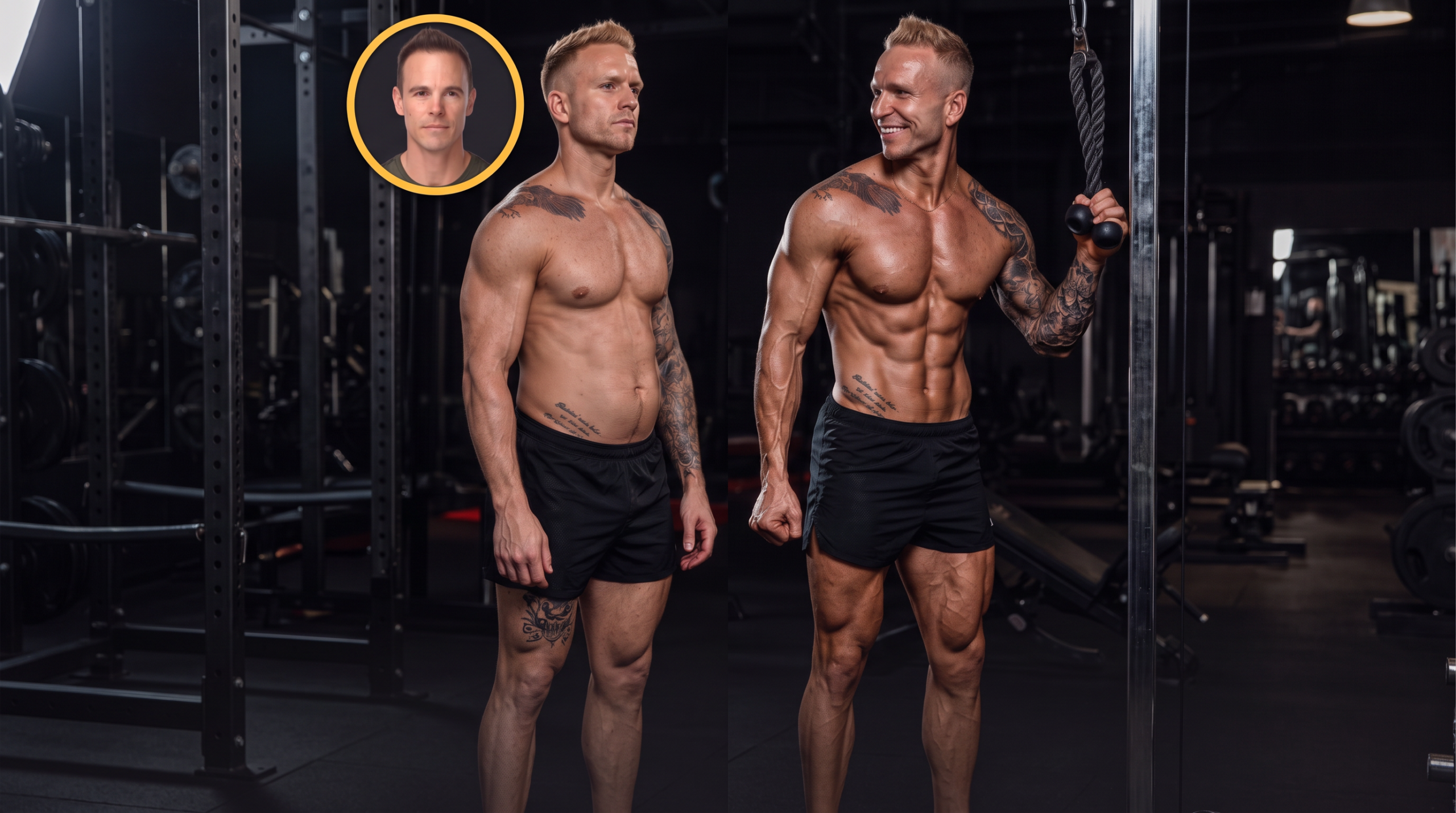
The roadmap exists, and it doesn’t require living in the gym or eating nothing but chicken and broccoli.
What it does require is a strategic approach that accounts for real life—the business trips, the client dinners, the weekends with kids, and everything else that makes traditional fitness advice feel laughably out of touch.
Jump to:
- Stop Waiting for the Perfect Time
- The Honest Starting Point: Documentation
- Set Realistic Targets (Then Double Them)
- The Calorie Foundation
- Macronutrient Breakdown: What Actually Matters
- Training: Minimum Effective Dose
- Daily Movement: The Underrated Game-Changer
- Sleep and Stress: The Silent Saboteurs
- Tracking and Adjustment: The Feedback Loop
- The Six-Month Reality
- Sources
Stop Waiting for the Perfect Time
For busy professionals in their 30s, 40s, and 50s, the excuses are always the same: too much travel, not enough time, family obligations.
The uncomfortable truth? This is your life now, and it’s likely to stay this way for the next decade or two.

If you want something simple that actually works, this is one of the most effective tools I’ve used to build strength, conditioning, and endurance without needing a full gym setup.
- Full-body training with one weight using swings, squats, and presses
- Solid cast iron build that feels stable and lasts for years
- Comfortable grip that makes high-rep workouts easier to handle
You absolutely will continue this life for the next 10, 20, 30 years. So you need to stop making excuses that you can’t get in shape and you need to start applying.
Waiting for circumstances to change is a losing strategy. The approach needs to fit the lifestyle, not the other way around.
The Honest Starting Point: Documentation
Photos That Tell the Truth
Before diving into meal plans and workout splits, documentation comes first. Take three photos—front, side, and back—in consistent lighting.
This isn’t about vanity. It’s about establishing a baseline that can’t be manipulated by wishful thinking or denial.
Forget Traditional Body Fat Testing
Those handheld scanners at gyms? The smart scales at home that promise body composition analysis?
They’re notoriously unreliable. Bioelectrical impedance devices, which most consumer body fat scales use, can vary wildly based on hydration status, meal timing, and even room temperature.
Those kind of things that you go to the gym and hold on the scanners, you know, that give you a body fat percentage, they’re crap and they will probably completely, you know, either underestimate or overestimate your body fat.
An unconventional alternative: upload photos to AI tools like ChatGPT with a prompt requesting an honest, unbiased body fat percentage estimate. While not scientifically validated, it can provide consistent tracking over time when used repeatedly in the same context.
If you want something simple that actually works, this is one of the most effective tools I’ve used to build strength, conditioning, and endurance without needing a full gym setup.
- Full-body training with one weight using swings, squats, and presses
- Solid cast iron build that feels stable and lasts for years
- Comfortable grip that makes high-rep workouts easier to handle
Set Realistic Targets (Then Double Them)
Most men drastically underestimate how much weight they need to lose. The guy who thinks he needs to drop five kilos probably needs to lose ten.
If you think you need to lose 5 kg, you need to lose 10. If you think you need to lose one stone, you need to lose two stone because we’re trying to get into good shape.
A sustainable target: 0.5 to 1% of body weight per week. For a 100-kilogram man, that’s 500 grams to one kilogram weekly—which translates to roughly 6 to 12 kilograms over 12 weeks.
Research supports this rate. A comprehensive review published in the Journal of the International Society of Sports Nutrition found that weekly weight loss of 0.5 to 1% of body weight optimizes fat loss while preserving lean muscle mass, particularly when combined with resistance training and adequate protein intake.
For busy professionals with irregular schedules, targeting the lower end—around 0.5%—makes adherence more realistic. That puts a 12-kilogram loss at approximately six months, not three.
The Calorie Foundation
Fat loss begins and ends with energy balance. Without a calorie deficit, nothing else matters—not macros, not meal timing, not training splits.
The Starting Formula
A simplified calculation: bodyweight in pounds multiplied by 10 to 12.
If you want something simple that actually works, this is one of the most effective tools I’ve used to build strength, conditioning, and endurance without needing a full gym setup.
- Full-body training with one weight using swings, squats, and presses
- Solid cast iron build that feels stable and lasts for years
- Comfortable grip that makes high-rep workouts easier to handle
For a 200-pound man, that’s 2,000 to 2,400 calories daily. The higher multiplier (12) offers more sustainability; the lower (10) creates a more aggressive deficit.
We need to know how many calories we’re consuming every day. That is the only way to lose weight because if we’re not in a calorie deficit, we’re not going to lose weight. And it is as simple as that.
While this formula provides a reasonable starting point, research on energy expenditure shows individual variation is significant. A 2021 study in the European Journal of Clinical Nutrition found that metabolic rate can vary by up to 30% between individuals of the same size, meaning formulas are useful estimates but require adjustment based on real-world results.
When Progress Stalls
If weight isn’t dropping after two weeks of consistent tracking, two levers exist:
- Reduce calorie intake by 10 to 15%
- Increase daily activity through additional steps or cardio
The second option preserves food intake, making the diet more sustainable and reducing hunger.
Macronutrient Breakdown: What Actually Matters
Protein: The Non-Negotiable
Aim for 0.8 to 1 gram per pound of target bodyweight—not current weight, but the weight you’re working toward.
For a 200-pound man targeting 180 pounds, that’s 180 grams of protein daily.
If you want something simple that actually works, this is one of the most effective tools I’ve used to build strength, conditioning, and endurance without needing a full gym setup.
- Full-body training with one weight using swings, squats, and presses
- Solid cast iron build that feels stable and lasts for years
- Comfortable grip that makes high-rep workouts easier to handle
We want to aim to consume 0.8 to 1 gram per pound of our target body weight. I always use target because I think if you just do it off your current weight right now, you actually set yourself a very high protein target.
This range is well-supported. A 2017 meta-analysis in the British Journal of Sports Medicine found that protein intakes of 1.6 grams per kilogram of body weight (roughly 0.73 grams per pound) maximized muscle retention during caloric restriction. Going slightly higher—around 1 gram per pound—offers additional satiety benefits during fat loss phases.
Why it matters: Protein has the highest thermic effect of any macronutrient, meaning your body burns more calories digesting it. It also preserves muscle mass during weight loss and dramatically improves satiety.
Fats: The Hormonal Foundation
Target 20 to 30% of total calories from fat. On a 2,000-calorie diet, that’s roughly 45 to 65 grams daily.
Dietary fat is essential for hormone production, vitamin absorption, and satiety. Too little fat—especially during sustained caloric deficits—can suppress testosterone levels, which is particularly relevant for men over 35.
Carbohydrates: Not the Enemy
Fill remaining calories with carbohydrates. They’re not inherently fattening, and they fuel training performance.
Then we move on to carbohydrates and these are not the devil. These absolutely are necessary and you’re going to want to fill the rest of your nutrition up with carbohydrates.
On a 2,000-calorie diet with 180 grams of protein and 55 grams of fat, that leaves roughly 180 grams of carbohydrates.
If you want something simple that actually works, this is one of the most effective tools I’ve used to build strength, conditioning, and endurance without needing a full gym setup.
- Full-body training with one weight using swings, squats, and presses
- Solid cast iron build that feels stable and lasts for years
- Comfortable grip that makes high-rep workouts easier to handle
Training: Minimum Effective Dose
Busy schedules demand efficiency. That means three full-body training sessions per week—no more, no less.
Two to three sessions per week. And we are going to want to be focusing on three full bodies. I’m going to say three cuz I think it’s important to get the third one in there.
Each session hits all major muscle groups: chest, back, legs, shoulders, and arms. The goal is 10 to 20 working sets per muscle group per week.
This approach is backed by research. A 2016 meta-analysis in Sports Medicine found that training each muscle group two to three times per week produced superior hypertrophy compared to once-weekly training, even when total weekly volume was equated. Full-body routines allow this frequency while minimizing time commitment.
These sessions are non-negotiable. Block them in the calendar like business meetings. Treat them with the same importance, because they are.
Daily Movement: The Underrated Game-Changer
Step count matters more than dedicated cardio sessions for fat loss. Target 10,000 to 12,000 steps daily.
If we can be consistent on a 10 to 12,000 step count every single day, fat loss becomes so much easier. And keeping the fat off becomes even easier as well.
Non-exercise activity thermogenesis (NEAT)—the calories burned through daily movement outside formal exercise—can account for several hundred calories per day. Research shows NEAT varies dramatically between individuals and can be a significant factor in weight regulation.
If you want something simple that actually works, this is one of the most effective tools I’ve used to build strength, conditioning, and endurance without needing a full gym setup.
- Full-body training with one weight using swings, squats, and presses
- Solid cast iron build that feels stable and lasts for years
- Comfortable grip that makes high-rep workouts easier to handle
Practical strategies:
- Park farther from entrances
- Take phone calls while walking
- Schedule 20-minute walking meetings
- Use lunch breaks for movement
If time allows, add 20 to 30 minutes of low-intensity steady-state cardio—walking on an incline, cycling, or using a stair climber. Keep heart rate moderate; this isn’t about crushing yourself, just accumulating calorie expenditure.
Sleep and Stress: The Silent Saboteurs
This is where busy professionals typically crater. Poor sleep elevates cortisol—the stress hormone that promotes fat storage and muscle breakdown.
You will have much higher cortisol from poor sleep. High cortisol means that your body will hold on to body fat more and break down muscle tissue.
Target 7 to 9 hours nightly. If that seems impossible, audit your calendar ruthlessly. Sleep isn’t negotiable—it’s a performance enhancer.
The research here is clear and consistent. A 2010 study in Annals of Internal Medicine found that dieters who slept 5.5 hours per night lost 55% less fat and 60% more lean body mass compared to those sleeping 8.5 hours, despite identical caloric restriction. Sleep deprivation also increases ghrelin (hunger hormone) and decreases leptin (satiety hormone), making adherence exponentially harder.
Sleep hygiene essentials:
If you want something simple that actually works, this is one of the most effective tools I’ve used to build strength, conditioning, and endurance without needing a full gym setup.
- Full-body training with one weight using swings, squats, and presses
- Solid cast iron build that feels stable and lasts for years
- Comfortable grip that makes high-rep workouts easier to handle
- Consistent sleep and wake times
- Phone out of the bedroom
- Complete darkness
- Cool room temperature
Chronic stress from work compounded by inadequate sleep creates a metabolic environment hostile to fat loss. You cannot outrain five hours of sleep and chronic stress, no matter how perfect your nutrition or training.
Tracking and Adjustment: The Feedback Loop
Daily weigh-ins provide more useful data than weekly checks. Weight fluctuates naturally due to water retention, sodium intake, training stimulus, and stress.
Look at weekly averages, not individual readings. If the trend hasn’t moved in 7 to 10 days—and adherence has been solid—make a small adjustment:
- Reduce calories by 100 to 200
- Add 1,000 to 2,000 daily steps
- Insert one additional cardio session
You don’t want to make changes out of panic. You only want to make them because of the data. If you can honestly say that you’ve done everything this week, and you tracked and you measured everything to a good standard.
Prioritize increasing activity over decreasing food when possible. Higher calorie intakes are more sustainable long-term and preserve metabolic rate better than aggressive restriction.
The Six-Month Reality
For busy professionals, thinking in 12-week transformations sets up failure. Plan for five to six months of consistent effort.
Some weeks will include business travel. Others will feature client dinners or family commitments that derail perfect adherence. That’s not failure—that’s reality.
If you want something simple that actually works, this is one of the most effective tools I’ve used to build strength, conditioning, and endurance without needing a full gym setup.
- Full-body training with one weight using swings, squats, and presses
- Solid cast iron build that feels stable and lasts for years
- Comfortable grip that makes high-rep workouts easier to handle
Building a sustainable approach that accounts for real life beats a perfect plan that collapses under the first bit of pressure.
The framework is simple:
- Document starting point with photos and measurements
- Set realistic targets (0.5 to 1% bodyweight loss weekly)
- Calculate calories (10 to 12 x bodyweight in pounds)
- Prioritize protein (0.8 to 1g per pound of target weight)
- Train three times weekly with full-body sessions
- Accumulate 10,000+ daily steps
- Protect 7+ hours of sleep
- Track weekly and adjust based on data
Nothing in this approach requires perfection. It requires consistency, honesty, and the understanding that health isn’t something you achieve once your schedule clears up—because that day never comes.
Your calendar won’t fix itself. Your body won’t either.
Sources
- Journal of the International Society of Sports Nutrition – weekly weight loss rates and muscle preservation: https://jissn.biomedcentral.com/articles/10.1186/s12970-017-0174-y
- European Journal of Clinical Nutrition (2021) – individual metabolic rate variation: https://www.nature.com/ejcn/
- British Journal of Sports Medicine (2017) – protein intake meta-analysis: https://bjsm.bmj.com/content/52/6/376
- Sports Medicine (2016) – training frequency meta-analysis: https://link.springer.com/article/10.1007/s40279-016-0543-8
- Annals of Internal Medicine (2010) – sleep deprivation and fat loss: https://www.acpjournals.org/doi/10.7326/0003-4819-153-7-201010050-00006