Rounded shoulders aren’t just an aesthetic problem.
They’re a structural imbalance that can derail shoulder health, limit strength gains, and sabotage physique development—especially for lifters who’ve spent years hammering chest and front delts without balancing the equation.
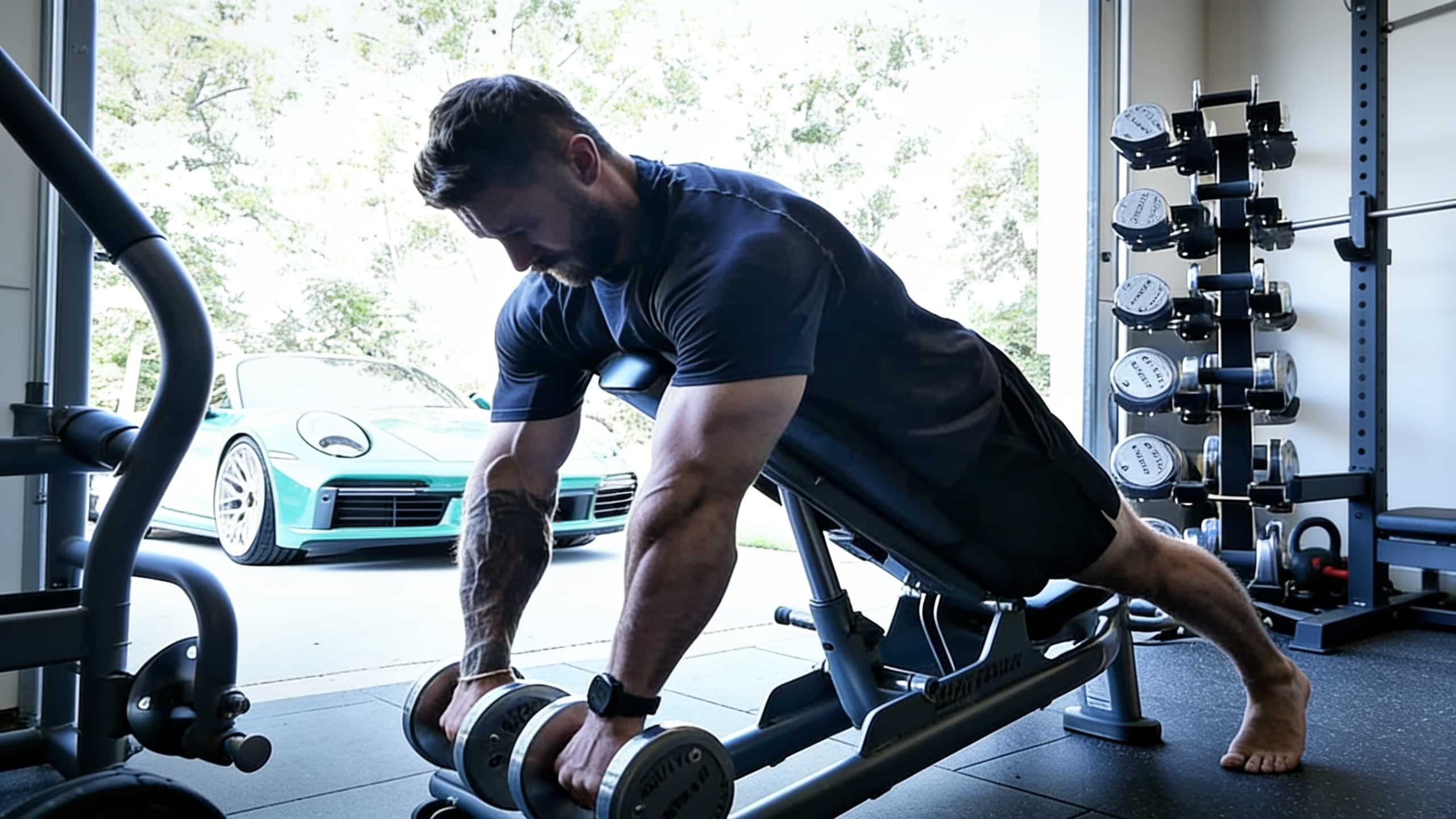
Chris Bumstead, the 6-time Mr. Olympia Classic Physique champion, has publicly discussed his own battles with shoulder pain and posture issues, and the training adjustments he made to correct them.
One exercise consistently highlighted in discussions of rear delt development and posture correction is the incline prone dumbbell rear delt fly—a movement that isolates the chronically undertrained posterior deltoid and directly addresses the muscular imbalance causing rounded shoulders.
Jump to:
Why Rounded Shoulders Happen in the First Place
Most gym-goers unknowingly create postural dysfunction through their own programming.
Bench press, overhead press, and push-ups dominate training splits. These movements overdevelop the chest and anterior deltoids while leaving rear delts, rhomboids, and lower traps woefully behind.
The result? Scapular protraction—shoulders that roll forward, creating that hunched, internally rotated look that screams “desk job” even if someone trains five days a week.
Reddit fitness communities consistently flag rear delt neglect as one of the most common training mistakes among intermediate lifters. The rear deltoid is the smallest and most overlooked head of the three-part shoulder muscle, yet it plays an outsized role in shoulder stability and postural alignment.
The Anatomy of the Fix
Correcting rounded shoulders requires strengthening what’s weak, not just stretching what’s tight.
While pec stretches and doorway hangs provide temporary relief, they don’t address the root cause: underdeveloped posterior chain musculature that can’t counterbalance anterior dominance.
Rear delts, rhomboids, and lower traps need direct, consistent stimulus to pull shoulders back into proper alignment. That’s where isolation work becomes non-negotiable.
CBum’s Training Philosophy: Light Weight, Full Contraction
Chris Bumstead has been vocal about his shift away from ego lifting.
In a September 2024 Gymshark breakdown of his back workout, CBum emphasized time-under-tension, full range of motion, and mind-muscle connection over chasing heavy loads. This philosophy extends to his rear delt work.
I’m not trying to move the most weight. I’m trying to feel every rep, get a full contraction, and make the muscle do the work—not my momentum.
That approach is exactly what makes rear delt isolation effective. Using lighter dumbbells and focusing on contraction quality allows lifters to target the posterior deltoid without compensating through traps or lower back.
The Incline Prone Dumbbell Rear Delt Fly: Exercise Breakdown
This movement is a staple isolation exercise for posterior deltoid development.
Here’s how it works:
- Setup: Set an incline bench to 30–45 degrees. Lie face-down with chest supported against the pad.
- Grip: Hold light dumbbells (5–15 lbs for most lifters) with arms nearly straight, slight bend in elbows.
- Movement: Drive dumbbells back toward hips—not out to the sides—while squeezing shoulder blades together at the top.
- Tempo: Slow, controlled eccentrics. Hold contraction for 1–2 seconds at the top.
- Volume: 3–4 sets of 12–15 reps, prioritizing feel over load.
The incline bench eliminates body English and momentum, forcing rear delts to do all the work. Unlike standing bent-over flies, there’s no cheating with hip drive or lower back extension.
Why the Angle Matters
Driving dumbbells back toward the hips rather than straight out to the sides shifts emphasis heavily onto the posterior deltoid and away from the middle trapezius.
This subtle cue—emphasized in CBum’s documented training philosophy—maximizes rear delt activation while minimizing compensatory recruitment from surrounding musculature.
Does One Exercise Really Fix Posture?
Not entirely—but it’s a critical piece.
Physical therapists and sports medicine specialists consistently emphasize that posture correction requires a multi-pronged approach: mobility work, daily habit modification (especially for desk workers), and strengthening antagonist muscles.
However, rear delt training is arguably the most underutilized tool in that toolbox. Most lifters stretch their pecs religiously but never directly strengthen the muscles responsible for scapular retraction.
Adding 10 minutes of rear delt isolation work three times per week can produce noticeable postural changes within 4–6 weeks, particularly when combined with reduced pressing volume or balanced push-pull ratios.
CBum’s Own Shoulder Pain Journey
Chris Bumstead has openly discussed struggling with shoulder pain and posture issues earlier in his career.
An Instagram reel titled “How CBum Fixed His Shoulder Pain (Posture Routine…)” suggests he implemented specific corrective strategies—likely including rear delt prioritization—to address structural imbalances caused by years of heavy pressing.
His current training philosophy reflects lessons learned: lighter weights, better contractions, smarter exercise selection.
Programming Rear Delt Work Into Your Split
Rear delts recover quickly and can be trained 2–3 times per week without overtraining.
Here’s how to integrate incline prone rear delt flies strategically:
- Back day: Superset rear delt flies with rows or pulldowns for upper back synergy.
- Shoulder day: Finish with rear delt isolation after overhead pressing to restore balance.
- Accessory day: Pair with face pulls, band pull-aparts, or reverse pec deck for comprehensive posterior chain work.
CBum’s documented back workout from Gymshark includes T-bar rows with chest support—an exercise that indirectly hammers rear delts while building thickness. Pairing compound rows with direct isolation creates a complete posterior development strategy.
Common Mistakes to Avoid
Even with perfect exercise selection, execution errors sabotage results.
- Using too much weight: Rear delts are small muscles. Going heavy recruits traps and rhomboids, diluting stimulus.
- Flaring elbows out: Driving dumbbells toward hips—not straight out—keeps tension on rear delts.
- Rushing reps: Explosive concentrics and uncontrolled eccentrics waste time under tension.
- Skipping the squeeze: The contraction at the top is where rear delts grow. Hold it.
The Celebrity Workout Phenomenon
Attaching Chris Bumstead’s name to this exercise dramatically increases its perceived legitimacy.
Sports psychologists and branding experts note that celebrity-adjacent workout marketing—whether fully verified or not—leverages social proof and aspirational identity to drive engagement and adherence.
Even if CBum doesn’t personally perform this exact variation with these precise parameters, the exercise itself is anatomically sound, aligns with his documented training philosophy, and addresses a widespread structural problem among lifters.
Beyond Aesthetics: Functional Benefits
Stronger rear delts don’t just improve posture—they reduce injury risk.
Shoulder impingement, rotator cuff strain, and chronic upper back pain often stem from anterior-posterior imbalances that rear delt training directly corrects.
Lifters who prioritize rear delt work report better bench press lockout strength, improved overhead pressing mechanics, and reduced shoulder discomfort during heavy training cycles.
For desk workers who lift, rear delt isolation becomes prehab—a proactive strategy for counteracting 8+ hours of hunched sitting with targeted muscular reinforcement.
The Bottom Line
Rounded shoulders won’t fix themselves.
The incline prone dumbbell rear delt fly—whether or not it’s definitively “CBum’s exercise”—is a proven, accessible tool for correcting the muscular imbalances that cause scapular protraction and forward shoulder posture.
Pair it with intelligent programming, reduced pressing volume, and consistent execution, and postural improvements follow within weeks.
Chris Bumstead’s training evolution—from ego lifting to mind-muscle mastery—offers a blueprint worth following. Light weight, full contraction, relentless consistency.
That’s how champions build shoulders that don’t just look impressive—they function flawlessly under load.