Dr. Jason Fung is challenging mainstream cardiology with a provocative claim: cholesterol just isn’t that important.
In a recent video, the nephrologist and bestselling author argues that the new 2025 American Heart Association lipid guidelines are fundamentally misguided—and that we’re medicalizing the majority of healthy adults for minimal benefit.
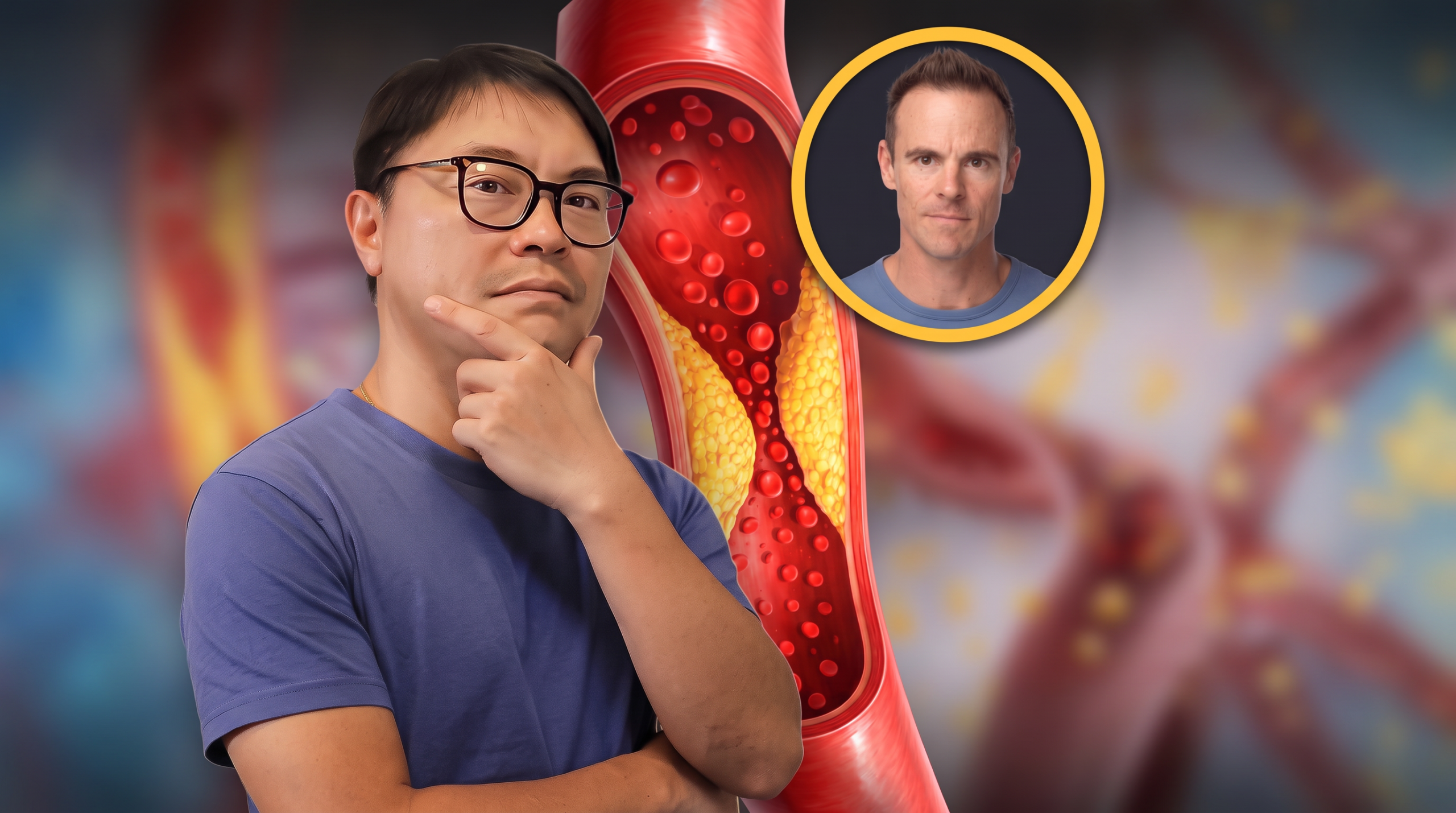
His argument centers on comparing cholesterol to other cardiovascular risk factors like diabetes and smoking, and what he found may surprise you.
But does the broader research support his position, or is he downplaying a legitimate health concern?
Jump to:
The New Guidelines Would Put Most Adults on Medication
According to Dr. Fung, the 2025 AHA guidelines represent a dramatic expansion of who should be screened and treated for high cholesterol.
They call for screening children as young as 9 to 11 years old, regular testing every five years starting at age 20, and much stricter LDL targets—as low as 55 to 100 mg/dL in some cases.

If you want something simple that actually works, this is one of the most effective tools I’ve used to build strength, conditioning, and endurance without needing a full gym setup.
- Full-body training with one weight using swings, squats, and presses
- Solid cast iron build that feels stable and lasts for years
- Comfortable grip that makes high-rep workouts easier to handle
They also suggest that when you find the cholesterol being high or LDL, that you treat it very aggressively, mostly with drugs. And that you can’t wait and watch. It could be dangerous.
He points to research published in JAMA showing that applying these guidelines would mean treating 56.5% of adults aged 30 to 79.
By age 60 to 69, that number climbs to 85%. By age 70 and beyond, it hits 93%.
Basically, the guidelines are saying you should just put this stuff in the water, right? Give it to everybody because that’s what you’re going to do. Over 21 million people are going to be added to the rolls of medicated for cholesterol.
Dr. Fung calls this approach “moronic,” arguing it reflects an echo chamber of cholesterol hysteria rather than sound science.
How Important Is LDL Cholesterol as a Risk Factor?
Dr. Fung doesn’t deny that LDL cholesterol is a risk factor for heart disease. His question is: how important is it compared to everything else?
To answer this, he turns to something called the hazard ratio—a statistical measure that compares disease risk in people with and without a given risk factor.
A hazard ratio of 1.0 means no effect. A ratio of 2.0 means double the risk.
If you want something simple that actually works, this is one of the most effective tools I’ve used to build strength, conditioning, and endurance without needing a full gym setup.
- Full-body training with one weight using swings, squats, and presses
- Solid cast iron build that feels stable and lasts for years
- Comfortable grip that makes high-rep workouts easier to handle
Comparing Risk Factors Using AHA’s Own Data
Dr. Fung references the AHA’s own PREVENT calculator, which was developed using data from over 6 million patients across 45 studies.
Here’s what the hazard ratios reveal:
- Diabetes: Hazard ratio of 1.65 (65% increased risk)
- Smoking: Around 60% increased risk
- High blood pressure: 36% increased risk
- Kidney disease: Significant risk elevation
- Low HDL cholesterol: Hazard ratio of 0.86 (protective effect)
- Non-HDL cholesterol (which includes LDL): Hazard ratio of 1.0 in women (no increased risk) and 1.05 in men (5% increased risk)
So, 5% risk compared to a 60% risk for smoking or diabetes, that means smoking or diabetes would be somewhere around 10 to 12 times more important than LDL cholesterol.
He also points out that non-HDL cholesterol includes triglycerides, which are influenced heavily by dietary carbohydrates—not the same pathways targeted by statins.
What the Research Actually Shows
The broader evidence is more complex than Dr. Fung suggests. Multiple large-scale meta-analyses and randomized controlled trials have consistently found that elevated LDL cholesterol is causally linked to cardiovascular disease, and that lowering it with statins reduces both heart attacks and strokes.
A 2016 review published in JAMA Cardiology examined data from the Cholesterol Treatment Trialists’ Collaboration and found that for every 1 mmol/L (approximately 38.7 mg/dL) reduction in LDL cholesterol, there was a roughly 20% reduction in major cardiovascular events.
While diabetes and smoking are indeed powerful risk factors, the evidence for LDL’s causal role in atherosclerosis is robust across genetic, epidemiological, and interventional studies. The hazard ratios Dr. Fung cites reflect relative importance in multivariable models, but they don’t necessarily mean LDL is unimportant—especially over decades of exposure.
If you want something simple that actually works, this is one of the most effective tools I’ve used to build strength, conditioning, and endurance without needing a full gym setup.
- Full-body training with one weight using swings, squats, and presses
- Solid cast iron build that feels stable and lasts for years
- Comfortable grip that makes high-rep workouts easier to handle
Do Statins Actually Save Lives?
Dr. Fung raises eyebrows by suggesting that statin use doesn’t translate to better outcomes—and in some cases, may be associated with harm.
He points to international comparisons showing that North America uses far more statins than other regions, yet doesn’t see proportionally better heart disease outcomes.
Japan has one of the highest life expectancies in the world and one of the lowest rates of heart disease. And that doesn’t—it’s not simply because of the cholesterol, but what it points out is that the statin is just not that important.
He also cites New England Journal of Medicine studies suggesting that modifying cholesterol has minimal effect on total mortality compared to other interventions like smoking cessation or diabetes management.
The Mortality Paradox
One of his more controversial points involves data showing that people with very low LDL cholesterol sometimes have higher all-cause mortality.
He references a Danish study showing that those with LDL levels below 55 mg/dL had a roughly 50% higher risk of death, and that optimal survival occurred around the 60th to 95th percentile of cholesterol levels.
This is insane. Why would you think that getting your LDL cholesterol down would prevent heart disease? In fact, the closer you get to zero, the more your risk of dying.
However, this interpretation is contested. Many researchers argue that extremely low cholesterol in observational studies often reflects reverse causation—people with serious illnesses like cancer, malnutrition, or advanced liver disease naturally have low cholesterol, which explains the elevated mortality.
If you want something simple that actually works, this is one of the most effective tools I’ve used to build strength, conditioning, and endurance without needing a full gym setup.
- Full-body training with one weight using swings, squats, and presses
- Solid cast iron build that feels stable and lasts for years
- Comfortable grip that makes high-rep workouts easier to handle
Randomized trials of statins, which isolate the effect of lowering LDL, do not show increased all-cause mortality. A 2012 Cochrane review of statin trials in primary prevention found a modest but significant reduction in all-cause mortality, and no evidence of net harm in most populations.
The Dialysis Patient Example
Dr. Fung, a nephrologist who treats kidney disease, uses dialysis patients to illustrate his point.
These patients typically have very low LDL cholesterol—between 68 and 81 mg/dL—yet they experience extraordinarily high rates of cardiovascular disease, 10 to 20 times higher than the general population.
So, if this idea that you get your cholesterol low enough, you’ll never get heart disease, then you really shouldn’t see any heart disease in my dialysis patients. But, they have tons of heart disease.
His point: lowering cholesterol alone doesn’t eliminate cardiovascular risk, especially in populations with overwhelming inflammation, vascular calcification, and metabolic dysfunction.
This is a fair critique of reductionist thinking—but it doesn’t necessarily invalidate LDL’s role in other populations or negate the benefits of statins in people without advanced kidney disease.
Stopping Statins in Older Adults
Dr. Fung closes with a study from The Lancet Healthy Longevity that randomized adults 75 and older to either continue or stop their statins.
If you want something simple that actually works, this is one of the most effective tools I’ve used to build strength, conditioning, and endurance without needing a full gym setup.
- Full-body training with one weight using swings, squats, and presses
- Solid cast iron build that feels stable and lasts for years
- Comfortable grip that makes high-rep workouts easier to handle
The trial found no increased risk of heart disease or death in those who stopped.
So, the whole point is that there’s a lot going on with heart disease. There’s risk factors that we all identify, diabetes, smoking, high blood pressure. And all of these studies have identified those as not only important risk factors… but when you treat them, you reduce your risk of heart disease. That is not true for LDL.
The research on deprescribing statins in the elderly is nuanced. Some trials suggest limited benefit in very old or frail patients, especially those without prior cardiovascular events. But blanket statements about lack of benefit don’t account for heterogeneity—many older adults do benefit, particularly those with established heart disease.
Where Should We Focus Our Attention?
Dr. Fung’s central thesis is that we’re obsessing over cholesterol while ignoring more powerful levers for cardiovascular health.
- Diabetes and metabolic syndrome are far stronger predictors of heart disease and death
- Smoking cessation yields dramatic risk reduction
- Blood pressure control is highly impactful
- Diet and lifestyle address root causes, not just lipid numbers
We should be talking about diet and diabetes 10 times more than we should be talking about cholesterol. But, of course, doctors don’t want to talk about the diet cuz that takes time, and time is money because you see more patients, get paid more. Writing that statin just takes 2 seconds, any trained monkey can give you a statin.
This critique resonates with many clinicians frustrated by the reductionist pill-for-every-ill model. But it also risks creating a false dichotomy—why not address both lifestyle factors and lipid management when appropriate?
The Inflammation Connection
Dr. Fung points to conditions like lupus and rheumatoid arthritis, which carry massively elevated cardiovascular risk despite normal or low cholesterol levels.
He argues this proves inflammation, not cholesterol, is the real driver of heart disease.
If you want something simple that actually works, this is one of the most effective tools I’ve used to build strength, conditioning, and endurance without needing a full gym setup.
- Full-body training with one weight using swings, squats, and presses
- Solid cast iron build that feels stable and lasts for years
- Comfortable grip that makes high-rep workouts easier to handle
Diseases such as lupus, for example, which has nothing to do with cholesterol, their risk of heart disease is 50 times greater. Well, it had nothing to do with the cholesterol, it had everything to do with the inflammation.
This is partially true—chronic inflammation is a major contributor to atherosclerosis. But the current scientific consensus is that both elevated LDL cholesterol and inflammation are necessary components of plaque formation. LDL particles infiltrate arterial walls, and inflammatory processes drive their oxidation and accumulation.
It’s not either-or; it’s both-and.
The Bottom Line
Dr. Fung’s message is clear: stop obsessing over cholesterol and start focusing on the big-picture drivers of metabolic and cardiovascular health.
He believes the new AHA guidelines represent overreach, medicalizing millions of people for minimal benefit while ignoring more impactful interventions like diet, smoking cessation, and blood sugar control.
Before you blindly go in and take that statin, think about the magnitude of the risk and how you can best help yourself. And thinking about cholesterol doesn’t barely help you at all.
The research, however, tells a more balanced story. While LDL may have a smaller hazard ratio than diabetes or smoking in some models, decades of genetic, epidemiological, and interventional evidence confirm its causal role in atherosclerosis. Statins do reduce cardiovascular events and, in many populations, mortality.
That said, Dr. Fung raises valid concerns about over-medication, the neglect of lifestyle interventions, and the limitations of treating lab values in isolation. Cardiovascular health is multifactorial, and cholesterol is just one piece of a much larger puzzle.
If you want something simple that actually works, this is one of the most effective tools I’ve used to build strength, conditioning, and endurance without needing a full gym setup.
- Full-body training with one weight using swings, squats, and presses
- Solid cast iron build that feels stable and lasts for years
- Comfortable grip that makes high-rep workouts easier to handle
The question isn’t whether LDL matters—it does. The question is: how much does it matter for you, and what’s the best way to address your unique constellation of risks?
Sources
- JAMA Cardiology, 2016 – Cholesterol Treatment Trialists’ Collaboration meta-analysis on LDL reduction and cardiovascular events
- Cochrane Database of Systematic Reviews, 2012 – Review of statins for primary prevention
- The Lancet Healthy Longevity – Trial on statin discontinuation in adults 75 and older
- New England Journal of Medicine – Studies on cardiovascular risk factor modification
- British Medical Journal – National trends in statin utilization