Most fitness advice comes from bodybuilding culture, whether we realize it or not.
That’s the provocative claim at the center of a recent viral discussion about training philosophy — and it’s one that challenges how millions of people approach their workouts.
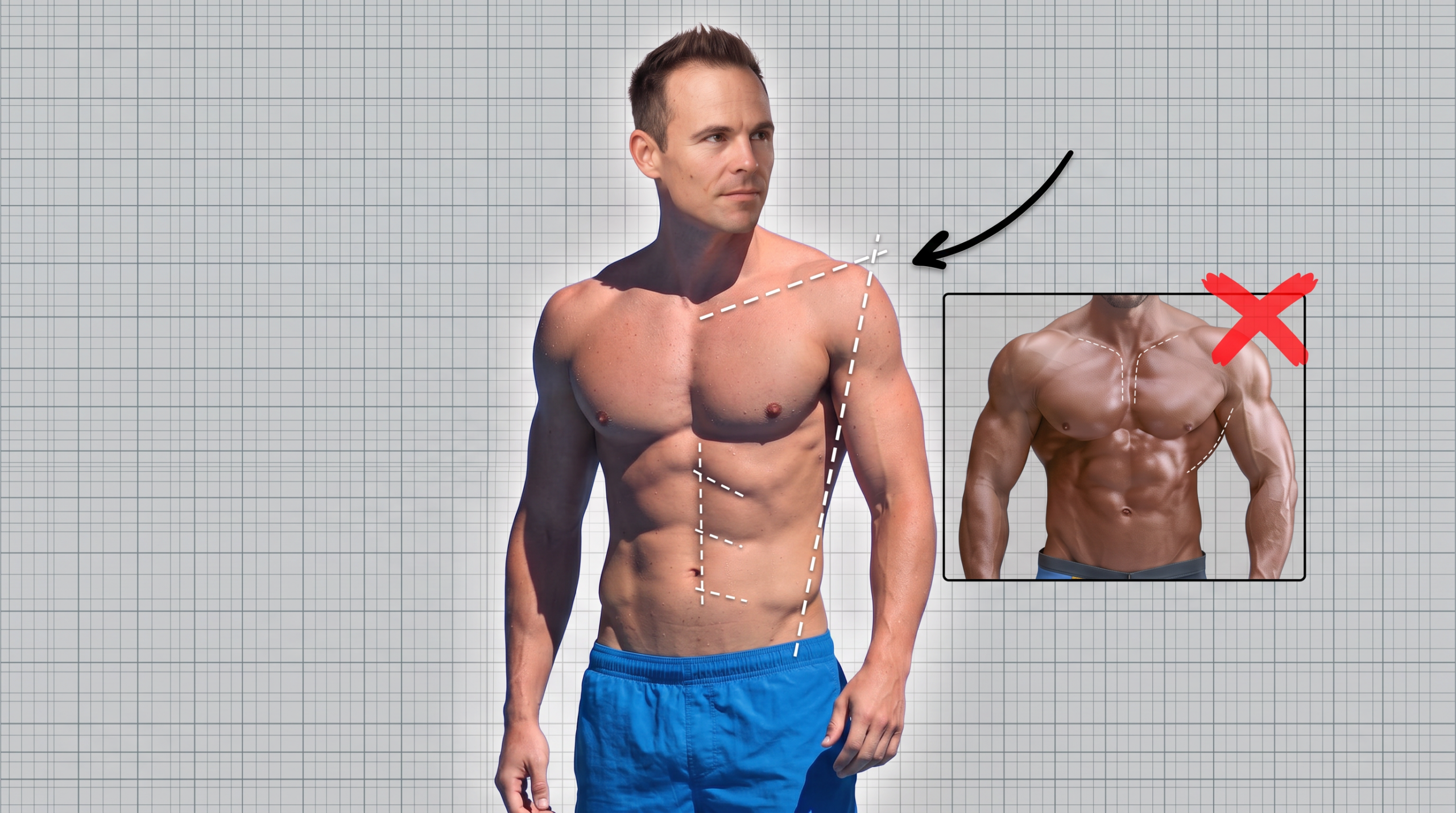
The argument? If you want to look like an athlete rather than a bodybuilder, you need to throw “balanced training” out the window.
What follows is a complete reimagining of how to prioritize muscle groups, choose exercises, and build a physique that screams performance over aesthetics.
Jump to:
- The Swimmer’s Body Fallacy
- Performance Bodies Versus Display Bodies
- Why Imbalance Creates Athletic Aesthetics
- Muscle Groups to Prioritize
- Muscle Groups to Deprioritize
- Rethinking the V-Taper
- The Synergy Principle
- Sample Training Approach
- Important Caveat for Beginners
- The Research Context
- Building Your Physique on Your Terms
- Sources
The Swimmer’s Body Fallacy
There’s a persistent myth that needs addressing right away: you don’t get a swimmer’s body by swimming.
The elite athletes we see on television represent a tiny fraction of people who swim regularly, and their physiques come from far more than pool time alone. Genetics play an enormous role, as does dedicated strength training.
No products found.
See, this is actually just a caricature of a swimmer’s physique based on the elite athletes you see on TV, but most people who swim don’t look like that. And in terms of genetics, you’re probably most people.
This applies to every athletic archetype — boxers, gymnasts, ballet dancers. The physiques we admire weren’t built solely by practicing their sport.
But there’s something deeper here than simple genetics or training methodology.
Performance Bodies Versus Display Bodies
What makes an athletic physique visually appealing isn’t just size or definition.
It’s the appearance of capability. Bodies that look like they can perform impressive feats naturally attract more admiration than those built purely to be looked at.
What we mean is we want a body that looks like it’s built for performance, that looks like it can do impressive stuff, rather than one that looks like it was built for people to look at, even if it can’t actually do the impressive stuff.
The irony? Most “balanced” training programs won’t get you there, despite being perfectly effective for building muscle and strength.
Why Imbalance Creates Athletic Aesthetics
Here’s where conventional wisdom gets flipped on its head.
No products found.
Athletic physiques are intentionally unbalanced. They feature certain muscle groups that are overdeveloped relative to others, creating a distinctive look that signals specificity rather than general fitness.
Think about it: swimmers have disproportionate lats and shoulders. Gymnasts display extraordinary arm and shoulder development. Sprinters carry massive leg musculature compared to their upper bodies.
This imbalance creates visual interest and suggests a body shaped by doing something specific rather than following a template.
I think that’s what we’re drawn to more because we intuitively know that’s the mark of a body that was built by doing something, in other words, specificity. It’s the imbalance that makes it more desirable because it doesn’t look as intentionally curated.
Muscle Groups to Prioritize
Shoulders: Go All In
Shoulders appear prominently across nearly every athletic physique type.
The good news? It’s virtually impossible to make shoulders look unnaturally large without pharmaceutical assistance. That means you can train them aggressively without worry.
It’s definitely possible for very big shoulders to appear unnatural and bodybuilder-esque, but you’re just not going to get to that point naturally, which means you’re absolutely safe to just spam delts, as people say.
Arms: Bigger Is Better
Similar to shoulders, arms are nearly impossible to overdevelop naturally.
No products found.
Gymnasts showcase some of the most impressive arm development in athletics, and their physiques remain universally admired. There’s no need to hold back on biceps and triceps work.
Muscle Groups to Deprioritize
Chest: Less Focus Than You Think
This recommendation might raise eyebrows, but consider the visual markers of bodybuilding culture.
The droopy pec with prominent chest sweep and developed upper chest screams bodybuilder, not athlete. Most athletic physiques feature relatively modest chest development.
Yes, some athletes do have quite developed chests, but it’s never or very rarely this big droopy pec with a fully defined chest sweep, and you rarely see a developed upper chest. That’s a very bodybuilder-like feature.
Chest work shouldn’t be eliminated, just deprioritized relative to conventional programs.
Abs: Train Them Less Directly
Athletes typically sport abs because of low body fat, not because of extensive direct abdominal training.
The blocky, protruding abs that come from heavy weighted core work create a distinctly bodybuilder aesthetic. Low-profile abs that don’t extrude significantly from the torso better match athletic appearances.
No products found.
Most just have abs because they’re low enough body fat, not because they’ve purposely built them up. These are low-profile abs that don’t extrude a lot from the torso, and I think they’re a key difference between athlete and bodybuilder.
Upper Traps: The Bodybuilder Tell
Overdeveloped upper trapezius muscles instantly shift physiques toward bodybuilder territory.
While some of this comes from enhanced androgen levels in competitive bodybuilders, even natural lifters can build excessive upper trap mass through direct work. Minimizing exercises that heavily target this area helps maintain athletic proportions.
Rethinking the V-Taper
Fitness culture obsesses over the V-taper — wide shoulders, tiny waist, flaring lats creating that coveted silhouette.
But when you actually compare extreme V-tapers to athletic physiques, something becomes clear: most athletes aren’t particularly V-shaped.
If you actually look at most swimmers, who are a good example because they typically have good shoulders and lats, they’re not particularly V-shaped. And the ones that are, it’s more of a bone structure than a musculature.
Chasing an exaggerated V-taper can push your appearance toward cartoonish rather than capable.
The Synergy Principle
Rather than focusing on individual muscle proportions, consider which muscles work together.
No products found.
Physiques where synergistic muscle groups dominate together appear more athletic. Developed shoulders and triceps signal pushing capability. Strong lats and biceps suggest pulling power.
A physique with dominant quads and chest, by contrast, doesn’t correspond to any particular athletic movement pattern. It looks constructed rather than functional.
What looks good in terms of athletic proportions is when muscle groups that work synergistically are the ones that are more developed. So, for example, a physique with dominant shoulders and triceps would instinctively register as more appealing than one with big quads and chest.
Sample Training Approach
Translating these principles into actual programming means rethinking both volume allocation and exercise selection.
Weekly Set Distribution
In a four-day training week focused on athletic aesthetics, weekly sets might look like:
- Shoulders: Higher volume (16-20+ sets)
- Arms: Higher volume (14-18 sets combined)
- Back: Moderate-high volume, emphasizing mid-traps over upper (12-16 sets)
- Chest: Moderate volume (8-12 sets)
- Abs: Lower direct volume (4-8 sets)
Exercise Order Matters
Starting workouts with lateral raises might seem unconventional, but exercise order signals priority.
Training shoulders first, when energy and focus peak, ensures maximum stimulus to this crucial muscle group. Chest work can be placed later without compromising overall development.
No products found.
Strategic Exercise Substitutions
Specific exercise choices can shift emphasis toward or away from certain muscle regions:
- Flat rows instead of incline rows keep emphasis on mid-traps rather than upper traps
- Weighted hyperextensions instead of deadlifts for hip hinge work reduces upper trap involvement
- Overhead pressing variations that minimize upper trap engagement
- Minimal direct upper chest work to avoid the bodybuilder shelf look
I’ve specified a flat row rather than an incline in this slot because we want to keep emphasis on mid traps and away from upper traps. I’ve also intentionally gone with a weighted hyperextension over a deadlift as the hip hinge movement to reduce upper trap emphasis.
Important Caveat for Beginners
Before rushing to implement an unbalanced training approach, beginners should proceed with caution.
Starting with a more balanced program serves an important purpose: discovering your individual muscle responsiveness.
Genetics determine which muscles grow more easily in your body. Some people naturally develop impressive shoulders; others build chest or arms more readily. You need baseline data about your own response patterns before intelligently manipulating training emphasis.
Even following a balanced program, you’ll find some muscles pull ahead and some lag behind. Some areas just tend to be more responsive than others in different people, or they appear bigger when they’re a bit more developed because of the muscle anatomy.
After 6-12 months of balanced training, you’ll have enough information to make strategic adjustments.
The Research Context
While the athletic versus bodybuilder aesthetic distinction has intuitive appeal, it’s worth noting that research on “athletic-looking” physiques is limited.
No products found.
Studies on muscle hypertrophy focus on growth mechanisms and training variables, not aesthetic outcomes. The idea that imbalanced development appears more athletic than balanced development represents an aesthetic theory rather than scientifically validated fact.
Research does confirm that different training approaches create different muscle development patterns. A 2016 systematic review in Sports Medicine established that exercise selection, volume, and intensity all influence regional muscle growth, supporting the concept that targeted training can shape specific proportions.
The claim that you can’t build excessively large shoulders or arms naturally also requires context. Individual genetic variation in muscle-building potential is enormous, and some natural lifters absolutely can develop muscle mass that appears disproportionate, particularly in responsive muscle groups.
Building Your Physique on Your Terms
The core message transcends specific muscle group recommendations: your training should reflect your actual aesthetic goals, not inherited bodybuilding conventions.
Bodybuilding judging criteria emphasize balance, symmetry, and maximum development across all muscle groups. Those standards have filtered into general fitness culture, influencing how programs are designed and how physiques are evaluated.
But if bodybuilding aesthetics don’t appeal to you, there’s no reason to train according to bodybuilding principles.
No products found.
Don’t let the bodybuilding angle warp your ideas of what looks good. I guess like everything else in life, try your best to just decide for yourself and do what you actually want.
The irony of deliberately building a physique that looks undeliberate isn’t lost on anyone. But that’s precisely the point — intentionality in pursuing your actual preferences rather than default settings.
Whether you prefer the aesthetic of a swimmer, gymnast, boxer, or yes, even a bodybuilder, the key is making conscious choices that move you toward that specific vision.
Athletic physiques tell stories of specific capabilities. They suggest performance, function, and skill developed over time. If that resonates more than pure size or symmetry, your training emphasis should reflect it.
Just remember: these are aesthetic preferences, not moral imperatives. There’s nothing inherently superior about looking like an athlete versus a bodybuilder. The only mistake is building someone else’s ideal body instead of your own.
Sources
- Schoenfeld BJ, et al. (2016). “Dose-response relationship between weekly resistance training volume and increases in muscle mass” – Sports Medicine