In 1903, Russian physiologist Ivan Sechenov conducted an experiment that would reshape how elite athletes think about recovery.
He built a device measuring how many times his arm could move before exhaustion set in.
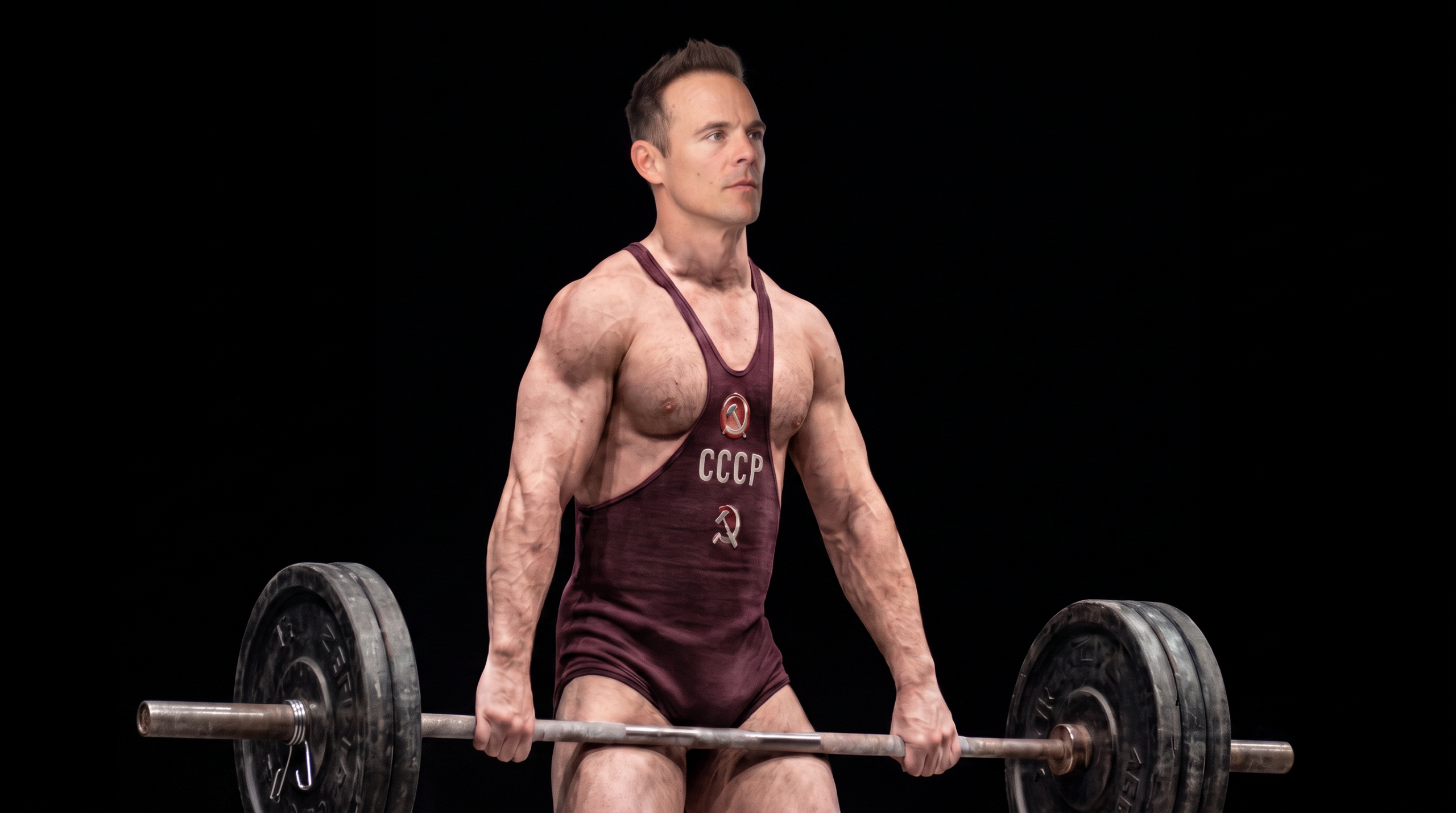
After fatiguing his right arm, he performed light work with his left instead of resting completely.
When he returned to his right arm, it had recovered far more than if he had simply sat still—and that discovery became the foundation of Soviet recovery science for the next eight decades.
Jump to:
- Why Sitting Still Between Sets May Be Sabotaging Your Recovery
- Sechenov’s Discovery: Active Rest and Nervous System Recovery
- Neuromuscular Memory: Why Your Last Rep Might Matter Most
- The Skill Elite Athletes Master That Beginners Ignore
- Relaxation as a Trainable Skill
- Practical Applications: How to Apply Soviet Recovery Science Today
Why Sitting Still Between Sets May Be Sabotaging Your Recovery
Soviet coaches built their entire recovery system on one central idea: sitting still between hard training is one of the worst things you can do.
Muscle isn’t a simple elastic band that stretches and recoils. At the microscopic level, muscle fibers are made of interlocking protein filaments—actin and myosin—that form tiny bridges during contraction and release during relaxation.
No products found.
When you finish a set and sit down, most of those bridges detach normally. But a small fraction, roughly 1%, spontaneously reform in a locked, non-working position.
They’re not generating force. They’re just frozen.
The longer you stay still, the more of these frozen bridges pile up. Muscle becomes stiffer, heavier, and slower to fire.
The Ketchup Effect Inside Your Muscles
Scientists call this phenomenon muscle thixotropy.
The simplest way to understand it is ketchup. Ketchup sits thick and stuck inside the bottle when you leave it alone. The moment you shake it, it becomes fluid.
Your resting muscle works exactly the same way. The longer you sit between sets, the more your muscle turns from fluid into gel.
No products found.
In 1976, researcher Herb found that muscle stiffness begins developing within seconds of stillness. A single movement breaks it apart almost immediately, but it starts building again as soon as muscle becomes still.
This is why legs feel stiff after sitting for an hour. A few seconds of shaking or walking makes them feel normal again.
Sechenov’s Discovery: Active Rest and Nervous System Recovery
Sechenov’s explanation had little to do with muscles alone.
He believed fatigue develops in the nervous system as well. When one group of muscles is pushed hard, the brain and spinal cord gradually reduce signals sent through that pathway.
By moving the opposite limb, a different neural pathway became active, helping the fatigued system recover more quickly. He called this active rest.
The practical application was simple. Between hard sets, Soviet coaches encouraged athletes to keep moving instead of sitting still.
No products found.
- Shake your arms and let them hang completely loose from the shoulder
- Shake your legs and bounce slightly
- Roll your shoulders and let momentum carry the movement rather than driving it
The cue Pavel Tsatsouline used with Soviet special forces was exactly that: imagine shaking water off your hands.
These movements also improve blood flow by activating muscle’s natural pumping action, helping clear away waste products that build up during hard exercise.
Watch a boxer between rounds. He drops his hands, shakes out his forearms, and rolls his shoulders instead of standing still. Those movements aren’t just habit—they help muscles recover and prepare the body for the next round.
Neuromuscular Memory: Why Your Last Rep Might Matter Most
There’s another detail from Soviet coaching that almost nobody talks about.
Dr. Anatoly Bondarchuk, one of the greatest hammer throw coaches in history, described a concept he called neuromuscular memory.
His idea was simple: the central nervous system remembers the final movement pattern of a training session.
No products found.
Whatever movement you finish with becomes the pattern your nervous system continues processing during recovery.
If the last thing you do is a heavy, slow, grinding lift, your nervous system spends recovery reinforcing that slow movement pattern.
This is why many Soviet coaches avoided ending heavy sessions with slow repetitions alone. Instead, they often finished with fast, unloaded, or explosive movements.
Complex Training and Post-Activation Potentiation
The same principle appears in complex training developed by Yuri Verkhoshansky.
A heavy exercise, such as a squat, is immediately followed by an explosive movement like a depth jump. The heavy lift recruits high-threshold motor units, a phenomenon now associated with post-activation potentiation.
The explosive movement then teaches those activated motor units to produce force rapidly instead of slowly.
No products found.
Rather than letting fatigue dictate movement quality, the nervous system finishes each session practicing explosive force production.
The Skill Elite Athletes Master That Beginners Ignore
Soviet researchers discovered another quality that separated elite athletes from beginners.
It wasn’t strength. It was how quickly a muscle could relax after it contracted.
Lev Matveyev began measuring the time between a muscle receiving the signal to contract and the moment it completely released that tension.
In beginners, there was always a delay. The nervous system had already sent the signal to relax, but muscle continued holding a small amount of unnecessary tension.
In elite athletes, that delay almost disappeared. Muscle released almost immediately after the movement was finished.
No products found.
The biggest difference between beginners and elite athletes wasn’t just producing force—it was how quickly they could stop producing it.
Why Relaxation Speed Matters More Than You Think
Every movement in the body requires one muscle to contract while the opposing muscle relaxes.
When you perform a bicep curl, the bicep shortens to lift weight while the tricep must release. When you sprint, muscles driving the leg forward can only work efficiently if muscles pulling in the opposite direction let go at exactly the right moment.
If the opposing muscle holds tension for even a fraction of a second too long, it begins resisting the movement instead of allowing it.
Lev Matveyev called this coordination enslavement.
Instead of all your strength moving weight, part of that strength is wasted overcoming unnecessary muscular tension.
No products found.
Imagine trying to drive a car while lightly pressing both the accelerator and the brake. The engine still produces power, but some of that power never reaches the wheels.
The same thing happens inside your body. The working muscle has to fight the opposing muscle before it can move weight.
Relaxation as a Trainable Skill
This is why Soviet coaches spent so much time teaching relaxation drills, rhythm exercises, and precise technique.
Removing unnecessary tension made every movement smoother, faster, and more efficient without adding any extra strength.
Research by Fedorov, Nazarov, and Farfel in 1975 reached the same conclusion. They found that most untrained people had very little ability to voluntarily relax specific muscles.
Relaxation was not an automatic human ability. It was a skill, and like any skill, it improved through practice.
No products found.
Practical Applications: How to Apply Soviet Recovery Science Today
By the 1970s, Soviet recovery science extended far beyond simply resting between workouts.
It included active rest, muscle relaxation, explosive movement, neuromuscular coordination, and nervous system recovery—all working together to prepare athletes for the next training session.
Here’s how you can apply these principles immediately:
- Between sets: Shake out working muscles instead of sitting still—let arms hang loose and swing naturally
- After heavy lifts: Finish with 2-3 explosive, unloaded movements to teach the nervous system speed instead of grinding through slow reps
- During rest periods: Walk, bounce lightly, or roll shoulders to maintain blood flow and prevent muscle stiffness
- Practice relaxation: Consciously release tension in non-working muscles during every exercise
- Focus on coordination: Train opposing muscles to relax at exactly the right moment, not just contract harder
The Soviet system wasn’t built on magic or secrets. It was built on understanding that recovery happens faster when you move intelligently, not when you sit still.
And that single insight—first discovered by Sechenov more than a century ago—remains one of the most underused tools in modern training.