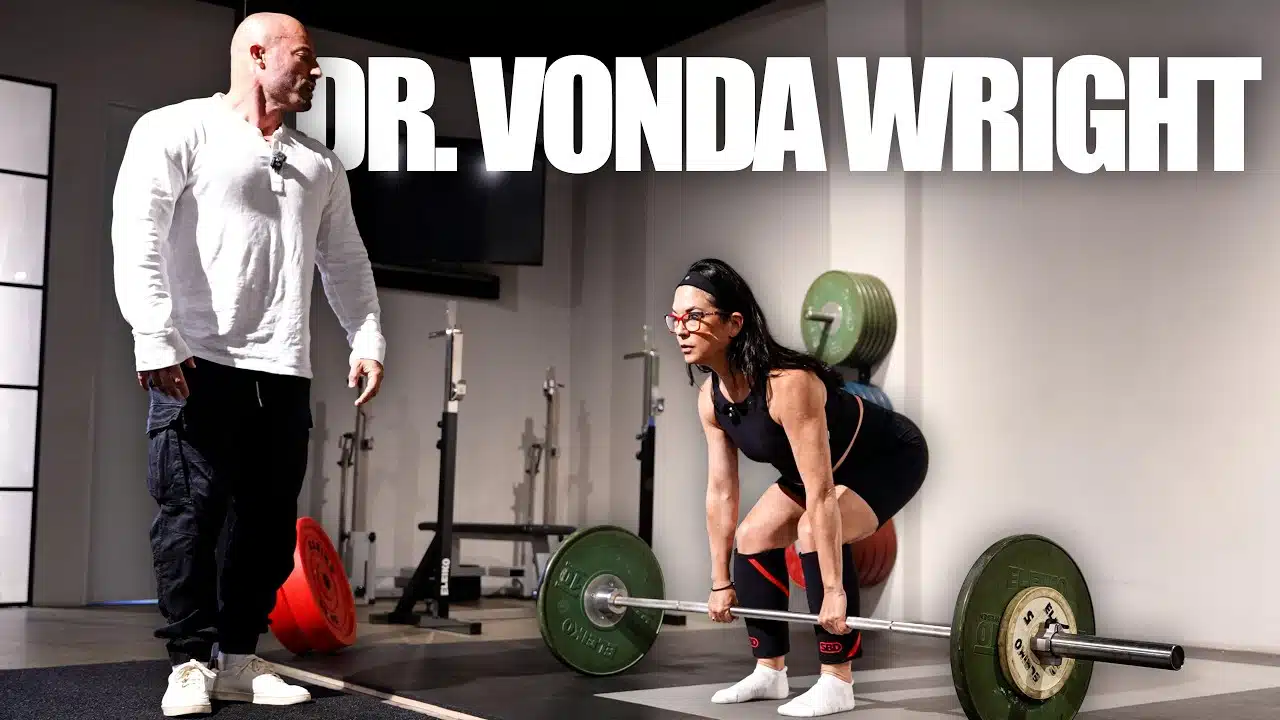
Popular fitness coach Sebastian Oreb, known online as “Australian Strength Coach,” recently sat down with Dr. Vonda Wright to completely transform her deadlift technique.
The session revealed something surprising: lifting heavier isn’t always about raw power.
Sometimes it’s about doing less—less jerking, less exploding, less forcing.
What emerged was a masterclass in precision over aggression, challenging everything most gym-goers think they know about deadlifting.
Jump to:
- The Culture Shift: Why Professional Deadlifters Don’t Explode Off The Floor
- The Technique Breakdown: What Most People Get Wrong
- Why Your Lats Matter More Than Your Core
- Finesse Over Force: The Game-Changing Cue
- The Pause Deficit Deadlift: Teaching Patience
- Programming Philosophy: Setting Yourself Up To Win
- Practical Cues You Can Use Today
- Why Wright’s Back Pain Disappeared
- The Thor Björnsson Connection
- The Training Tool That Changes Everything
- Why This Matters Beyond The Gym
The Culture Shift: Why Professional Deadlifters Don’t Explode Off The Floor
Oreb’s first revelation came early in the session when he discussed his evolution as a lifter.
I used to worry a lot about the weight that I was lifting and you know the program that I had. It’s like we have to hit this certain number today. Now I don’t care about the number. I’ll get to the number if I get there. And if I don’t, I’ll happily throw in the towel and save it for another session.
This mindset shift represents something deeper than just training philosophy. It’s about longevity, sustainability, and intelligent progression.
Dr. Wright, who had been experiencing back pain during deadlifts, was about to discover why.
The Technique Breakdown: What Most People Get Wrong
Stance Width Creates Efficiency
Oreb immediately identified Wright’s stance as too wide, forcing her arms outward rather than straight down.
The closer to perpendicular we are, the less we have to travel, the more efficient that movement is.
By bringing her stance to hip width, Wright’s arms could travel in a straighter line. Less distance equals more efficiency.
Hip Position: The Push-Pull Balance
Wright was sitting too low, essentially trying to squat the weight up rather than deadlift it.
Oreb explained the critical balance:
The lower the hips, the more push we get. The higher the hips, the more pull we get. This is a pull lift. It’s both. I want as much of both as possible.
The solution? Drop hips only until shins gently touch the bar—no lower.
The Lat Engagement Secret
Perhaps most importantly, Wright was retracting her shoulder blades, creating shorter arms and longer bar travel.
Oreb corrected this immediately:
We engage the lats in a different way. Not by retracting scapula, but by pulling the bar in. So it’s shoulder extension, not retraction of scapula.
This cue—pull the bar into your body—transformed everything. Wright’s technique smoothed out instantly.
Why Your Lats Matter More Than Your Core
Most lifters obsess over core bracing and breath holding. Oreb flipped that priority completely.
The strongest core muscle is lats. The lats are stronger than the breath hold.
He broke down the bracing hierarchy:
- Head to ceiling: Elongates spine, activates erector spinae
- Armpits to pelvis: Engages lats (the primary brace)
- Breath hold: The cherry on top, not the foundation
When Wright struggled with remembering breathing cues, Oreb reassured her that lat engagement matters far more than perfect breathing for back safety.
Finesse Over Force: The Game-Changing Cue
The most transformative moment came when Oreb introduced his signature concept: finesse the weight off the ground, don’t explode it.
I like to say finesse it off the ground. Squeeze it off the ground. Don’t punch it off the ground.
Wright immediately noticed the difference. When she tried to aggressively rip the weight up, her form broke down and she felt pain. When she squeezed methodically, everything felt smooth and controlled.
Oreb even shared his own recent experience failing a lift because he attacked it too aggressively, only to succeed moments later by squeezing instead.
Taking Slack Out Of The Bar
Listen for the click. That telltale sound when the bar leaves the ground signals you haven’t created tension first.
I want you to pull as if you’ve already pulled 20 kg out. You don’t go from here to fully engaged. You go from gradually take some out.
By gradually building tension—stretch, reach toward ceiling, squeeze—the bar lifts silently and smoothly.
The Pause Deficit Deadlift: Teaching Patience
To reinforce the finesse approach, Oreb introduced Wright to pause deficit deadlifts—standing on a platform and pausing just off the ground.
What I love about this technique is it teaches you how to not rush off the floor. This is the issue in most instances when people break down is they’re rushing off the floor and they’re trying to be too aggressive.
The exercise forces lifters to take maximum slack out of the bar before moving, building strength in that critical initial position.
Wright found she could handle the same weight on this harder variation as on regular deadlifts—proof that her issue wasn’t strength but timing and tension.
Programming Philosophy: Setting Yourself Up To Win
Oreb’s approach to programming challenged conventional “push until failure” mentality.
I don’t just go, let’s push as hard as you can. Let’s see how heavy you can go and now let’s try and beat it next week. Instead of going as heavy as you can on week one, we leave repetitions in reserve. We start conservative to allow room for life circumstances.
His recommendation for Wright: Start at a weight she handled comfortably (70kg for 3×3), then progress by 5kg weekly for three weeks.
This creates sustainable momentum rather than battling against your best performance under perfect conditions.
Practical Cues You Can Use Today
Oreb distilled proper deadlift technique into three primary cues:
- Reach down (elongate arms, engage lats)
- Pull back (bar into shins, creating tension)
- Head to ceiling (extend spine, maintain position)
Additional technical points:
- Bar over midfoot, about one inch from shins
- Hip-width stance so arms hang perpendicular
- Hands one finger-width onto smooth part of bar
- Knees pushed gently outward into arms
- Drop hips only until shins touch bar
- Squeeze the weight off the ground—don’t explode
Why Wright’s Back Pain Disappeared
Dr. Wright had been experiencing back discomfort that she gutted through during deadlifts. After implementing Oreb’s techniques, she noticed something remarkable:
The difference that I feel doing this is that I feel the pulling you’re telling me to do with no pain. But when I try to be aggressive and jerk it, that’s when I feel pain.
Oreb’s response was simple: “So we know the answer.”
By maintaining lat engagement and finessing rather than forcing, load distributes evenly across the entire posterior chain rather than concentrating stress on lower back structures.
The Thor Björnsson Connection
To underscore the validity of his methods, Oreb revealed his prized possession: a plate from Thor Björnsson’s 501kg world record deadlift.
The techniques that I’m teaching you is in good company.
These aren’t experimental theories. They’re proven methods used by the strongest deadlifters on earth.
The Training Tool That Changes Everything
Oreb emphasized one practice tool above all others: video feedback.
Set up the camera, do the set, and then watch your set back and then go, where did I move anywhere that I shouldn’t have moved by a millimeter? Fix it on the next set. And that’s how you train.
Combined with his principle of “earn the right to add weight,” this creates a systematic approach to perfection.
Don’t chase numbers. Chase flawless execution, then the numbers follow.
Why This Matters Beyond The Gym
Dr. Wright, a leading expert in women’s musculoskeletal health, reminded viewers of an essential truth:
Everyone comes from a woman. You were in somebody’s uterus at some point, right? So we have to care about the women and daughters and wives and partners in our lives.
Proper strength training technique isn’t just for elite athletes. It’s for sustainable health, injury prevention, and longevity for people of all ages and backgrounds.
By the end of the session, Wright was handling 65kg (143 lbs) on pause deficit deadlifts—a harder variation than standard deadlifts—with zero back pain and pristine form.
The transformation didn’t come from getting stronger. It came from moving smarter.