Getting that first pull-up feels impossible for many people, especially when traditional advice points toward banded assistance work.
But fitness coach and content creator Meghan Gallagher argues that bands might actually be holding you back from achieving your pull-up goals.
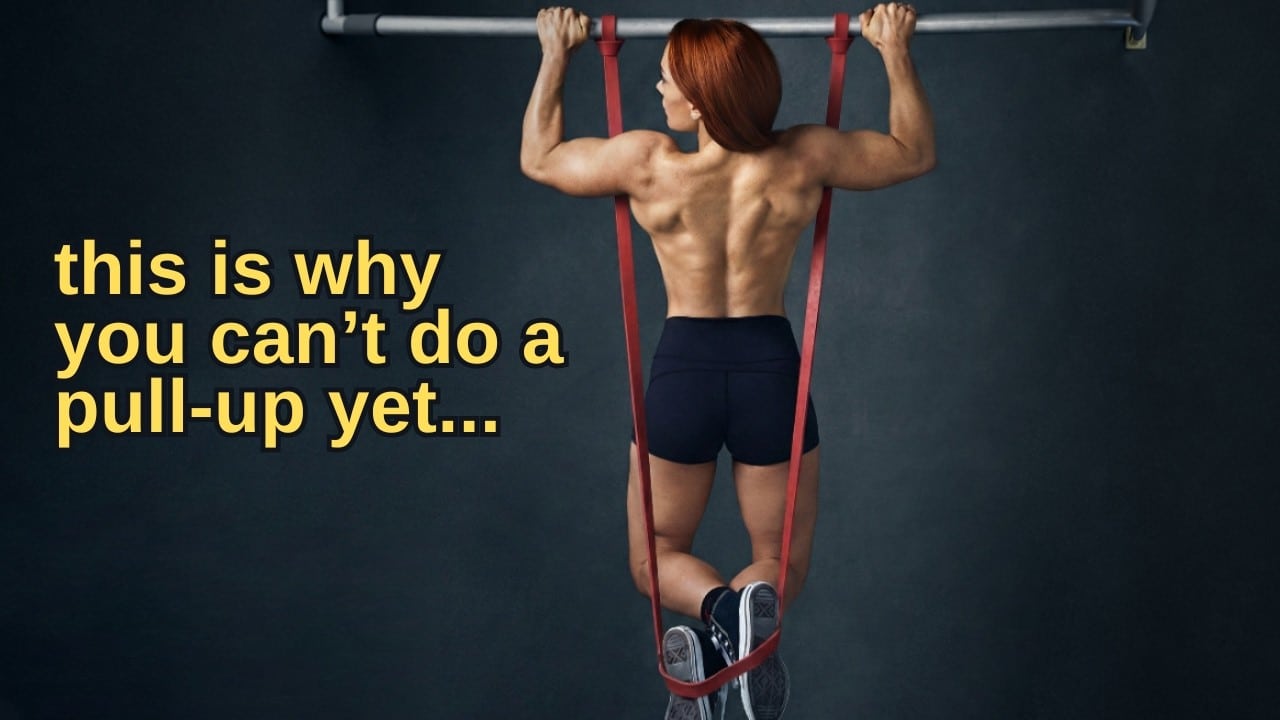
In a recent video addressing common pull-up training mistakes, she breaks down why banded pull-ups create a fundamental problem: they provide maximum assistance exactly where you need to build the most strength.
Her alternative approach focuses on greasing the groove in the hardest part of the movement—and it’s backed by biomechanics that make total sense.
Jump to:
The Problem With Banded Pull-Ups
Resistance bands seem like the logical solution for pull-up progression. They’re everywhere in gyms, recommended by countless trainers, and feel supportive during the movement.
The issue? Physics works against you.
When you’re using a band, you get most of the help in the hardest part of the range of motion. The band is making it easiest in the part of the lift that you need the most help on.
Bands provide maximum assistance at the bottom of the pull-up—the dead hang position where most people struggle. As you pull higher and the band stretches less, assistance decreases right when the movement gets easier.
This creates a training gap. You never actually strengthen the muscles responsible for initiating the pull from a dead hang, which means you’re practicing a movement pattern that doesn’t translate to an unassisted pull-up.
If you never get a chance to grease the groove, you are going to be stuck not having your first pull-up forever.
Understanding the Anatomy of Pull-Up Initiation
Most people think pull-ups are primarily about lats and biceps. While those muscles certainly matter, they’re not the stars of the show in those crucial first few inches.
The real MVPs at the bottom of a pull-up are smaller, often-neglected muscle groups.
The muscles that are engaged are our scapular depressors and the smaller muscles that make up our rotator cuff.
Gallagher demonstrates this with a simple exercise: shrug your shoulders up to your ears as hard as possible, hold for five seconds, then slowly depress them downward. This movement—scapular depression—is what initiates proper pull-up mechanics.
When you hang from a bar with shoulders elevated, your lats can’t engage effectively. Depression sets your shoulder blades into position, allowing those bigger prime movers to activate and generate pulling force.
The Scap Pull-Up
This foundational movement isolates scapular depression. Hang from a pull-up bar and practice pulling your shoulder blades down without bending your elbows.
It looks like a tiny movement—maybe just two or three inches—but it builds strength in exactly the muscles that fail most people at the bottom of their pull-up attempt.
The Superior Alternative: Negative Pull-Ups
Instead of bands, Gallagher recommends negative pull-ups as the most effective path to your first unassisted rep. The concept is brilliantly simple: start at the top and slowly lower yourself down.
Jump or step up so your chin clears the bar, then control your descent for as long as possible.
Your body is naturally going to want to lower. And it’s going to feel so nice and easy. Nice and easy. And once your elbow hits about this angle, you’re going to want to just let go. No.
The magic happens in that final portion of the negative—from bent arms to dead hang. This is precisely where banded pull-ups rob you of training stimulus.
Eccentric contractions (the lowering phase) allow you to handle more load than concentric contractions (the lifting phase). You can control a negative pull-up before you can perform a positive one, making it perfect for building strength in your specific weakness.
Progressive Overload With Time Under Tension
Start by timing your negatives. Can you control the descent for five seconds? Next session, aim for six. The week after, try seven.
This progression is measurable, motivating, and directly builds the strength you need. As time under tension increases, you’re developing both muscular endurance and the neuromuscular control required for a strict pull-up.
Debunking the “Women Can’t Do Pull-Ups” Myth
Gallagher addresses a frustrating narrative that persists in fitness circles—that women simply can’t achieve pull-ups. She points out that even The New York Times published an article titled “Why Women Can’t Do Pull-Ups.”
When asked how many pull-ups women can do on average, responses in her video ranged from 1.5 to four. The statistical answer? Zero.
But that statistic reflects opportunity and training, not biological impossibility.
These are usually things that are said by men who’ve been able to do a pull-up since they were age 11 and just haven’t added much body mass since.
Yes, women face legitimate challenges: lower center of gravity, narrower shoulder girdles with less muscle mass, and lower testosterone levels. But these factors make pull-ups harder, not impossible.
Gallagher’s coaching experience proves this daily. Her app, Stronger by the Day, has over 25,000 active members—many of whom joined specifically to achieve their first pull-up and prove doubters wrong.
Why Lat Pulldowns Don’t Guarantee Pull-Up Success
Another common myth: if you can lat pulldown your bodyweight, you should be able to do a pull-up. The logic seems sound, but biomechanics tell a different story.
Three key differences explain why lat pulldown strength doesn’t directly translate:
- No dead hang component: Lat pulldowns eliminate the hardest part of the pull-up entirely
- Mechanical advantages: Thigh pads provide stability, you can adjust torso angle, and momentum becomes easier to generate
- Missing skill elements: Pull-ups require significant anti-rotation and anti-swing core control that machines don’t demand
You have to remember that the pull-up is, yes, a strength movement, but it is a skill. You have to work on the skill of getting your first pull-up.
Lat pulldowns aren’t worthless—they build relevant strength. But they’re supplementary, not sufficient. Specificity matters in training, and nothing replicates a pull-up quite like pull-up variations themselves.
Building Your Pull-Up Training Plan
Based on Gallagher’s approach, an effective pull-up progression looks like this:
- Master scap pull-ups: Build strength in scapular depression before progressing
- Practice negative pull-ups: Focus on controlled descents with increasing time under tension
- Track your progress: Measure seconds in negatives, not just reps completed
- Supplement wisely: Use lat pulldowns and rows for additional volume, but prioritize pull-up-specific work
- Stay consistent: Frequency matters—practice the movement pattern multiple times per week
The journey from zero pull-ups to that first rep takes time. For some people, it’s weeks. For others, months. What matters is training the right things with proper progression.
Gallagher’s message cuts through the noise of conflicting pull-up advice with clarity: stop compensating for your weakness and start training it directly. Ditch the bands that artificially inflate your performance at the bottom of the movement.
Embrace negatives that force you to control the exact range of motion where you’re weakest. Master the scapular mechanics that most people never learn.
And perhaps most importantly, reject the narrative that pull-ups are reserved for naturally strong individuals or permanently out of reach for women. With proper programming and consistent effort, that first pull-up is achievable—and it’s one of the most satisfying strength milestones you can hit.