Dr. Jordan Feigenbaum just delivered one of the most thorough takedowns of the peptide therapy craze that’s swept through fitness and biohacking circles.
In his latest commentary, the physician and strength coach dismantled the recent FDA advisory committee decision that voted to allow continued access to six experimental peptides—despite what he calls a glaring absence of evidence.
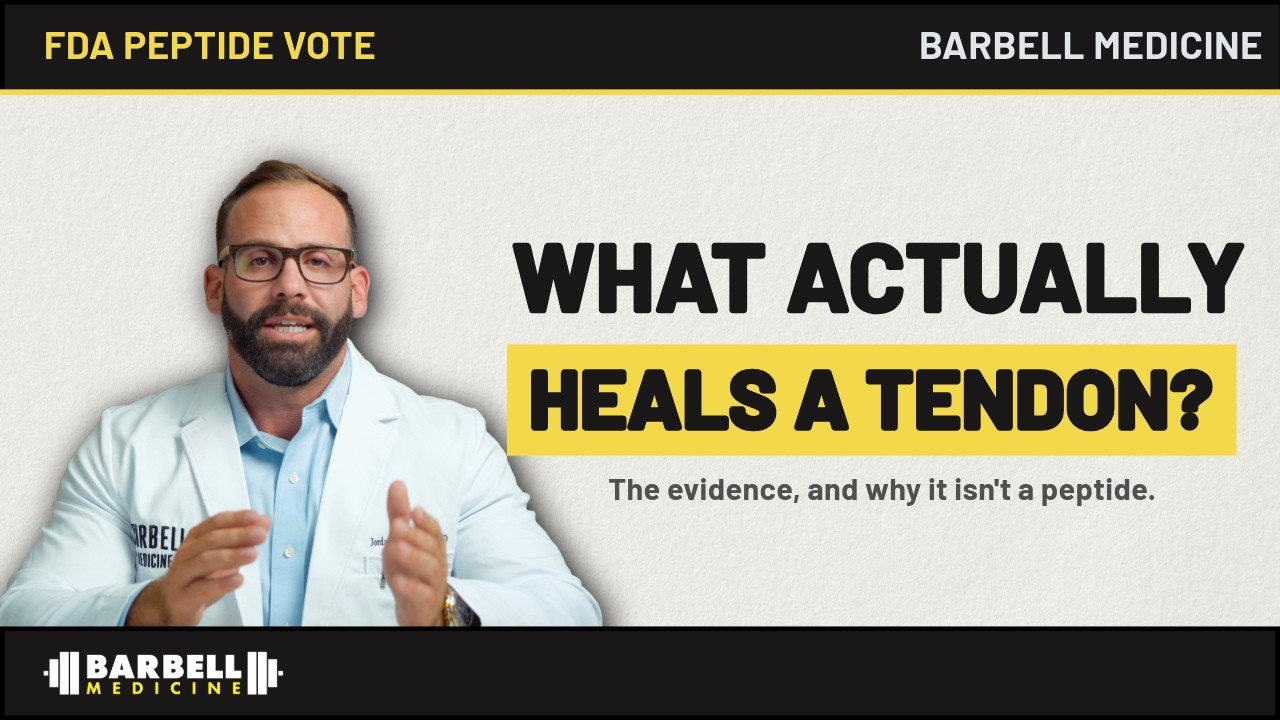
His central argument? We’re treating medical decisions like consumer choices, and that’s a dangerous precedent.
What follows is a sobering look at what informed consent actually means, why legal precedent doesn’t support peptide access, and what intervention actually works for the tendon injuries driving most people toward these compounds in the first place.
Jump to:
- The Foggy Scale: When Neither Risk Nor Benefit Is Clear
- The “My Body, My Choice” Argument Doesn’t Hold Up in Court
- Oral BPC-157 Probably Does Exactly Nothing
- Athletes: You’re Breaking the Rules
- What Actually Works for Tendon Pain: Loading
- What Would Change His Mind
- The FDA Committee Got It Wrong
- The Bottom Line
The Foggy Scale: When Neither Risk Nor Benefit Is Clear
Feigenbaum frames the peptide dilemma with stark clarity.
For most drugs, you weigh the known risks against the known benefits. Here, both sides of the scale are mostly blank or at least foggy. The benefit for your specific use case has never been shown. The risk side is worse than unknown because we don’t even know what to look out for.
This isn’t a typical medical risk-benefit calculation. It’s a decision made in informational darkness.

If you want something simple that actually works, this is one of the most effective tools I’ve used to build strength, conditioning, and endurance without needing a full gym setup.
- Full-body training with one weight using swings, squats, and presses
- Solid cast iron build that feels stable and lasts for years
- Comfortable grip that makes high-rep workouts easier to handle
Users are choosing substances where efficacy hasn’t been demonstrated and safety profiles remain uncharacterized. That’s not informed consent—it’s gambling dressed up as bodily autonomy.
The “My Body, My Choice” Argument Doesn’t Hold Up in Court
Feigenbaum acknowledges the clinical reality many physicians face: patients who insist on using peptides regardless of medical advice.
He concedes that dismissing these patients accomplishes nothing except ensuring nobody with medical training monitors their health. So doctors continue care and do their best—that’s the job.
But where he draws the line is the notion that self-determination equals unlimited access to unproven compounds.
Self-determination in medicine has a name already, and it’s called informed consent. The word doing the work is informed. You have a well-established right to refuse anything. But what you don’t have is a right to a decision made under information nobody’s generated yet.
Legal Precedent Says No
Feigenbaum cites two landmark cases that directly contradict the idea that patients have constitutional rights to experimental substances.
Abigail Alliance was formed after Abigail Burroughs, a young woman with head and neck cancer, died in 2001 after being unable to access an experimental drug her oncologist believed might help. Her father sued the FDA, arguing terminally ill patients should have constitutional rights to drugs that cleared basic safety testing.
If you want something simple that actually works, this is one of the most effective tools I’ve used to build strength, conditioning, and endurance without needing a full gym setup.
- Full-body training with one weight using swings, squats, and presses
- Solid cast iron build that feels stable and lasts for years
- Comfortable grip that makes high-rep workouts easier to handle
They lost.
Even earlier, in United States vs. Rutherford (1979), terminally ill patients argued FDA safety and effectiveness requirements shouldn’t apply when death is imminent. The Supreme Court ruled unanimously against them.
Right to Try legislation exists, but it’s a 2018 statute with strict limitations—not a constitutional right. It only covers drugs in active investigation that have cleared Phase 1 trials, and requires company consent.
Feigenbaum’s point lands hard: if dying patients with exhausted options couldn’t secure legal access to drugs further along in development, healthy people have no case for compounds abandoned two decades ago.
Oral BPC-157 Probably Does Exactly Nothing
Many users aren’t injecting peptides—they’re swallowing capsules, particularly BPC-157 for gut health.
Feigenbaum cuts through that market entirely.
If you want something simple that actually works, this is one of the most effective tools I’ve used to build strength, conditioning, and endurance without needing a full gym setup.
- Full-body training with one weight using swings, squats, and presses
- Solid cast iron build that feels stable and lasts for years
- Comfortable grip that makes high-rep workouts easier to handle
An oral capsule has to survive the exact system designed to digest it. It probably does nothing since getting a peptide to work orally requires a lot of sophisticated engineering, all of which is usually proprietary and very costly.
Peptides are protein fragments. Digestion breaks them down. Making peptides orally bioavailable requires advanced pharmaceutical engineering—technology that doesn’t exist in over-the-counter supplements.
Athletes: You’re Breaking the Rules
For anyone competing in tested sports, this debate ends immediately.
BPC-157, TB-500, and MOTS-c are all banned by WADA, prohibited both in and out of competition. Using them isn’t a gray area—it’s a violation.
What Actually Works for Tendon Pain: Loading
Here’s where Feigenbaum shifts from critique to solution.
The reason most people seek out BPC-157 is chronic tendon pain—Achilles tendinopathy, tennis elbow, patellar tendinitis. These injuries are stubborn, painful, and slow to heal.
There’s an intervention with robust human evidence: progressive heavy slow resistance training.
If you want something simple that actually works, this is one of the most effective tools I’ve used to build strength, conditioning, and endurance without needing a full gym setup.
- Full-body training with one weight using swings, squats, and presses
- Solid cast iron build that feels stable and lasts for years
- Comfortable grip that makes high-rep workouts easier to handle
Progressive, heavy, slow resistance training works. That’s the thing shown in randomized trials to cut pain and remodel the tissue across the Achilles, the patellar tendon, and the elbow.
Loading tendons under controlled, progressive stress does exactly what peptide advocates claim their injections do: it increases blood flow to the area.
But loading does something no injection can: it stimulates tendons to lay down and reorganize new collagen in the correct alignment.
Even Established Injections Don’t Beat Placebo
Cortisone shots and platelet-rich plasma (PRP) injections—both far more studied than peptides—don’t outperform saline placebo when patients are already doing loading exercises.
Cortisone actually performs worse at one-year follow-up.
So why do peptides feel appealing? Because loading is slow.
Tendon adaptation takes weeks to months. There’s no fast track. An injection promising results in days sounds infinitely better than months of disciplined rehab.
If you want something simple that actually works, this is one of the most effective tools I’ve used to build strength, conditioning, and endurance without needing a full gym setup.
- Full-body training with one weight using swings, squats, and presses
- Solid cast iron build that feels stable and lasts for years
- Comfortable grip that makes high-rep workouts easier to handle
Feigenbaum acknowledges this isn’t trivial—pain is real, patience is hard, and hope is powerful.
If that worked, it would be the obvious choice, and I’d tell you to take it. It would also be worth billions. A shot that reliably heals tendons faster than loading does would be one of the most valuable drugs in orthopedics, and every company in the space knows it.
That massive financial incentive exists. Yet no company has produced evidence that peptides deliver.
What Would Change His Mind
Feigenbaum doesn’t position himself as ideologically opposed to peptides. He’s opposed to unproven peptides being treated as proven interventions.
He outlines exactly what evidence would shift his stance.
There’s a phase two trial in acute hamstring strain recruiting right now. Say that trial gives the compound the way that people actually take it, at the dose they typically use, in the injury they actually have, against a real placebo. And say it shows a pretty good signal that it works, and that it’s safe. Then I change my answer, and I say so right here on this show.
That’s the standard: a well-designed placebo-controlled trial in the actual population using the compound for the condition they’re treating.
It’s not an impossible bar. It’s basic science.
If you want something simple that actually works, this is one of the most effective tools I’ve used to build strength, conditioning, and endurance without needing a full gym setup.
- Full-body training with one weight using swings, squats, and presses
- Solid cast iron build that feels stable and lasts for years
- Comfortable grip that makes high-rep workouts easier to handle
The FDA Committee Got It Wrong
Feigenbaum argues the advisory committee failed on six of seven decisions.
Take BPC-157. The evidence reviewed involved a condition almost nobody uses it for, based on a single conference abstract that didn’t beat placebo. The FDA’s own scientists noted the substance isn’t well characterized.
The tendon applications—the primary reason people seek it out—weren’t evaluated at all because no human studies exist.
For the other six compounds, the FDA’s conclusion was nearly identical: not well characterized, insufficient efficacy data, inadequate safety information.
The panel read those assessments seven times and voted yes to six anyway.
What This Opens the Door To
Feigenbaum warns this decision sets a precedent that’s hard to contain.
If you want something simple that actually works, this is one of the most effective tools I’ve used to build strength, conditioning, and endurance without needing a full gym setup.
- Full-body training with one weight using swings, squats, and presses
- Solid cast iron build that feels stable and lasts for years
- Comfortable grip that makes high-rep workouts easier to handle
If people are buying it anyway is enough to open a legal supply line, then tell me what that doesn’t cover. It works for these peptides, it works for the next five, it works for anything with a website and enough customers—which is how you know it isn’t an argument.
Another FDA meeting is scheduled for late February 2027 to review five additional compounds, including Melanotan II—which has published melanoma case reports associated with its use.
Whatever standard applied last week will likely apply then. And if consumer demand becomes the benchmark for medical access, the floodgates are open.
The Bottom Line
Feigenbaum isn’t dismissing patient autonomy or clinical judgment. He’s defending the integrity of informed consent—which requires actual information.
Peptides like BPC-157 remain uncharacterized, unstudied in relevant populations, and unsupported by human trial evidence. Meanwhile, the intervention with the most robust data—progressive loading—is available right now, costs nothing, and actually remodels tendon tissue.
Desperation, hope, and impatience are understandable. But they don’t create evidence. And opening legal pathways based on popularity rather than proof doesn’t protect patients—it abandons the standard that keeps medicine tethered to reality.