When a karate champion teams up with a former World’s Strongest Man to tackle Bruce Lee’s 1965 training program, something magical happens.
The result? A brutally honest look at what made the legendary martial artist so powerful—and why his workout might be harder than anyone expected.
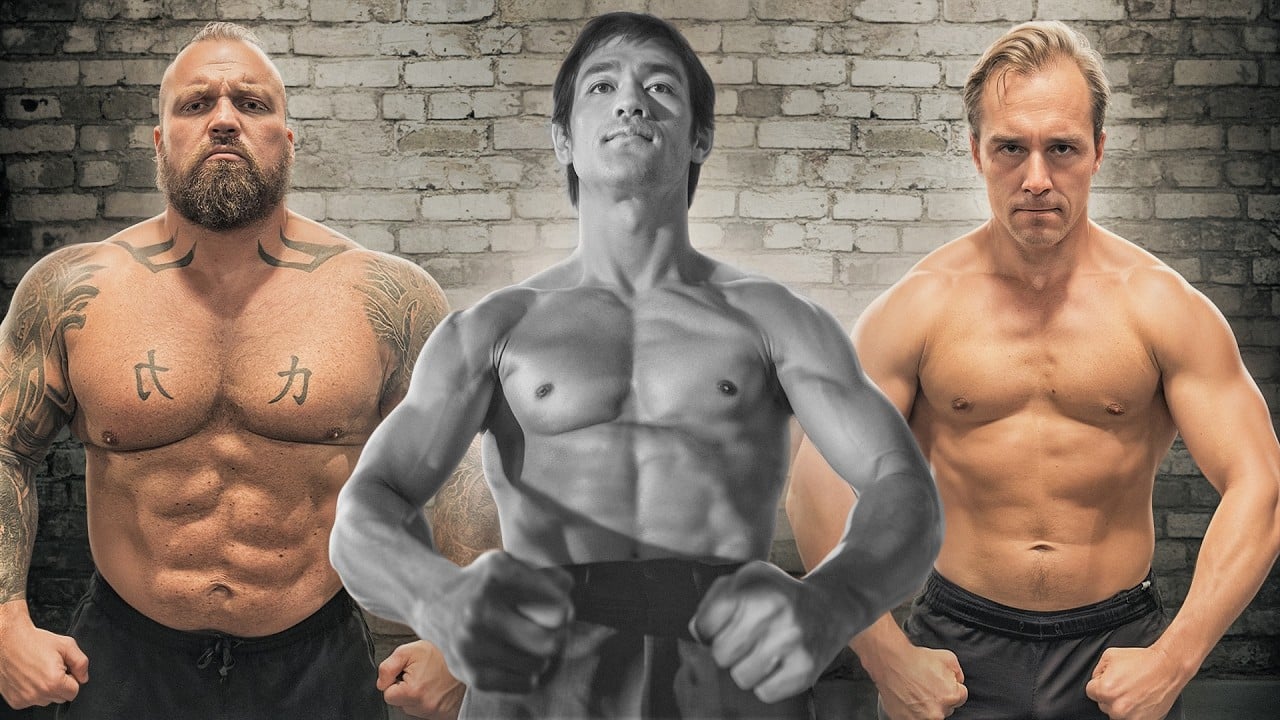
Jesse Enkamp, known as the Karate Nerd, recently joined forces with Eddie Hall to recreate Lee’s actual strength training routine. What they discovered challenges everything people think they know about old-school martial arts training.
Spoiler alert: It’s basically bodybuilding disguised as functional training, with a serious emphasis on explosive power and arm strength.
Jump to:
- Starting With Squats: Bruce Lee’s Secret to Devastating Kicks
- Bench Press: Building Punching Power From the Chest
- The Arm Assault Begins: Curls, Extensions, and Everything Between
- Forearm Training: The Grip Strength Obsession
- The Dumbbell Circle Challenge: Training to Infinity
- Core Work and Calf Raises: Finishing Strong
- The Grand Finale: Testing the One-Inch Punch
- Key Takeaways From Bruce Lee’s Training Philosophy
- Could Modern Athletes Benefit From This Approach?
Starting With Squats: Bruce Lee’s Secret to Devastating Kicks
The workout kicked off with back squats using 95 pounds for six reps. While that might sound light, Enkamp quickly realized the challenge.
I suppose when you only weigh 65 kilo, 40 kilo is like 80% of your body weight. It’s like you’re doing 130 kilos.
Hall pointed out that relative to body weight, Lee was lifting impressively heavy loads. And he did this three times per week.
This wasn’t random volume either. Squats directly contributed to Lee’s legendary kicking power by building lower body explosiveness and stability.
Bench Press: Building Punching Power From the Chest
Next up was the bench press, designed to strengthen the chest, shoulders, and triceps—all critical for generating punching force.
Enkamp initially struggled with form, prompting Hall to step in with coaching advice about proper bar path and shoulder safety.
You want it like on in line with your nipples. Yeah, lovely.
Hall emphasized that bench press done incorrectly becomes an injury waiting to happen. Proper technique matters more than ego lifting, especially when training for functional power rather than pure strength.
The Arm Assault Begins: Curls, Extensions, and Everything Between
What surprised both athletes was how arm-focused Lee’s program really was. The workout included barbell curls, French presses (overhead tricep extensions), concentration curls, and multiple tricep variations.
Hall explained Lee’s logic behind the tricep emphasis.
Bruce Lee knew that triceps make up 2/3 of the arm’s volume.
Bigger, stronger triceps don’t just look impressive—they generate more force during strikes. Lee understood anatomy decades before it became mainstream fitness knowledge.
Enkamp felt the burn immediately, especially during French presses.
Oh, I could feel that in my elbows. Yeah, it is in the elbows, isn’t it?
Push-Ups: The Martial Arts Staple
Classic push-ups made an appearance, though both athletes joked about doing them with two arms instead of Lee’s famous one-arm and two-finger variations.
Ten reps might not sound like much, but combined with everything else, the cumulative fatigue started building fast.
Forearm Training: The Grip Strength Obsession
Lee was famously obsessed with forearm and grip strength, dedicating multiple exercises specifically to wrist and finger power.
The duo performed wrist curls and reverse wrist curls, with Hall explaining the fighting application.
The stronger your grip and the stronger your forearm strength, the harder you punch. That’s a proven fact.
Enkamp struggled more than expected with these deceptively difficult movements. His right wrist gave out faster than his left, prompting some good-natured ribbing from Hall.
They also performed plate pinches—holding weight plates between fingers until failure. Hall crushed these easily thanks to his arm wrestling training, while Enkamp tapped out much sooner.
The Dumbbell Circle Challenge: Training to Infinity
One particularly grueling exercise called for dumbbell circles “until infinity”—essentially until complete muscle failure.
These involved holding dumbbells out to the sides and making controlled circular motions. Hall’s swimming background gave Enkamp hope, but reality hit hard.
I can barely do one. Can I move my whole body?
Hall pushed him through four reps with full-body English, reminding him that Bruce Lee wouldn’t quit.
Core Work and Calf Raises: Finishing Strong
The workout included sit-ups (done five sets total) and standing calf raises for 20 reps. Both exercises look simple but add significant burn when performed explosively.
Hall emphasized that Lee would have performed all exercises explosively, not slowly grinding through reps.
I’ve got in my head. So I reckon he trained all this very explosive.
Why Explosive Training Builds Speed
Many people assume heavy strength training makes athletes slower. Lee proved otherwise by training explosively.
Hall explained his own experience as a strongman.
I was a very explosive athlete during my strongman days. Like moving weight from A to B as quick as you can. And you wouldn’t think I can move fast when I want to. Really fast.
Moving weight quickly builds neurological efficiency and power output—exactly what martial artists need for devastating strikes.
The Grand Finale: Testing the One-Inch Punch
After completing the workout (which totaled around 500 reps), both athletes tested their power using Lee’s famous one-inch punch technique.
Despite having arms completely fried from training, they each attempted to break a board from just one inch away.
Enkamp went first, successfully snapping the board with minimal telegraph. Hall watched impressed by the speed and efficiency.
Then came Hall’s turn. Despite holding the world record for hardest recorded punch, the one-inch variation posed unique challenges.
He successfully broke through on his attempt, demonstrating that raw strength combined with proper technique creates devastating results.
Key Takeaways From Bruce Lee’s Training Philosophy
Several important lessons emerged from this experiment:
- Relative strength matters more than absolute numbers: Lee lifted heavy for his body weight, creating functional carryover
- Volume builds work capacity: Multiple sets of the same exercises done three times weekly develop serious conditioning
- Arm strength directly impacts striking power: Lee’s emphasis on triceps, biceps, and forearms wasn’t vanity—it was strategic
- Explosive training builds speed: Moving weights quickly develops neurological adaptations that translate to fast, powerful movements
- Grip and forearm strength amplify punch force: Stronger wrists and hands create a more solid connection during impact
Could Modern Athletes Benefit From This Approach?
Lee’s program looks remarkably similar to modern bodybuilding splits combined with explosive athletic training. That’s actually brilliant.
He built functional muscle—not just size for show, but strength and power that directly enhanced fighting ability.
Today’s combat athletes could absolutely benefit from this approach, especially the emphasis on:
- Progressive overload with compound movements
- Dedicated arm and grip work
- Explosive execution of every rep
- High-frequency training (three times weekly)
- Relative strength development based on body weight
The collaboration between Enkamp and Hall revealed that Lee’s methods weren’t just effective for martial arts—they represent timeless principles of strength and power development.
Whether someone trains for combat sports, general fitness, or pure strength, Lee’s explosive approach to traditional exercises offers valuable lessons.
His program proves that functional strength and aesthetic muscle aren’t mutually exclusive. With proper programming, athletes can build both simultaneously while developing the explosive power that separates good fighters from legendary ones.