Core training has fallen into a predictable rut for most gym-goers.
Week after week, the same planks, crunches, and Russian twists dominate workout routines.
While these foundational movements help manage back pain, without variety and progression, your core remains undertrained—limiting performance when weights get heavy and increasing injury risk.
Physical therapist and strength coach Dr. Squat University recently shared ten highly effective core stability exercises that 95% of gym-goers completely skip, all grounded in science and tested by top strength and rehab professionals.
Jump to:
Understanding Real Core Stability
Core stability extends far beyond six-pack abs. Dr. Panjabi from Yale broke down spine stabilization into three critical subsystems.
First comes the passive aspect—bones, discs, and ligaments you can’t consciously control. Next is the active system, composed of major core muscles surrounding your torso.
Last is the neural system, your body’s control center. Much like a sophisticated robot adjusting to external forces without toppling over, your nervous system constantly receives feedback from tiny sensors within muscles, tendons, and ligaments, instantaneously telling muscles how to redistribute tension for stability.
When one subsystem fails, movement quality breaks down and injury becomes likely.
Testing Your Carry Capacity
Before diving into exercises, Dr. Squat University recommends testing your baseline stability with a simple carry capacity assessment.
Find 75% of your body weight and split it evenly between two kettlebells or dumbbells. Walk while maintaining perfect posture without regripping for as long as possible.
This test, developed in part by Gray Cook, serves as a biomarker for how well your body maintains alignment, posture, and control—what professionals call real-world stability. Passing requires holding good posture for 90 seconds without regripping.
Many people with solid gym strength struggle significantly with this assessment, revealing hidden weaknesses that traditional bodybuilding and strength programs never expose.
The Six Position Carry Drill
Rather than simply training the test, build better stability using single-arm carries with Gray Cook’s six position carry drill.
Select a kettlebell you can press overhead 12 to 15 times with ease. If you struggle to meet this rep range on one arm, drop weight.
Start walking with a right-handed overhead carry. Before reaching complete failure, transition to the rack position at chest height.
When integrity breaks down in the rack position, drop weight to your side into a suitcase carry. Eventually, switch the kettlebell to your left hand and press overhead.
Continue this cycle on the opposite side, moving through rack and suitcase positions before returning to your right side. Gray Cook recommends eventually building toward 12 to 15 minutes of continuous work, though beginners should ease into that timeline.
Experiencing shoulder pain in the overhead position? Simply alternate between front rack and suitcase carries instead.
Side Plank With Leg Lift
This variation trains lateral core musculature—obliques, erectors, and quadratus lumborum—while activating the glute medius, a key pelvic stabilizer.
Start by lying on your side with your forearm on the ground, elbow directly under your shoulder. Stack legs on top of each other, then lift hips from the ground into a traditional side plank while keeping your core tight.
Next, lift your top leg toward the sky and hold for at least 10 seconds.
Research has specifically used this exercise variation to evaluate and train lateral chain endurance. It’s gold for assessing how well hips and side core muscles resist collapsing sideways, something that plays a huge role in fixing movement root causes of many injuries.
Notice a significant difference between sides? Include this exercise in workout warm-ups with four reps of 10-second holds per side, progressing in reps rather than hold time.
Offset Walk for Deep Core Activation
Dr. Squat University learned this exercise from late physiotherapist Dr. Andrew Lockwood, using it extensively with back pain patients requiring enhanced core stability.
Hang a light weight off the end of a very light bar or PVC pipe. Place the bar on your back like a back squat, then slide weight away from your torso until you feel abs kick on to keep you upright.
Without tipping over, stay tall and walk forward five to 10 steps, then backwards to your start position without losing balance.
Weight will swing and bounce around while walking, making it difficult to remain upright. That’s the magic. The instability enhances the neural subsystem, stimulating very deep core muscles running between each joint—your interspinalis, intertransversarii, and multifidus.
Their small size means their true role isn’t creating spine movement. Rather, think of them as proprioceptive muscles packed with tiny sensors called muscle spindles that sense joint position changes.
When activated, they quickly provide feedback, telling larger core muscles how to engage properly for enhanced stability. Many people with spine instability experience less back pain after performing them.
Start around 10 pounds and progress with walking duration—from 30 seconds toward one minute per set—or with slightly more weight. Don’t overload this exercise excessively, especially when dealing with back pain.
Around the World
Dr. Lockwood routinely used this drill to build core strength and control.
Rotate a kettlebell around your body five times clockwise, then five times counterclockwise. This may feel easy in a double-leg stance.
Now switch to one foot and perform the same rotations—five times clockwise and five counterclockwise. Being in single-leg stance creates a far greater stability challenge.
Finally, drop to both knees and stay tall while rotating again in both directions. Use appropriate weight and deep core muscles will fire hard, providing information needed to maintain spine stability without twisting or tipping over.
Renegade Row
This common back exercise with a twist will smoke your abs.
Assume a push-up position on top of a pair of heavy kettlebells. Tense your whole body and squeeze glutes, then press down hard into one kettlebell before rowing with your opposite hand in slow, controlled motion.
Don’t allow your body to sag, twist, or hips to shoot up. Anti-rotation is the goal.
For programming, shoot for several sets of just three to five reps per arm. Master kettlebell instructor Pavel recommends doing these with a 70-pound kettlebell.
Can’t do that weight with perfect technique yet? Drop weight and use more stable dumbbells, as very light kettlebells could tip over and risk injury. Alternatively, stick to light kettlebells but rest your opposite hand on a more stable object like a stack of plates.
Ab Wheel Rollout
This exercise challenges abdominal strength and control while turning your core into a bridge that transfers force from shoulders through torso and into hips—exactly how the core works in real life.
Start by moving your pelvis forward through hip extension until your torso forms one straight line. Don’t focus on moving arms yet, only the pelvis.
Once you’ve assumed a straight line with your torso, then move arms forward, rolling out while maintaining position.
No ab wheel? Place two small weights on a barbell for the same effect.
Finding yourself rounding your back or letting hips sag excessively? Try a regressed ball rollout instead. Focus on moving hips into a straight line with your torso, then rolling the ball out as far as possible before coming back.
Another equipment-free variation: walk-outs from push-up position. Assume normal push-up stance, stiffen core, then slowly walk hands out as far as possible before coming back. Keep your back flat the entire time, eventually walking hands out farther and holding the end position for 5 to 10 seconds.
Stir the Pot
Elite powerlifter Brian Carroll used this exercise to build his core to support his spine under a world record lift of 1,306 pounds in 2020.
It’s an outstanding drill that integrates entire anterior core musculature and lateral obliques to limit torso twisting or bending.
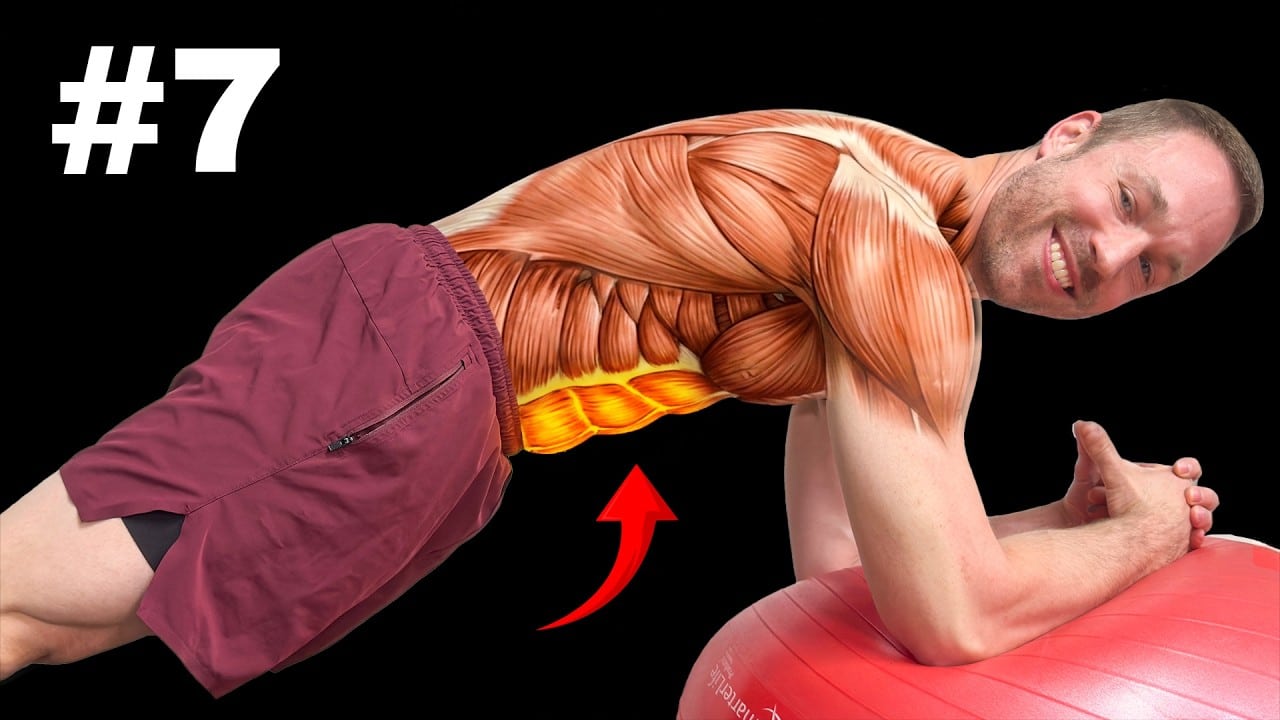
Start in a front plank with elbows on a stability ball and feet about shoulder-width apart. Rigid start position is key—stiffen core, squeeze glutes, and push your upper back away from the ball slightly to lock in desired full-body stiffness.
First time trying this? See if you can hold this plank position for 30 seconds.
Once accomplished, progress to drawing tiny circles clockwise and counterclockwise while keeping your torso completely still.
Progressions are going to look like this. Front plank, front plank on the ball, small circles. You can go north, south, east, west on it. Eventually, sets of 25, sets of 50, sets of 100, but I’ve seen people be able to increase from doing about five or 10 at a time to within the end of the summer doing 100 at a time.
Chop and Lift Patterns
These powerful functional core drills build stability in three planes of motion through distinct spiral and diagonal movements key for real-world movements, injury prevention, and transferring power from lower body to upper body.
The Chop
Set cable pulley at high position. Assume half-kneeling position perpendicular with the cable machine, with your knee closest to the machine up and a fairly narrow stance to challenge balance.
From a side view, front knee should be at 90 degrees and back knee stacked directly under hip, torso, and head for tall, stacked alignment.
Your cues: pull to center and push away. Using a tricep rope attachment, pull it to your chest with your lower arm, then push it away toward your downside knee with your upper arm.
Cable should stay close to your body and move at a constant angle while your torso remains tall. All motion comes from arms while core and hip muscles create a stable base.
Eventually, you should feel co-contraction of ab and back muscles before arms move. This reflexive stabilization is how your body naturally creates efficient movement—core stability precedes arm and leg movement.
The Lift
Lower your cable attachment to floor level. Base of support remains identical except your inside knee now goes down.
Taller individuals will need to elevate that knee on a small 4 to 8-inch step to maintain desired vertical pull angle while maintaining a slight stretch in the front of your down thigh.
With palms down, pull rope to your chest beginning with your outside arm, then press away with inside arm. This is an arm movement on a stabilized trunk—any trunk twisting should be limited.
Chops and lifts can also be performed in tall kneeling position, especially helpful for those with squat technique problems. Common form breakdowns like excessive toe-out, knee cave, or excessive back rounding can all stem from lack of hip and core stability.
FMS founder Gray Cook recommended Tim Ferriss perform these in his best-selling book The 4-Hour Body as a way to expose and clear up hidden muscular and movement imbalances.
Test how many quality reps you can do in each of the four quadrants. If one direction is significantly weaker or more unstable, perform just that one direction during weekly training for massive improvements.
Programming tip: Don’t perform a set of 10 reps in a row. Instead, do 10 sets of one rep, separating each repetition with a small pause. Take your breath, feel core engage, then move arms with perfect technique. Remember, you’re training reflexive stabilization, not just strengthening core stabilizers.
The Milko Bench Press
Learned from Milko Gorgiev, who coaches one of the world’s best weightlifters today, this exercise develops rotational control.
Position your body perpendicular on a bench with only your lower back in contact. Lock feet into ground, then keeping core engaged, lift upper back and chest slightly to lock in your torso.
Perform a controlled twist through upper back as you punch one hand as high as possible, then twist in the other direction, punching the other hand to the sky.
Focus on turning from shoulders while keeping pelvis horizontal and low back glued to bench. Perform just five reps on one arm before switching sides.
Medicine Ball Rotation Toss
All exercises up until this point have been isometric in nature. But the abdominal wall also functions as a spring, storing and releasing energy in many athletic movements—and should be trained accordingly.
Stand with feet perpendicular to a brick wall. Shift weight into your back hip, then quickly rotate through hips and release the ball toward the wall.
As soon as you catch the rebound, absorb force and immediately toss it back like a game of hot potato. Keep hands in close and minimize torso motion while focusing on generating explosive force from hips.
With this approach, the exercise becomes a true short-range plyometric drill for abs, training the elastic, reactive qualities needed in sports and dynamic movements.