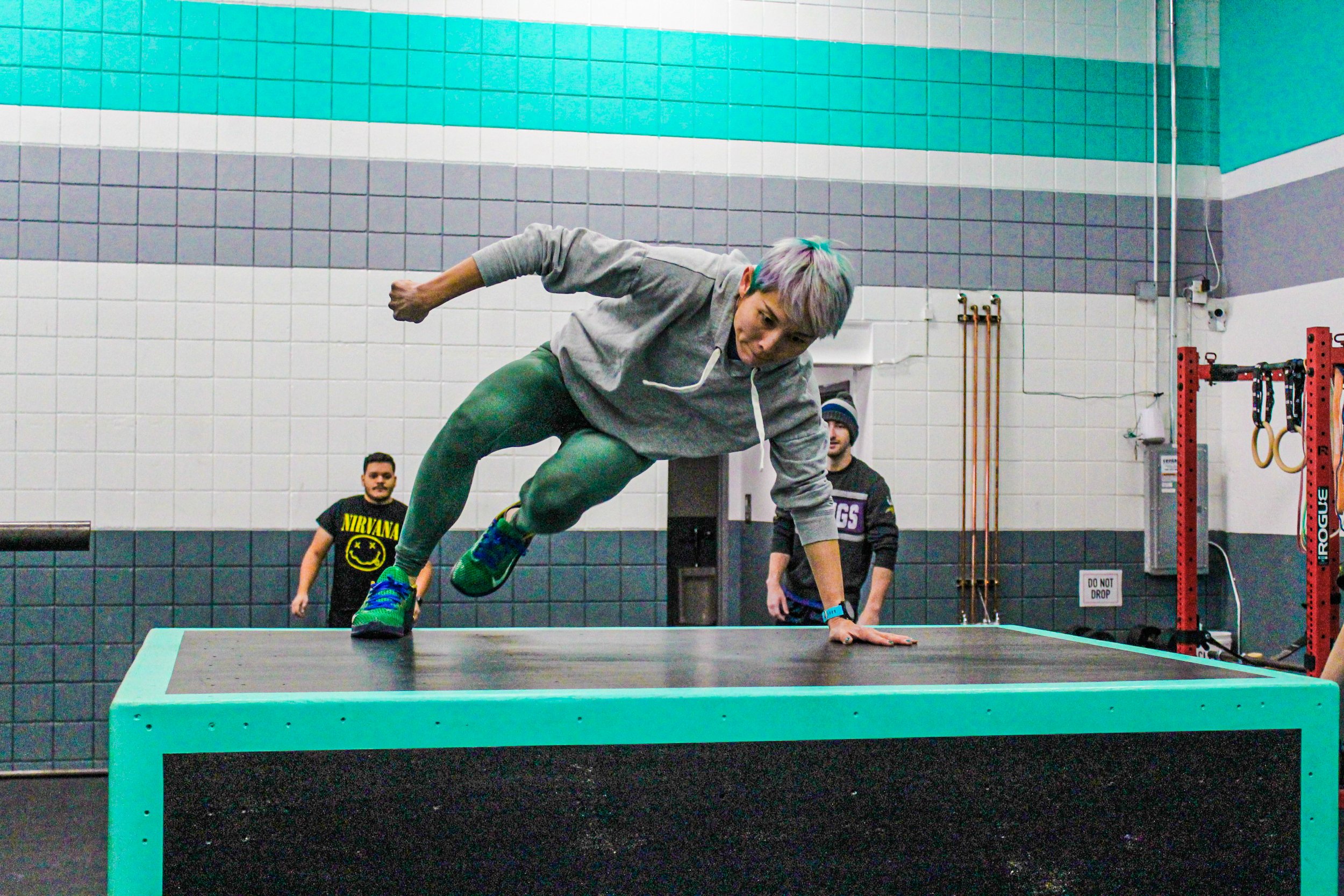
In a spacious Vancouver gym, Jane Henry sprints toward a foam obstacle, plants her hands firmly on top, and vaults her body clean over it.
She’s 60 years old, and she’s been practicing parkour for nearly 15 years.
While most people associate parkour with daredevil teenagers flipping off rooftops, a growing number of older Canadians are discovering that this dynamic discipline—built on running, jumping, climbing, and creatively navigating obstacles—might be one of the best-kept secrets for healthy aging.
And the science is starting to back them up.
Jump to:
- When Jelly Legs Lead to Something More
- The Science Behind Parkour for Aging Bodies
- Breaking Down the Intimidation Factor
- Building Confidence Through Movement Mastery
- The Reality of Risk and Injury
- Beyond Muscles: The Cognitive and Social Benefits
- Rediscovering Play in Adulthood
- A Growing Movement for Healthy Aging
When Jelly Legs Lead to Something More
Henry’s first parkour class, taken one week before her 46th birthday, left her legs trembling and her mind buzzing with possibility. She had initially visited Origins Parkour in Vancouver to enroll her son, but watching young athletes leap and swing around the gym sparked something unexpected.
I watched what all these primarily young people were doing, and my brain said, ‘I want to do that.’ It just looked like so much fun and I didn’t think about whether I could or not.
That hour-and-a-half session introduced her to movements like the Kong vault—a technique where you take a running start, plant your hands on an obstacle, and leapfrog your entire body over it with fluid momentum.
It’s very contradictory to what your brain would say is a smart thing to do.
Fourteen years later, Henry has far outlasted her son’s interest in the sport. Now retired from building houses and a previous career in fashion and costume design, she credits parkour with dramatically improving her balance, strength, coordination, and reaction time.
The Science Behind Parkour for Aging Bodies
Parkour might seem like an unlikely prescription for midlife fitness, but researchers are paying attention to activities that challenge multiple physical systems at once.
Teresa Liu-Ambrose, a physical therapy professor at the University of British Columbia and Canada Research Chair in Healthy Aging, emphasizes that targeted exercises addressing balance, strength, and muscle power are highly effective at preventing falls—reducing fall risk by upward of 28 percent.
Falls are no minor concern. As we age, the typical loss of balance and muscle power translates directly into higher fall risk, which can lead to serious injury and loss of independence.
I don’t think age in itself is a limit as to what people can try. It’s about individualizing the activity for the person.
Parkour naturally incorporates the exact movements that combat age-related decline: explosive power, dynamic balance, spatial awareness, and controlled landings. Unlike repetitive gym routines, every parkour session presents new physical puzzles to solve.
Breaking Down the Intimidation Factor
Tom Coppola, an instructor at Origins Parkour, insists that beginners—regardless of age—start low to the ground and master foundational skills before attempting anything flashy.
I really do believe parkour is for everyone.
His gym welcomes students ranging from age 5 to “as old as is willing to give it a shot.” While Origins doesn’t offer seniors-specific classes, the progressions are infinitely scalable.
Students begin with basic movements like the bear crawl—moving on hands and feet—before gradually building toward using that quadrupedal pattern to push off obstacles or pull themselves onto ledges.
Werner Tanzo discovered this firsthand. The 50-year-old IT professional from Burlington, Ontario, joined Play Project gym after a parent-child session with his son. In one early class, he faced a six-foot slanted wall that seemed impossibly tall for his 5-foot-7 frame.
When you look at it, you’re like ‘I don’t know if I can do that.’
But with instruction on using momentum effectively, Tanzo cleared that wall by the end of class.
It encourages me to keep on going when I’m able to see that type of progression.
Building Confidence Through Movement Mastery
Physical gains in parkour come hand-in-hand with mental shifts. Understanding your body’s capabilities—and limits—builds confidence that extends far beyond the gym.
Professor Liu-Ambrose stresses that anyone starting a new exercise program should consult with a physician and begin at their baseline fitness level. Parkour movements can be modified extensively for people with limited mobility or lower fitness levels, allowing everyone to participate at their own pace.
Coppola emphasizes that students learn crucial safety skills: how to fall properly, how to bail from unsuccessful attempts, and how to assess risk in real time.
Students practice rolls on the ground to absorb impact and learn to push off walls with their feet to regain balance—skills that translate directly to preventing everyday falls.
If you start going down, you might be able to do some sort of a side roll or a breakfall. That might be the difference between being able to stand back up and keep walking, or a broken hip.
The Reality of Risk and Injury
Parkour isn’t without risks. Coppola notes that common injuries include hand rips—when calluses tear from friction—and ankle sprains or impingements.
Henry has experienced her share of setbacks over 15 years, from repetitive strain injuries to cracked ribs. But she’s also developed sharper instincts about when to push forward and when to pull back.
I’ve learned how to assess that risk to be safe enough for me. Sometimes you’re about to go and something says, ‘Nope,’ and then you stop.
That internal awareness is itself a form of training. Learning to listen to your body’s signals and respect its boundaries becomes increasingly valuable with age.
Beyond Muscles: The Cognitive and Social Benefits
Parkour challenges more than just muscles and joints. The sport demands problem-solving, spatial reasoning, and creative thinking—creating beneficial cognitive load similar to activities like dance and tai chi.
Coppola explains that parkour fundamentally changes how practitioners see their environment.
A curb is no longer a curb; a curb is something you can balance on or jump between. A tree is no longer just a tree, a tree is an opportunity to climb or swing.
Professor Liu-Ambrose adds that group activities like parkour provide crucial social connection, which becomes increasingly important for well-being as we age.
Training alongside others creates community and accountability. Henry and her training partner Catherine Beston sometimes take their practice outside to playgrounds, jumping from rock to rock, swinging from monkey bars, and climbing rope structures.
Rediscovering Play in Adulthood
Perhaps the most striking aspect of parkour for older adults isn’t the physical transformation—it’s the psychological shift toward playfulness and exploration.
Parkour is a very playful activity, it kind of gets back to the roots of being a child … seeing what you could do and testing your limits.
Henry embodies this philosophy completely. When she looks at urban architecture or natural landscapes, she sees possibility rather than limitation.
Architecture is just something to play on, right? I’m always going to be a child. I don’t think I’m ever going to grow up.
A Growing Movement for Healthy Aging
While parkour for older adults remains relatively niche in Canada, dedicated seniors classes have emerged in the United States and Singapore, signaling broader recognition of the discipline’s potential for healthy aging.
The appeal is clear: parkour combines functional fitness with genuine fun. It builds exactly the physical capacities—balance, power, coordination, spatial awareness—that decline with age while simultaneously engaging cognitive and social dimensions often missing from traditional exercise programs.
For adventurous older Canadians willing to challenge assumptions about age-appropriate activity, parkour offers something rare: a complete reimagining of what aging bodies can do.
It turns everyday environments into playgrounds, obstacles into opportunities, and aging into an adventure rather than a decline.
Whether you’re 50 or 60 or beyond, the message from these parkour practitioners is simple: it’s never too late to start moving in ways that surprise you.