The number on your bathroom scale tells only half the story.
When weight drops, many people celebrate without asking a critical question: how much of that loss was fat, and how much was muscle?
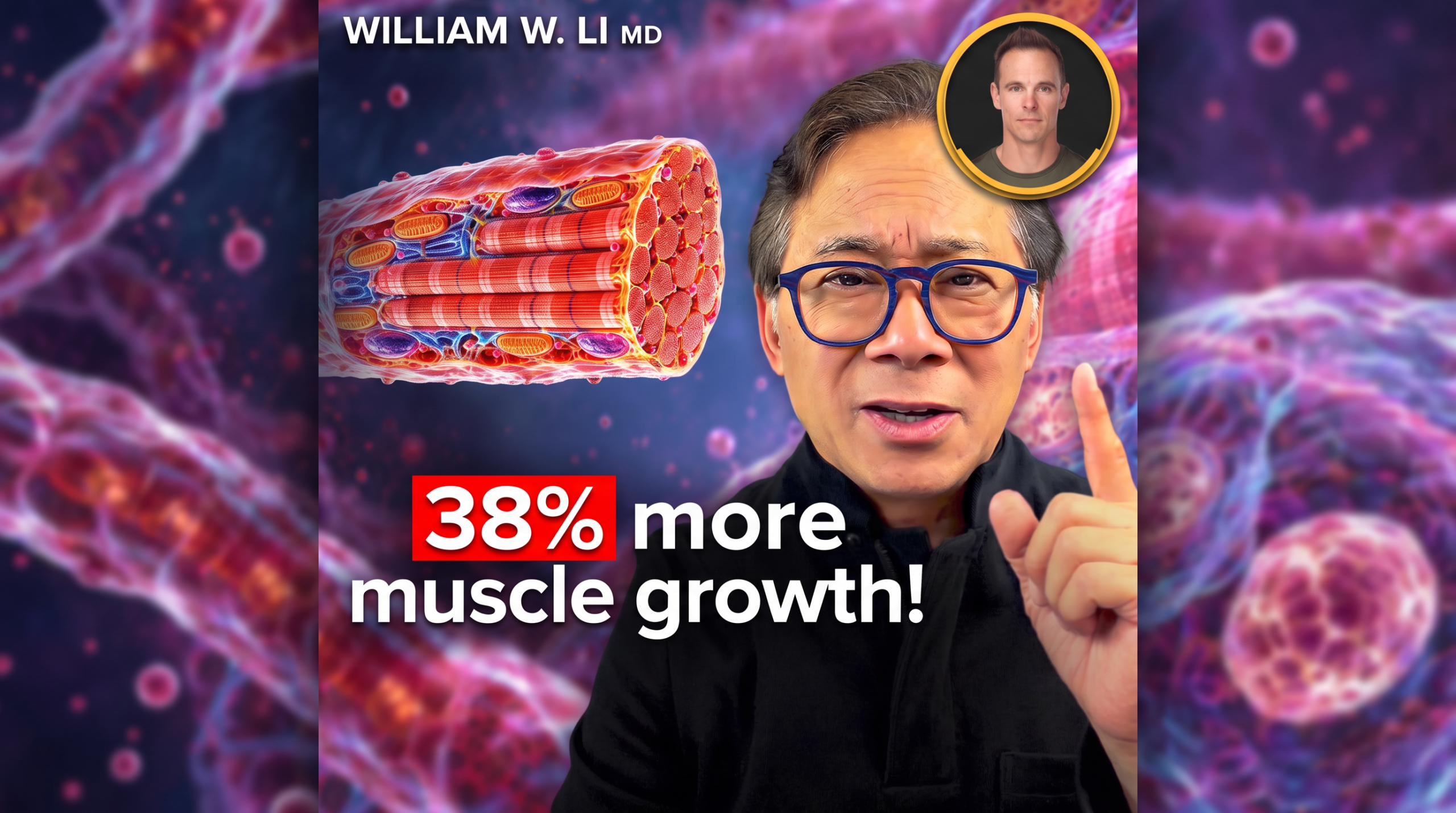
Dr. William Li, a physician and researcher specializing in vascular medicine, recently broke down why preserving muscle matters far more than most people realize—and what foods can help protect it.
His insights reveal that muscle isn’t just about appearance or strength; it’s one of the most powerful predictors of how long and how well you’ll live.
Jump to:
- The Hidden Cost of Weight Loss
- Grip Strength: A Surprising Longevity Marker
- You Lose Strength Faster Than You Lose Muscle
- Two Hidden Systems That Rebuild Muscle
- How to Keep Blood Vessels Healthy
- The Foods That Build Muscle and Blood Vessels
- Exercise: The Non-Negotiable
- A Special Note for GLP-1 Users
- Measuring What Matters
- The Bottom Line
The Hidden Cost of Weight Loss
Losing weight through diet alone comes with a trade-off many don’t see coming.
Researchers at Purdue University reviewed 52 studies of adults over 50 who were losing weight. In most participants who relied on dieting alone, at least 15% of the weight lost was lean mass—mostly muscle.
That’s a problem.
Dr. Li explains that skeletal muscle is where most blood sugar clearance happens. Researchers at the University of Texas Health Science Center at San Antonio reported that up to 80% of insulin-stimulated glucose uptake occurs in skeletal muscle.
When you lose muscle, you are losing your biggest sugar sponge. That makes blood sugar harder to control, and therefore your metabolism is much harder to control.
This makes maintaining muscle mass essential not just for strength, but for metabolic health.
Grip Strength: A Surprising Longevity Marker
Muscle strength turns out to be one of the best windows into overall health and lifespan.
The PURE study by McMaster University in Canada measured grip strength in nearly 140,000 adults across 17 countries. For every 5 kg decline in grip strength, there was a 16% higher risk of dying from any cause.
Even more striking: grip strength predicted heart-related death better than blood pressure, which has long been a gold standard for assessing cardiovascular function.
The strength that you have in your body is way more than vanity. It is one of your vital signs, like your temperature and your heart rate and your blood pressure.
Dr. Li emphasizes that strength reflects what’s happening inside your body—and it’s a signal worth paying attention to.
You Lose Strength Faster Than You Lose Muscle
Age brings natural declines in both muscle mass and strength, but the two don’t decline at the same rate.
A study at the University of Nottingham found that by age 75, men lose 3 to 4% of their strength each year, while women lose about 2.5 to 3%.
This helps explain why everyday tasks—getting out of a chair, climbing stairs, catching yourself when you stumble—become more difficult with age.
But the good news? This loss isn’t inevitable.
Two Hidden Systems That Rebuild Muscle
Inside every muscle are two recovery systems that can be activated at any age.
Satellite Cells: Your Muscle Stem Cells
Satellite cells are stem cells tucked against each muscle fiber, waiting to be called into action.
When muscle tissue is stretched or damaged—even through exercise—these stem cells race to repair and regenerate the muscle.
Capillaries: Your Muscle’s Supply Lines
Capillaries are the tiniest blood vessels in your body, thinner than a human hair.
Every muscle fiber is wrapped in these blood vessels, which deliver oxygen, nutrients, proteins, and hormones like insulin to muscle cells. They also remove metabolic waste products like lactate, which causes cramping.
Dr. Li, who specializes in angiogenesis—the growth of blood vessels—points to a fascinating study from McMaster University and Maastricht University in the Netherlands.
Researchers trained 22 healthy older men, average age 71, with 24 weeks of resistance exercise. Subjects with denser capillary networks in their muscles saw 38% larger muscle fiber growth compared to those with fewer blood vessels.
Their satellite cells also increased by about 73% with better blood supply.
Building muscle isn’t just about working out, lifting weights, going for a run, swimming. You want to make sure that your muscles have an excellent blood supply to give them the capacity to grow and regenerate.
The takeaway? Same workout, same time period, but different blood supply led to vastly different results.
How to Keep Blood Vessels Healthy
The simplest way to maintain healthy blood vessels in your muscles is to keep moving.
Exercise pushes blood through vessels, and that motion signals them to stay healthy and grow. Even walking counts.
But diet plays a role, too. Certain foods deliver bioactive compounds that improve blood flow and trigger blood vessel growth.
The Foods That Build Muscle and Blood Vessels
Protein: The Muscle-Building Switch
Every time you eat protein, you trigger muscle protein synthesis—your body’s signal to build muscle.
But as we age, muscles become less sensitive to that signal. Researchers at McMaster University wanted to know: how much protein does it take to fully switch on muscle building?
In young men (around 22 years old), it took about 16 grams of protein. In older men (around 71 years old), it took 27 grams.
Beyond that amount, extra protein in the same meal didn’t build more muscle.
Dr. Li recommends aiming for 25 to 30 grams of protein at each meal.
Here’s what that looks like in real food:
- Breakfast: Two eggs and ¾ cup Greek yogurt
- Lunch: Bean salad with a chicken thigh or half a chicken breast
- Dinner: A piece of salmon (deck-of-cards size) with half a cup of lentils
Food is the best way to get protein. You can always supplement with other protein products if you like, but I prefer to actually use food as a starting base.
Fatty Fish: Omega-3s for Muscle Growth
Fatty fish like salmon, sardines, mackerel, herring, and anchovies are rich in omega-3 fatty acids.
Researchers at Washington University School of Medicine in St. Louis gave 60 healthy adults (ages 60 to 85) either fish oil omega-3s or corn oil for six months.
The fish oil group gained 36% more thigh muscle volume, and their hand grip strength improved by about 5 pounds.
Omega-3s appear to slow the normal decline in muscle mass during aging and may help prevent sarcopenia—age-related muscle loss.
The trial used fish oil capsules equivalent to the omega-3 content of a piece of fish the size of your palm.
Beets: Nitrates for Blood Flow and Power
Beets are rich in natural nitrates, which your body converts into nitric oxide—a compound that relaxes and dilates blood vessels, improving blood flow.
Better blood flow means more oxygen and nutrients reach your muscles.
Researchers at Indiana University in Indianapolis gave 16 adults (average age 71) beetroot juice and tested their muscle strength by measuring knee extension speed.
Within hours of drinking beet juice, knee extension speed improved by 5%, and muscle power increased by 7%.
After two weeks of daily beet juice, muscle speed was up 7% and power up 9%.
Dr. Li suggests eating one beet a day—roasted, steamed, or grated into salads. Pair it with arugula, another excellent source of dietary nitrates.
Spinach is another great option.
Exercise: The Non-Negotiable
Food alone won’t do the job. You have to move.
Resistance training improves satellite cell activity and blood flow. A team at Tohoku University reviewed 16 clinical trials and found that people who did muscle-strengthening activities had a 10 to 17% lower risk of death from any cause, including heart disease and cancer.
The sweet spot? 30 to 60 minutes a week.
That’s just two short sessions a week, working your legs, hips, back, chest, shoulders, and arms.
Simple exercises include:
- Standing up from a chair without using your hands
- Pushing against a wall or counter
- Using a resistance band
The key is to make the last few repetitions genuinely hard, stressing your muscles and triggering repair signals.
Walking is excellent for cardiovascular health, and everyday activities like carrying groceries add resistance training to your routine.
A Special Note for GLP-1 Users
If you’re using a GLP-1 drug for weight loss, muscle preservation becomes even more important.
Some studies suggest that GLP-1 medications may lead to lean muscle loss in some people. While weight loss by any route can include some muscle, Dr. Li emphasizes the importance of getting enough protein and incorporating strength training into your plan.
The goal is living long and strong. Get enough protein in your diet and make sure that strength training is part of your regular plan.
Measuring What Matters
Your bathroom scale can’t tell the difference between muscle and fat.
Dr. Li uses a device called the Hum Health Pod, which measures body composition using bioelectrical impedance. It sends a tiny electrical current through the body—undetectable to the user—and measures how easily it travels.
Muscle holds more water than fat, so it conducts electricity differently. The device estimates skeletal muscle mass, body fat percentage, and even muscle distribution in each arm, your trunk, and each leg.
If one leg has noticeably less muscle, it often means you’ve been favoring one side—perhaps due to an old injury or habit.
Dr. Li steps on it once a week, usually after showering, and tracks trends over time: Am I adding muscle? Am I losing fat?
The Bottom Line
Muscle isn’t just about how you look. It’s a metabolic powerhouse, a blood sugar sponge, and a key predictor of longevity.
Two systems help you stay strong: satellite stem cells and your capillary blood supply.
The foods you eat—protein, fatty fish, and beets—combined with regular resistance training can activate those systems at any age.
Aim for 25 to 30 grams of protein at each meal, eat foods that boost circulation, and commit to 30 to 60 minutes of muscle-strengthening activity each week.
Strength is a vital sign. And it’s never too late to start building it.