In a recent video, Mitchell Hooper — former World’s Strongest Man and elite strength coach — sparked debate by asking a deceptively simple question: how much should the average man be able to squat?
The conversation quickly snowballed from basic estimates to elite lifting stats and some surprisingly insightful context.
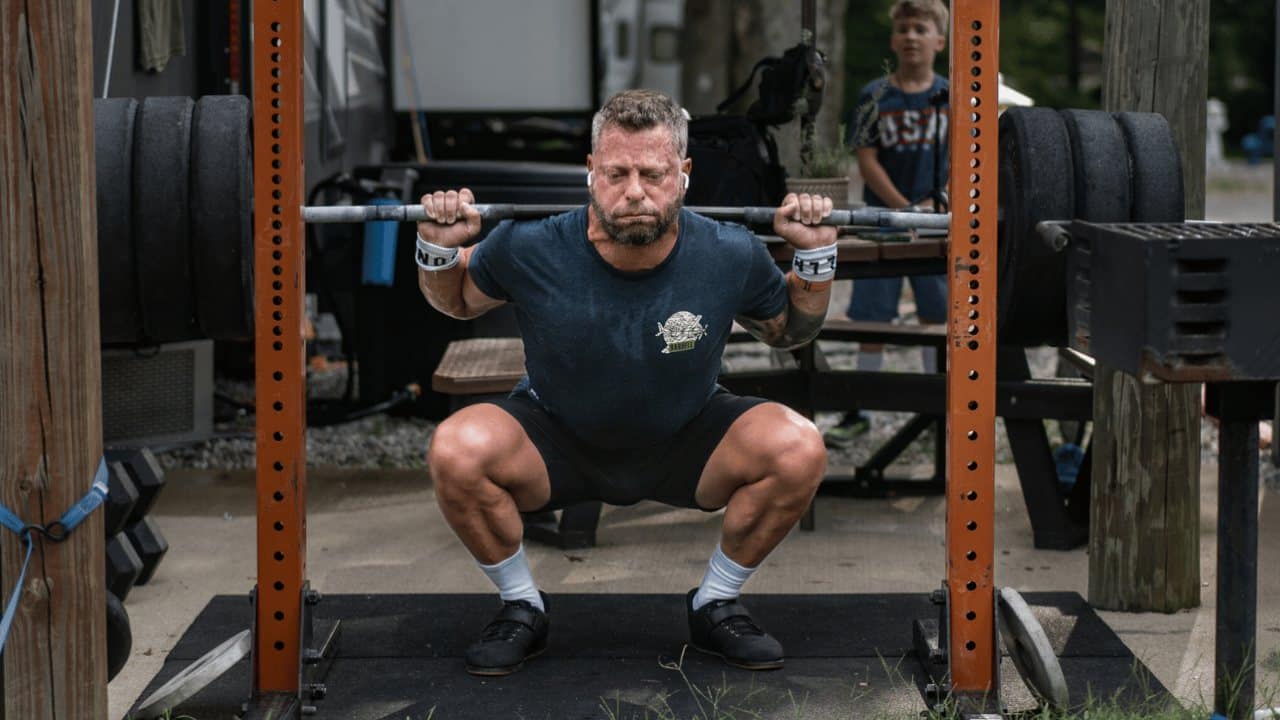
So what does the data — and real-world experience — actually say about this fundamental test of strength? Here’s what you need to know.
Jump to:
Squatting: More Than Just a Gym Exercise
Hooper starts with an essential truth: squatting is a foundational human movement.
“You go down to a toilet, up out of a chair — squatting is something that should be a normal part of everyday life,” he says.
It’s not just about big legs. The barbell squat challenges core stability, upper back posture, mobility, and full-body control. It’s one of six primary movement patterns in functional training: push, pull, hinge, squat, carry, and overhead press.
And because it uses so many muscles, it’s often considered one of the best indicators of total-body strength.
How Strong Are the Strongest?
Before answering what the average man should lift, Hooper gives us some jaw-dropping examples from the upper echelon:
- Nathan Baptist squatted 1,311.7 lbs in a squat suit at 500 lbs bodyweight.
- Vlad Alhazov did 1,157.4 lbs in knee wraps at 394 lbs.
- Ray Williams, in raw competition, squatted 1,080 lbs at 420 lbs bodyweight.
These men are outliers in every sense. But even among top-tier raw lifters closer to average size, numbers stay high. For instance, John Haack — possibly the greatest powerlifter of all time — squatted 863 lbs at around 198 lbs bodyweight.
Still, these feats aren’t realistic benchmarks for everyday people.
What Does the Data Say About “Average”?
Hooper dug into user-generated databases to find real-world averages:
- According to Strength Level, an “intermediate” lifter (training regularly for a couple of years) around 200 lbs bodyweight can squat about 350 lbs.
- In Open Powerlifting, the average squat at or below 198 lbs bodyweight is roughly 400 lbs — but again, these are trained competitors, not general population.
Clearly, those numbers reflect consistent, focused training — not casual gym-goers or inactive individuals.
Real-World Expectations: Let’s Talk “Average”
Hooper makes a key distinction: being average in society doesn’t mean being incapable. But we also shouldn’t confuse powerlifting statistics with real-world expectations.
Take this relatable example: Hooper’s own stepfather — a 60-year-old office worker with no athletic background — squats 225 lbs for 10 reps after just 3 years of working with a trainer. That’s not elite — it’s simply the product of consistent, intelligent training.
He also shares that some professional basketball players he’s coached can’t squat 225 lbs — especially tall athletes with mobility challenges. Likewise, NFL wide receivers — who are among the fittest athletes on earth — usually squat 300–400 lbs, but they also train for speed and agility, not max strength.
The key takeaway? Lifting ability varies widely, and it’s more about habits, goals, and training age than raw talent.
Mitchell Hooper’s Recommended Standard
So what does the former World’s Strongest Man himself recommend?
“Personally, I believe a reasonable one-rep max squat for the average man who is weighing 200 lbs should be 275 lbs.”
That’s two plates and a 25 on each side, give or take.
For rep targets, here’s how Hooper breaks it down:
- 2 reps at 261 lbs
- 4 reps at 247 lbs
- 6 reps at 233 lbs
- 8 reps at 220 lbs
- 10 reps at 206 lbs
- 12 reps at 192 lbs
Want a simpler test? He adds, “If you can do 225 lbs for five reps, you’re pretty much there.”
And in terms of squat depth, he avoids the endless internet arguments. His standard? Sit to a toilet. If you can squat to that depth safely and consistently, you’re in a good place.
Why This Matters for Your Health
Squatting well isn’t just about gym bragging rights. It’s one of the most valuable skills you can maintain for longevity and quality of life.
- Improved mobility and joint health
- Better posture and back strength
- Increased bone density
- Protection against injury and falls
- Greater independence as you age
Whether you’re an athlete or a desk worker, squatting builds resilience.
How to Reach That 275 lbs Goal
If your current squat is nowhere near that target, don’t stress. Hooper emphasizes consistent training of fundamental movement patterns.
Here’s how to work toward it:
- Master bodyweight squats first — work on depth, balance, and control.
- Add goblet squats or light barbell squats for strength and form.
- Prioritize progressive overload — add weight slowly and methodically.
- Strengthen your core and upper back — squatting isn’t just about legs.
- Train 2–3 times per week with proper form, and stay consistent.
- Work with a trainer if possible — especially to address mobility or technique issues.
The Bottom Line
A 275-lb squat may sound lofty for some, but it’s a realistic goal for the average man who trains regularly. More than that, it represents a standard of functional strength that supports health, independence, and long-term well-being.
As Hooper puts it:
“Strength is never a weakness.”
So, how much should the average man squat? Enough to thrive — not just survive.