Visceral fat—fat wrapped around internal organs like your liver, pancreas, and heart—may be silently increasing your risk of heart disease, diabetes, and chronic inflammation, even if you look healthy on the outside.
Dr. Sean O’Mara, a Minneapolis-based physician with both an MD and JD, has built his entire practice around identifying and eliminating this hidden threat.
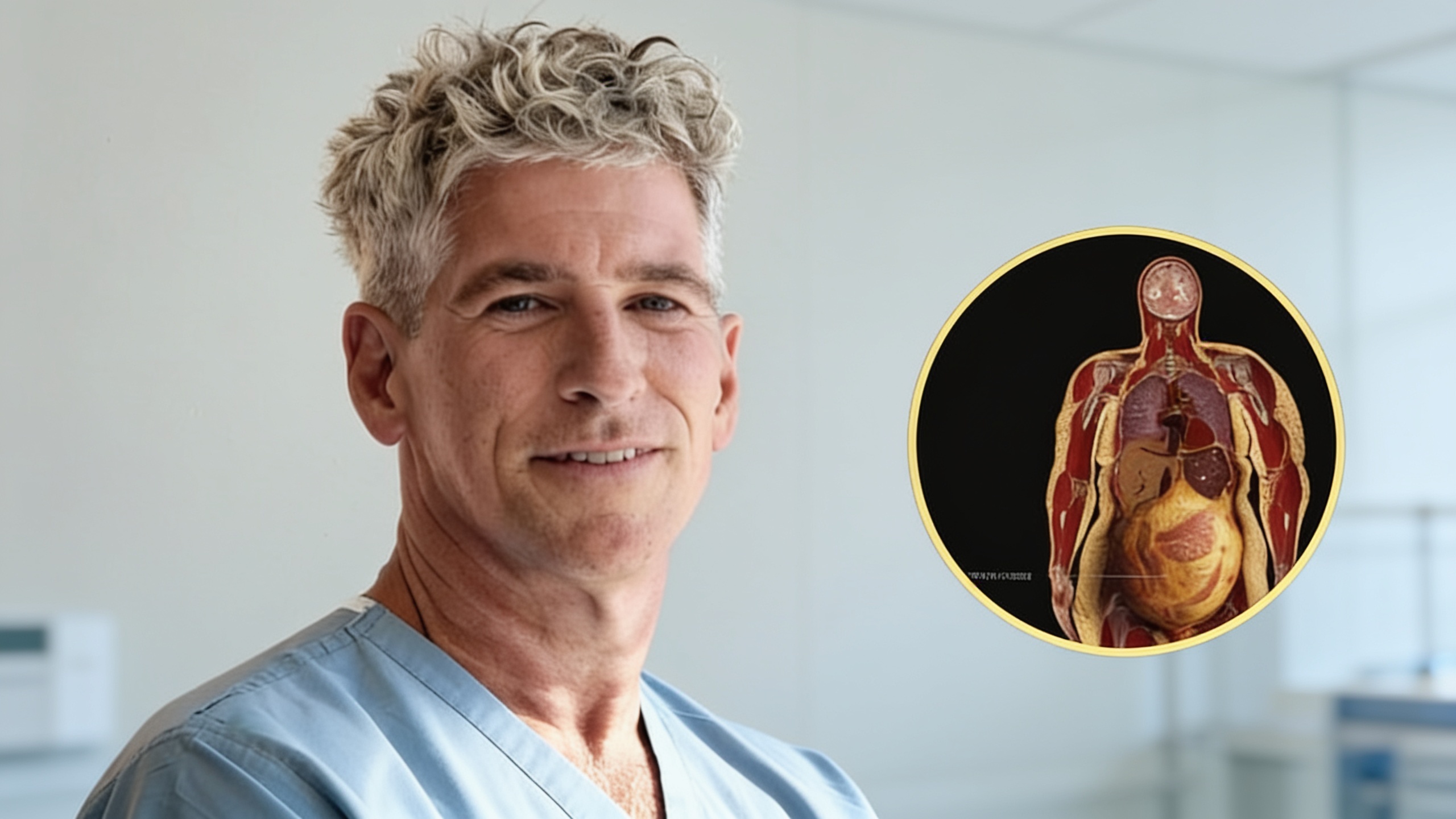
According to O’Mara, who received a reported $1.2 million National Science Foundation grant in 2016 for research on visceral fat biomarkers, traditional metrics like body weight and BMI miss the most dangerous fat entirely.
His approach? Direct MRI imaging to visualize exactly where fat hides, combined with specific lifestyle interventions to eliminate it.
Jump to:
- Why Visceral Fat Is Different—And More Dangerous
- The TOFI Trap: Normal Weight Doesn’t Mean Healthy
- How O’Mara Measures What Others Miss
- O’Mara’s Prescribed Interventions: Sprint, Cut Carbs, Ditch Processed Foods
- The Cholesterol Controversy
- What Mainstream Medicine Says About Visceral Fat
- Practical Takeaways: What You Can Do
- The Bottom Line
Why Visceral Fat Is Different—And More Dangerous
Subcutaneous fat—the kind you can pinch—sits just beneath your skin and is metabolically relatively harmless. Visceral fat operates entirely differently.
Stored deep in your abdominal cavity, visceral fat wraps around organs including your liver, intestines, and pancreas. It functions almost like an endocrine organ, actively secreting inflammatory molecules called cytokines, free fatty acids, and hormones that wreak havoc throughout your body.

If you want something simple that actually works, this is one of the most effective tools I’ve used to build strength, conditioning, and endurance without needing a full gym setup.
- Full-body training with one weight using swings, squats, and presses
- Solid cast iron build that feels stable and lasts for years
- Comfortable grip that makes high-rep workouts easier to handle
Research from Harvard and the Mayo Clinic shows these inflammatory substances contribute to insulin resistance, high blood pressure, abnormal cholesterol levels, fatty liver disease, and dramatically elevated cardiovascular risk.
The most unsettling part? You can be thin and still carry dangerous levels of visceral fat—a phenomenon researchers call TOFI, or “Thin Outside, Fat Inside.”
The TOFI Trap: Normal Weight Doesn’t Mean Healthy
O’Mara’s entire methodology centers on exposing this hidden risk. Someone might weigh 150 pounds, wear size-medium clothing, and receive a clean bill of health at their annual physical based on BMI alone.
Yet an MRI scan could reveal dangerous visceral fat deposits surrounding vital organs, setting the stage for metabolic disease years down the road.
Waist circumference and visceral fat levels are stronger predictors of cardiometabolic disease than BMI or total body weight alone.
This explains why doctors increasingly emphasize waist measurement over scale weight. Distribution matters more than total amount.
How O’Mara Measures What Others Miss
O’Mara arranges MRI scans—reportedly around $400—to directly visualize and quantify visceral fat in his clients’ torsos and upper legs. MRI represents the gold standard for fat measurement because it distinguishes between subcutaneous and visceral deposits with precision.
If you want something simple that actually works, this is one of the most effective tools I’ve used to build strength, conditioning, and endurance without needing a full gym setup.
- Full-body training with one weight using swings, squats, and presses
- Solid cast iron build that feels stable and lasts for years
- Comfortable grip that makes high-rep workouts easier to handle
Consumer body composition scales, DEXA scans, and BMI calculations can’t reliably detect visceral fat. They might show total body fat percentage, but they can’t tell you where that fat lives.
O’Mara also measures intramuscular fat deposits and psoas muscle mass during these scans, tracking markers beyond what standard medical imaging reveals.
O’Mara’s Prescribed Interventions: Sprint, Cut Carbs, Ditch Processed Foods
Once visceral fat is identified and quantified, O’Mara advocates specific lifestyle changes centered on three pillars: high-intensity exercise, dietary modification, and eliminating ultra-processed foods.
Sprint Training Takes Center Stage
O’Mara particularly emphasizes sprint training as uniquely effective for visceral fat reduction. Research on high-intensity interval training (HIIT) supports this approach—studies show HIIT effectively targets visceral adiposity more efficiently than moderate-intensity steady-state cardio.
Short bursts of maximum effort followed by recovery periods appear to trigger hormonal and metabolic responses that specifically mobilize visceral fat stores.
Carnivore and Low-Carb Diets
O’Mara advocates low-carbohydrate or carnivore-style eating patterns, positioning himself firmly within the keto and carnivore wellness communities. He’s appeared on podcasts with figures like Dr. Ken Berry and Thomas DeLauer, building substantial followings on social platforms.
If you want something simple that actually works, this is one of the most effective tools I’ve used to build strength, conditioning, and endurance without needing a full gym setup.
- Full-body training with one weight using swings, squats, and presses
- Solid cast iron build that feels stable and lasts for years
- Comfortable grip that makes high-rep workouts easier to handle
This is where mainstream medical consensus diverges from O’Mara’s specific recommendations. While reducing refined carbohydrates and added sugars has broad support for metabolic health, zero-carb carnivore diets lack large-scale randomized controlled trial evidence demonstrating long-term safety and efficacy.
O’Mara has authored a book titled Growing Better Not Older: How to biologically optimize your body, improve your appearance, and crush your goals by targeting visceral fat, outlining his complete methodology.
Mainstream-Supported Strategies
Beyond his more controversial dietary prescriptions, O’Mara recommends interventions with solid evidence bases:
- Strength training to build muscle mass and improve insulin sensitivity
- Regular walking for baseline metabolic activity
- Sleep optimization, as poor sleep correlates strongly with visceral fat accumulation
- Higher protein intake for satiety and muscle preservation
- Eliminating ultra-processed foods, which drive inflammation and metabolic dysfunction
These recommendations align with clinical guidelines from institutions including the NIH and American Heart Association.
The Cholesterol Controversy
O’Mara has stated that cholesterol measurement is less important than visceral fat measurement—a minority medical opinion that raises eyebrows among mainstream cardiologists.
While visceral fat absolutely represents an independent cardiovascular risk factor, current clinical practice still relies heavily on lipid panels for risk stratification and treatment decisions. Most cardiologists would argue both metrics matter, not one or the other.
If you want something simple that actually works, this is one of the most effective tools I’ve used to build strength, conditioning, and endurance without needing a full gym setup.
- Full-body training with one weight using swings, squats, and presses
- Solid cast iron build that feels stable and lasts for years
- Comfortable grip that makes high-rep workouts easier to handle
What Mainstream Medicine Says About Visceral Fat
The core scientific premise—that visceral fat drives metabolic disease independent of total body weight—enjoys robust support from peer-reviewed research.
Studies published by Harvard, the Mayo Clinic, and the NIH consistently demonstrate visceral fat’s association with type 2 diabetes, cardiovascular disease, non-alcoholic fatty liver disease, and all-cause mortality.
Where O’Mara’s approach becomes controversial is in the specificity of his dietary recommendations and his reliance on individual case studies rather than large clinical trials.
An endocrinologist would likely validate visceral fat as a serious concern worth addressing, while cautioning that carnivore diets and dismissing cholesterol monitoring represent personal philosophy rather than evidence-based standard of care.
Practical Takeaways: What You Can Do
Even without an MRI, you can assess and address visceral fat risk through accessible means.
Measure your waist circumference at belly button level. Men with measurements exceeding 40 inches and women exceeding 35 inches face elevated visceral fat risk, according to clinical guidelines.
If you want something simple that actually works, this is one of the most effective tools I’ve used to build strength, conditioning, and endurance without needing a full gym setup.
- Full-body training with one weight using swings, squats, and presses
- Solid cast iron build that feels stable and lasts for years
- Comfortable grip that makes high-rep workouts easier to handle
Incorporate high-intensity exercise into your routine. Whether through sprinting, cycling intervals, or other HIIT modalities, brief intense efforts appear uniquely effective for targeting visceral deposits.
Prioritize whole foods over processed options. Ultra-processed foods consistently correlate with visceral fat accumulation in research studies.
Get adequate sleep—seven to nine hours nightly. Sleep deprivation reliably increases visceral fat storage through hormonal mechanisms.
Consider resistance training at least twice weekly. Building muscle improves insulin sensitivity and metabolic health markers across the board.
The Bottom Line
O’Mara’s central message—that visceral fat represents an underdiagnosed health threat more significant than body weight—aligns with established medical research.
His diagnostic approach using MRI imaging represents gold-standard methodology for quantifying this hidden risk.
If you want something simple that actually works, this is one of the most effective tools I’ve used to build strength, conditioning, and endurance without needing a full gym setup.
- Full-body training with one weight using swings, squats, and presses
- Solid cast iron build that feels stable and lasts for years
- Comfortable grip that makes high-rep workouts easier to handle
However, his specific dietary prescriptions, particularly carnivore eating and downplaying cholesterol measurement, extend beyond mainstream clinical consensus. These represent personal philosophy informed by his work with individual clients rather than large-scale randomized trials.
For most people, the validated interventions—increasing activity, emphasizing whole foods, improving sleep, and monitoring waist circumference—offer actionable starting points without requiring controversial dietary extremes or expensive imaging.