In a recent YouTube video, Nick Norwitz of the StayCurious Metabolism newsletter laid out a headline-grabbing claim: a specific eating pattern was linked to a biological age about 2.5 years lower after just 15 days.
Not younger-looking. Younger on a blood test.
Stranger still, weight loss barely explained the drop.
A monkey experiment he covers hints at body-weight effects lingering more than 1,000 days after the diet ended.
So how solid is the science, and what does his under-$10-a-day version look like?
There’s a diet that makes people two and a half years younger in only 15 days.
Jump to:
Why the Fasting Mimicking Diet Exists
Fasting works, but fasting is hard. Norwitz explains that deeper metabolic shifts generally need about three full days of water only, which few people can stomach.

If you want something simple that actually works, this is one of the most effective tools I’ve used to build strength, conditioning, and endurance without needing a full gym setup.
- Full-body training with one weight using swings, squats, and presses
- Solid cast iron build that feels stable and lasts for years
- Comfortable grip that makes high-rep workouts easier to handle
Enter the fasting mimicking diet (FMD). Researchers wondered whether a small amount of carefully chosen food could keep the body in a fasting-like state.
Instead of eliminating food entirely, could you eat just enough to keep the experience tolerable while still convincing your body that it’s fasting metabolically?
What the 2024 Human Trial Found
The key study, published in Nature Communications in 2024, had participants complete three five-day FMD rounds, roughly one per month. Daily intake ran about 700 to 1,100 calories, mostly from fat, with very little carbohydrate and protein.
- Biological age: fell by a median of 2.5 years
- Replication: a second independent trial reportedly found almost the same result
- Fatty liver: liver fat dropped from 14% to 8% in those who started with the condition, a relative cut above 40%
- Immune aging: cell ratios shifted toward a younger profile
Here’s the twist. Pounds lost did not predict biological age improvement. Losing more weight simply didn’t mean a bigger payoff.
How “Biological Age” Was Measured
The trial used a validated blood-based score built from albumin, creatinine, C-reactive protein, blood sugar, HbA1c, and blood pressure. Norwitz notes it was not invented for this study.
Previous research had shown that this score predicts mortality better than chronological age, that is the number of birthdays you’ve had.
Still, such tests are snapshots. Norwitz once tested after only five hours of sleep and scored 18.3, versus under 18 on earlier tests, because poor sleep bumped his inflammation marker hsCRP.
Translation: these scores can be nudged in the wrong direction by a rough night.
If you want something simple that actually works, this is one of the most effective tools I’ve used to build strength, conditioning, and endurance without needing a full gym setup.
- Full-body training with one weight using swings, squats, and presses
- Solid cast iron build that feels stable and lasts for years
- Comfortable grip that makes high-rep workouts easier to handle
The Two Levers Behind the Effect
Norwitz is upfront that nobody fully understands the mechanism, since fasting remodels thousands of proteins at once.
The best and most honest answer I can give you is we don’t fully know how this works.
Stripped down, he describes two levers:
- Calorie restriction with fat as the main fuel: forces ketosis and mimics a fasting state
- Protein restriction: lowers IGF-1 and dials down mTOR, described as the cell’s growth switch
Cycles matter more than constant restriction. Norwitz does not suggest staying on this long-term, warning that prolonged calorie and protein restriction carries real risks.
These are in effect software updates and upgrades for the body that have lasting effects.
Mouse Hearts and “Differential Stress Resistance”
Some experiments can’t be done in people. In a 2023 mouse study, cancer immunotherapy inflamed and scarred the animals’ hearts.
Adding an FMD cycle calmed cardiac inflammation and fibrosis, lowered oxidative stress, and left the cancer cells more vulnerable to treatment.
Healthy cells basically hunker down and armor up.
Cancer cells, addicted to growth signals, get caught exposed. The caveat is obvious: these were mice, so the finding illustrates a principle rather than proving a human benefit.
If you want something simple that actually works, this is one of the most effective tools I’ve used to build strength, conditioning, and endurance without needing a full gym setup.
- Full-body training with one weight using swings, squats, and presses
- Solid cast iron build that feels stable and lasts for years
- Comfortable grip that makes high-rep workouts easier to handle
The Longevity Projections: Handle With Care
The researchers also modeled 20-year outcomes. Heart disease deaths were predicted to fall 17.4% and cancer deaths 6.4% with routine cycles.
Their modeling also suggested three yearly cycles, just 15 days total, could slow biological aging by about 15%, even in healthy people.
It’s hard to verify that projection since we simply can’t do 30-year randomized controlled trials on humans until death.
These numbers come from statistical modeling, not observed lifespans. Norwitz himself says to take them with a grain of salt.
The Monkey Study That Surprised Norwitz
Humans can’t ethically be monitored for years in controlled settings. Monkeys can.
In the experiment Norwitz describes, rhesus macaques followed four days of FMD, then ten days of eating freely, on repeat. Even 1,000 days after the study ended, treated monkeys still weighed less than controls.
Honestly, I’m still not sure if I completely believe them, which is why I have to show them to you.
Weight typically creeps back after stopping GLP-1 drugs, so a lasting lower “set point” would be notable. Humans share about 93% of DNA with rhesus macaques, but Norwitz admits he can’t say whether this translates to people.
If you want something simple that actually works, this is one of the most effective tools I’ve used to build strength, conditioning, and endurance without needing a full gym setup.
- Full-body training with one weight using swings, squats, and presses
- Solid cast iron build that feels stable and lasts for years
- Comfortable grip that makes high-rep workouts easier to handle
Who Benefits Most?
Participants were healthier than the average American, yet still improved as a group. Those healthiest at baseline had the least to gain, particularly people with the lowest hsCRP and blood pressure.
Norwitz offers two explanations:
- Regression to the mean: exceptional readings on day one tend to drift toward average on retest
- Noisy markers: blood pressure spikes with stress, and inflammation jumps after one bad night of sleep
His synthesis: less healthy people have more to gain, while healthier people may still maintain health and perhaps slow aging.
How to Try an FMD at Home
First, the obligatory step. Norwitz stresses talking to a doctor before any extreme diet and running self-experiments under medical guidance.
- Frequency: five consecutive days, roughly once monthly for three months a year
- Calories: one-third to one-half of usual intake, often around 1,000 to 1,100 daily
- Protein: under 10% of calories (15% is acceptable if 10% proves too hard)
- Fat: the majority of calories, leaning toward unsaturated sources like extra virgin olive oil, raw walnuts, avocado, or fish-derived omega-3s
This is not the week for low-fat protein shakes. Norwitz says they defeat the entire purpose.
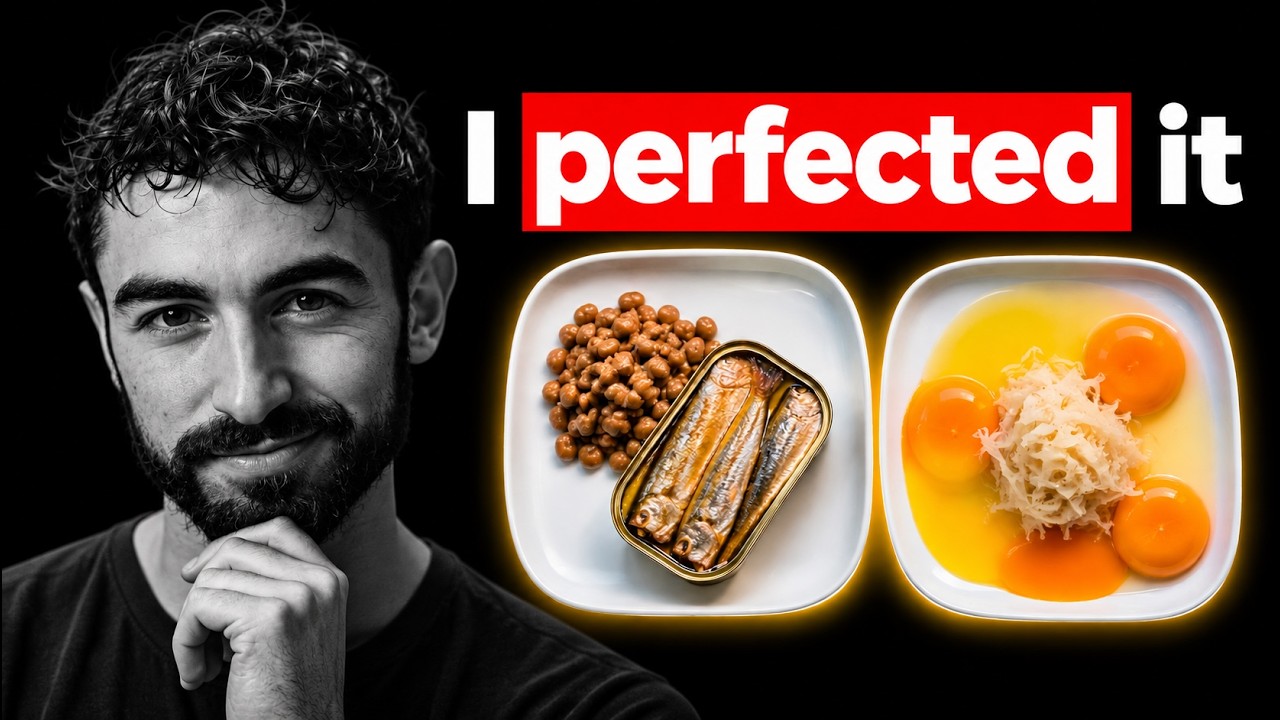
Norwitz’s Own $49 Menu
His daily menu, eaten as one meal around 5 p.m., looked like this:
If you want something simple that actually works, this is one of the most effective tools I’ve used to build strength, conditioning, and endurance without needing a full gym setup.
- Full-body training with one weight using swings, squats, and presses
- Solid cast iron build that feels stable and lasts for years
- Comfortable grip that makes high-rep workouts easier to handle
- One can of sardines
- Three tablespoons of extra virgin olive oil
- One ounce of walnuts
- One tablespoon of cod liver oil
- A quarter cup of sauerkraut
- Three pasture-raised egg yolks (no whites)
Totals: 1,051 calories, 33 g protein (12%), 99 g fat (85%), 7 g carbs, and 7.6 g omega-3s. Five days cost about $49.
His ketones reached 3.2 to 4.5 millimol on days three through five, levels he compares to a seven-day fast. He called it tolerable and “pretty delicious.”
Why His Version Differs From the Trial
Norwitz corrected a slip from earlier in his video. The trial diet was low in net carbs, at 80 to 84 g daily, yet still about 47% carbohydrate by calories.
His theory involves commercialization, since the trial used a proprietary packaged product and carbs make bars and shakes easier to formulate.
I would argue the metabolically optimal way to do it and honestly cheaper is with whole foods that are higher in fat and lower in carbs.
That remains his argument, not a trial result. His whole-food menu differs from the formulation tested, so the study’s findings don’t automatically carry over to it.
Norwitz closes with a question for viewers: how about you?
If you want something simple that actually works, this is one of the most effective tools I’ve used to build strength, conditioning, and endurance without needing a full gym setup.
- Full-body training with one weight using swings, squats, and presses
- Solid cast iron build that feels stable and lasts for years
- Comfortable grip that makes high-rep workouts easier to handle