Big muscles can still get hurt just reaching for a seat belt.
Meanwhile, lean athletes hang from one arm and land flips on a single leg without a scratch.
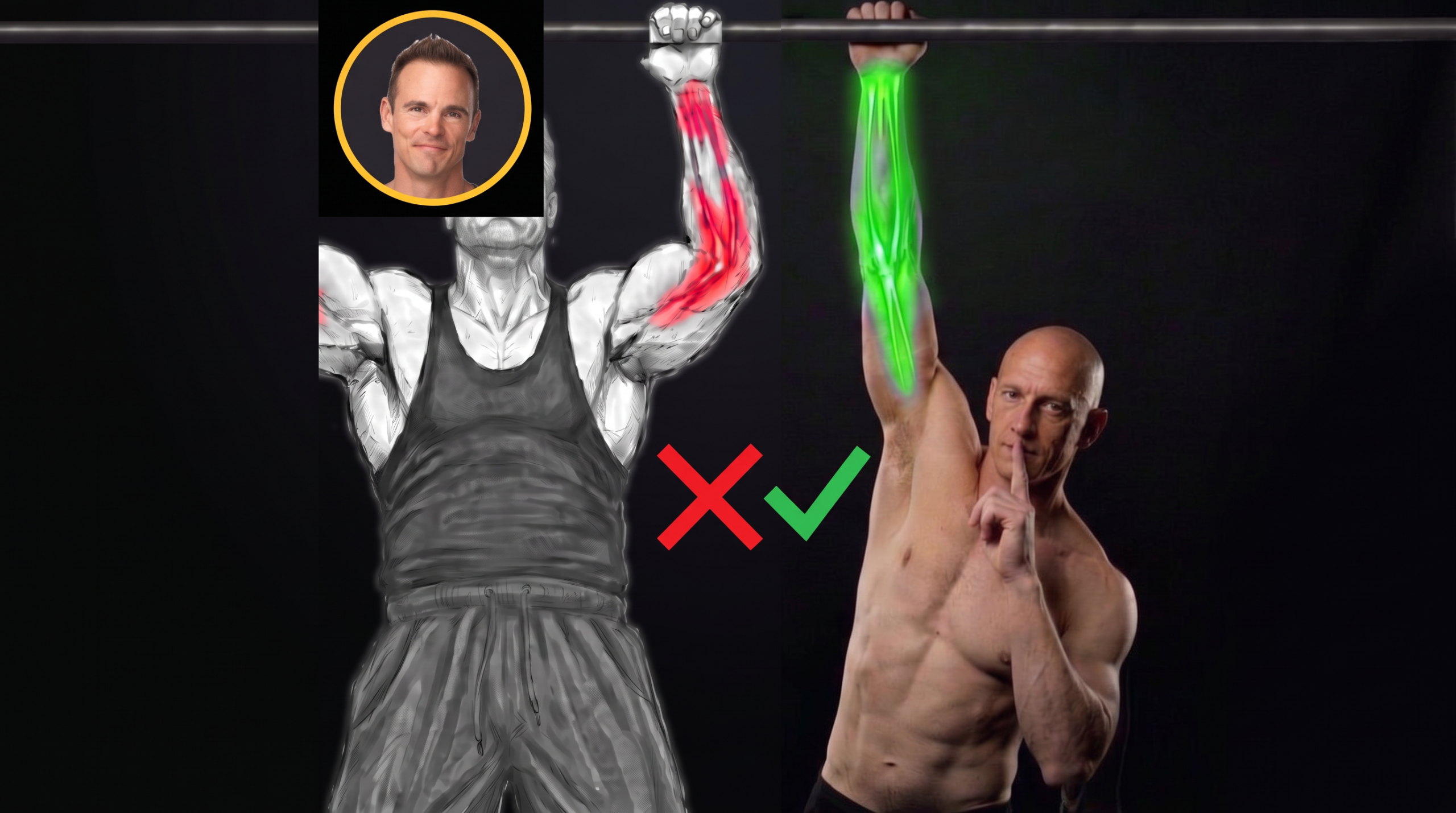
In a recent YouTube video, the coach behind Pacific Rim Athletics and Powerbatics training argued that the difference is tendons, not muscle.
He breaks down four no-barbell moves to build them, including one that most people skip.
Stick around for a quick hang test that exposes your weak link.
Jump to:
- Why Strong Muscles Still Get Injured
- Your Starting Point: The Dead Hang Test
- Move 1: The Twist Stance (Legs)
- Move 2: The Hang (Pulling)
- Move 3: The Leg Iron Cross (The One People Skip)
- Move 4: The Planche Lean (Pushing)
- The Rules for Every Hold
- Are Fast Reps Useless for Tendons?
- The Hidden Danger: Transitions
Why Strong Muscles Still Get Injured
His core argument: muscle adapts in weeks, while tendons take months.

If you want something simple that actually works, this is one of the most effective tools I’ve used to build strength, conditioning, and endurance without needing a full gym setup.
- Full-body training with one weight using swings, squats, and presses
- Solid cast iron build that feels stable and lasts for years
- Comfortable grip that makes high-rep workouts easier to handle
So when you build muscle faster than tendon, you’re like Tarzan trying to swing from dental floss.
He calls that mismatch the injury zone, and he says he learned about it painfully.
I learned that the hard way, swinging on a high bar with bent arms and an undergrip with hundreds of pounds of force going through one tendon, pop.
He eventually rebuilt his way up to one-arm pull-ups and high bar swings.
The 57% Claim
He cites a study in which men held contractions for 20 seconds at a time for 12 weeks, and their tendons reportedly grew 57% stronger. Short, fast reps in the comparison group changed almost nothing.
The video never names that study, so treat the exact percentage as a ballpark rather than a promise. The takeaway worth keeping: tendons seem to reward patient, sustained, heavy loading over months.
Your Starting Point: The Dead Hang Test
Grab a bar. Arms straight, body slack. Start a timer.
Your time sorts you into one of four buckets, which he reveals near the end of the video and which are covered below.
If you want something simple that actually works, this is one of the most effective tools I’ve used to build strength, conditioning, and endurance without needing a full gym setup.
- Full-body training with one weight using swings, squats, and presses
- Solid cast iron build that feels stable and lasts for years
- Comfortable grip that makes high-rep workouts easier to handle
Move 1: The Twist Stance (Legs)
Drop into a low stance. Rotate hips and chest fully to one side while the feet stay planted.
Knees and ankles now hold load under rotation. He calls that torque, and he says it mirrors how knees really get wrecked.
Not squatting straight down, but twisting on a planted foot. Squats never train that angle.
- The test: hold 60 seconds per side, for three rounds.
- Level up: once that feels easy, shift all body weight onto a single leg.
- Elite version: the 540 kick, which means jumping, spinning, kicking, and landing on the takeoff leg.
Skipping this foundation, he warns, is how people blow out knees while skiing, snowboarding, or surfing despite countless gym hours. Build it properly, and “they can land like a cat.”
Move 2: The Hang (Pulling)
That test you just did? It was move two. Fingers, forearms, elbows, and shoulders carried your entire body.
Most people’s grip quits long before their shoulders do or their back does or their core does. And that’s not a muscle problem, that’s a tendon problem.
Progress to a single-arm hang. Each arm takes double the load, and the shoulder must resist rotation.
Start with feet touching the floor, then remove support gradually until you hang freely.
If you want something simple that actually works, this is one of the most effective tools I’ve used to build strength, conditioning, and endurance without needing a full gym setup.
- Full-body training with one weight using swings, squats, and presses
- Solid cast iron build that feels stable and lasts for years
- Comfortable grip that makes high-rep workouts easier to handle
The high-level payoff is the one-arm sidewinder, where a straight arm swings and rotates while the shoulder catches your whole body at constantly shifting angles.
Move 3: The Leg Iron Cross (The One People Skip)
No progressions here. Mobility is the limiter, not raw strength.
If your hips won’t open, your knees and lower back do the moving for them.
His method blends stretching and strength simultaneously. Exhaling helps you sink deeper into the position.
The test is a 60-second hold with no hands. Open hips, he says, keep twisting forces from funneling through your knee.
Move 4: The Planche Lean (Pushing)
Take a push-up position with locked arms. Then lean your shoulders forward past your hands.
Every inch your shoulder moves past your wrist makes the lever longer.
Wrists, elbows, and shoulders face rapidly rising torque. Same body weight, far more tendon stress, with no plates required.
If you want something simple that actually works, this is one of the most effective tools I’ve used to build strength, conditioning, and endurance without needing a full gym setup.
- Full-body training with one weight using swings, squats, and presses
- Solid cast iron build that feels stable and lasts for years
- Comfortable grip that makes high-rep workouts easier to handle
- Test: three rounds of 60 seconds.
- Next step: the crunch planche, tucking knees tight to the chest with a rounded back and lifting the feet while straight arms bear everything.
- Advanced: a full planche, with the body near horizontal.
The Rules for Every Hold
Two requirements apply across all four moves.
- Last at least 20 seconds.
- Be hard enough that the final five seconds feel like a fight.
Hold times will climb quickly in early weeks, but he credits that to your nervous system acclimating.
The real tendon change takes about 12 weeks. Don’t judge it before then.
Resist advancing levels faster than your body is ready. Sloppy compensation just creates new weak links.
What Your Hang Time Means
- Under 30 seconds: the hang is your weak link.
- 30 to 60 seconds: average, so keep running it.
- Over a minute: time for one-arm progressions.
- Over two minutes: grip is decent, so focus on the planche lean.
He stresses this is a coaching scale, not a medical test. Retest after four weeks.
Are Fast Reps Useless for Tendons?
Not entirely, and he walks back his own claim. He describes a “pulse method” of high-volume fast reps in the 50 to 100 range.
His theory is that a blood-filled muscle pumps blood toward tendons, which he says lack their own supply, aiding recovery. That explanation is his own simplified framing, so view it as a coaching idea rather than settled science.
If you want something simple that actually works, this is one of the most effective tools I’ve used to build strength, conditioning, and endurance without needing a full gym setup.
- Full-body training with one weight using swings, squats, and presses
- Solid cast iron build that feels stable and lasts for years
- Comfortable grip that makes high-rep workouts easier to handle
You don’t want to just do long static holds, but you want to have the full spectrum of training.
The Hidden Danger: Transitions
Here comes the twist. Mastering every static position still leaves you exposed.
Nobody gets injured in a position. They get injured moving between positions, the transition, the twist into the jump, the swing into the catch, the lean into the press.
Angles change fast, forces spike, and tendons have little time to brace. His answer is linking positions into flowing sequences he calls katas, so tissues learn to take load in motion.
Quick Takeaways
- Build tendons through long, challenging holds across twisting, pulling, mobility, and pushing patterns.
- Be patient: meaningful change takes roughly 12 weeks.
- Progress gradually, especially toward single-limb and advanced skills.
- Anyone with existing joint pain or a past tendon injury should check with a qualified clinician before attempting these.