A father just made the impossible look routine.
On August 8, 2026, Stephen Biebelhausen crossed the finish line of Cleveland’s Guardian Mile in 4 minutes and 17 seconds — while pushing his baby in a jogging stroller — and the running world hasn’t stopped talking about it since.
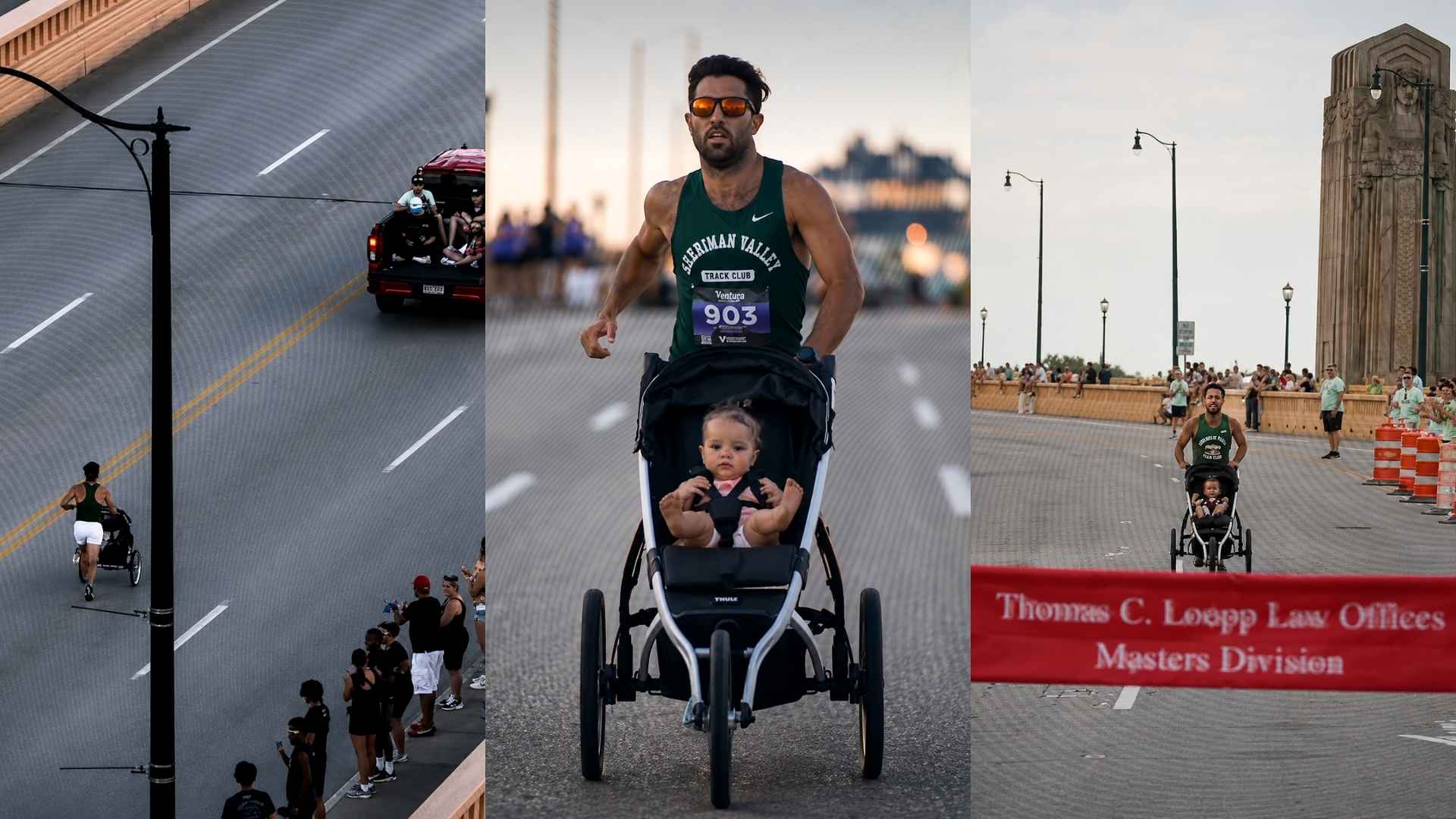
That single run didn’t just break a record; it shattered it by nine full seconds, obliterating the previous men’s stroller mile world best of 4:26.29 set just over a year ago.
Here’s why that number is even more jaw-dropping than it sounds — and what it means for every parent who’s ever used a stroller as an excuse to skip a run.
Jump to:
The Man Who Just Rewrote the Record Books
Biebelhausen isn’t some weekend warrior chasing a viral moment.
He’s a former Miami University miler and Mid-American Conference finalist with a 1500m personal best of 3:47.62. He also ran a 2:25:31 at the Boston Marathon in 2024 — the kind of résumé that places him firmly in the sub-elite tier of American distance running.
That context changes everything. A 4:17 mile sits well within his legitimate open-race range, which transforms the stroller from a gimmick into a genuine physics problem he had to solve at full speed.
What 4:17 Pace Actually Feels Like
Let’s put the number in perspective.
Running a 4:17 mile means averaging 64.25 seconds per quarter mile. Most recreational runners cannot sustain that pace for a single 400 meters at maximum effort — let alone four of them back-to-back, while steering a stroller carrying a child.
This wasn’t a fitness flex. It was a technical masterclass.
Why the Course Makes This Even Wilder
The Guardian Mile isn’t just any road race. It’s Cleveland’s premier one-mile event, run across the Hope Memorial Bridge with the city skyline as a backdrop — and it’s World Athletics-certified.
The course climbs for the first half, then drops sharply toward the finish. Elite men have broken the four-minute barrier on this very road. That net downhill plays a real role in fast times, making it inherently quicker than a flat 400-meter track oval — which is precisely where previous stroller records have been set.
And that’s where things get complicated.
Will Guinness Officially Recognize It?
Guinness World Records has strict criteria for ratifying stroller mile attempts. Prior certified marks — including Kaitlin Donner’s women’s pram record of 5:11.46 — were set on flat courses, typically a track, with documented witnesses and a child of a stated minimum age.
A point-to-point road course with measurable elevation loss is a fundamentally different proposition. The running community may already recognize Biebelhausen’s 4:17 as the world best, but the Guinness certificate is a separate — and still open — question.
Notably, even the previous men’s mark of 4:26.29 remains listed as under review pending Guinness verification. So this story is far from over.
The Three Physics Penalties He Overcame
Pushing a jogging stroller at mile pace isn’t just hard — it’s mechanically brutal in ways most people don’t anticipate.
- Aerodynamic drag: A three-wheel jogging stroller at full speed acts like a rolling parachute. Wind resistance increases with the square of velocity, meaning the faster Biebelhausen ran, the harder the stroller fought back.
- One-arm running mechanics: Pushing eliminates the natural arm counter-swing on one side, destroying stride efficiency and forcing the torso to over-rotate with every step.
- The steering tax: Roads camber. Strollers drift. Every tiny correction mid-race bleeds precious fractions of a second that add up fast over a mile.
Absorbing all three of those penalties simultaneously — and still running 4:17 — is not something raw fitness can fake.
Stroller Running Is Having a Moment
This record didn’t arrive in a vacuum. Stroller running is experiencing a genuine surge at the elite level, and Biebelhausen’s run is the latest — and most dramatic — data point.
Earlier in 2026, an Italian runner claimed the world record for the fastest 100km while pushing a pram. On the mile side, records have been falling almost annually. Sub-elite parents with real track credentials are increasingly treating the stroller division as the last open frontier in competitive running — a category where world-class marks are still within reach.
The trend line is pointing in one very fast direction.
What This Means for Parents Who Run
Nobody reading this is about to run a 4:17 mile. That’s not the point.
The point is that the stroller officially stops being an excuse. If Biebelhausen can hit that pace with his child along for the ride, Tuesday’s tempo run doesn’t get to be cancelled just because the baby needs to come too.
Research backs this up in a surprising way. Parents who train regularly with a stroller tend to build stronger posterior chains, develop better upper-body control, and push their heart-rate ceilings higher at equivalent paces — because the resistance is baked in without any extra programming required.
A father ran a mile in 4:17 with his kid along for the ride. And running just got a new impossible.
A Benchmark That Changed the Game Overnight
The moment Biebelhausen crossed the Hope Memorial Bridge finish line, the stroller mile record dropped by nine seconds and the entire definition of a legitimate stroller time shifted a full pace zone faster.
Every sub-elite miler with a jogging stroller in the garage now has a new target. Guinness will deliberate, officials will debate course legality, and the running community will argue about what counts and what doesn’t.
None of that changes what happened on that bridge in Cleveland on August 8, 2026. A real dad, pushing his real baby, ran a mile faster than almost anyone thought was physically possible in those conditions.
*Impossible* just moved again.