

A 25-year-old shoe store worker from Warren, Ohio just quietly secured his spot in one of the most competitive marathon fields ever assembled — and the running world is still trying to figure out exactly who he is.
In April, Vinny Mauri ran a 2:05:54 marathon debut at the Glass City Marathon in Toledo, making him the fastest American to ever debut at the distance, and landing him fourth on the all-time U.S. list behind only Conner Mantz, Khalid Khannouchi, and Zouhair Talbi.
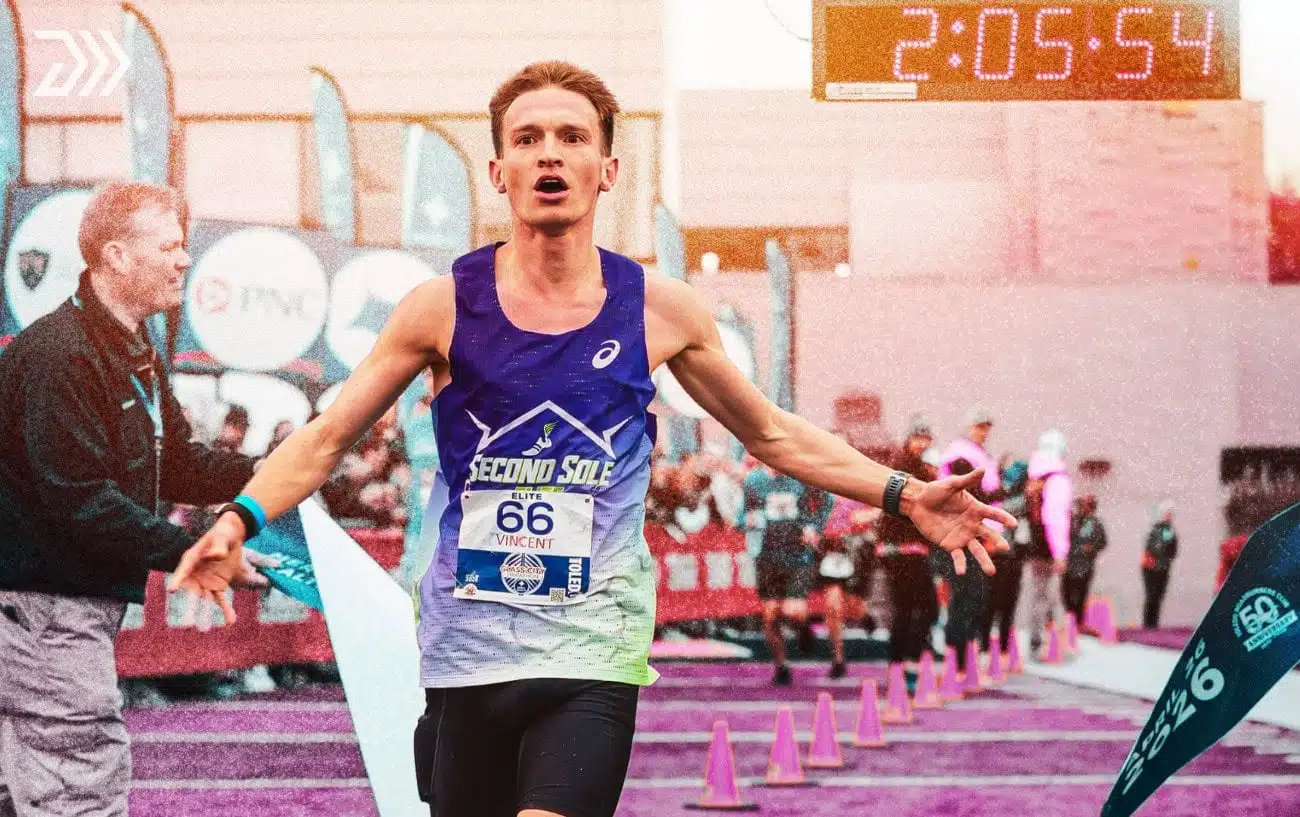
He has no coach, no agent, no shoe deal, and no training group.
Now he’s headed to the 2026 Chicago Marathon on October 11 — his second marathon ever — and the story building around him might be the most compelling in the sport right now.
Jump to:
The Fourth-Fastest American Marathon Man Has a Day Job Selling Sneakers
Three months after his historic debut, Mauri’s daily routine looks nothing like what you’d expect for a man of his caliber.
He’s back living with his parents in Northeast Ohio, working shifts at the Second Sole running store in Youngstown, fitting customers for the same type of shoes he raced to history in — without so much as a discount code to show for it.
The irony is almost too on the nose.
According to his former Notre Dame coach Chris Neal, this wasn’t a fallback plan. It was a deliberate bet Mauri made with himself after finishing graduate school — degrees from both Notre Dame and Arizona State in hand — and deciding the traditional career path could wait.
I’m going to give it a year and see if I can figure out this marathon thing, and if not, I’ll go into the workforce. But I really just want to see if I can make running work.
Toledo was the first answer to that question. Chicago will be the next one.
Self-Coached, Self-Funded, and Running on Feel
Perhaps the most striking element of Mauri’s rise is that nobody is officially guiding it.
Neal was his last formal coach, working with him at Notre Dame from 2023 to 2025. Since leaving, Mauri has designed his own program — built around double-threshold workouts on Tuesdays, the twice-a-day tempo approach made famous by Norwegian distance runners, and a surprising amount of that work logged on a Planet Fitness treadmill.
He occasionally crosses into Pennsylvania to join a group of marathoners for hard long runs. Everything else, he figures out himself.
His college career explains a lot of the self-reliance. Neal paints a picture of a genuinely gifted athlete constantly undone by injury — a severe concussion during cross country in 2023, followed by two femoral neck stress fractures across 2024 and 2025. Mauri never once raced a 10,000m on the track in college because his body simply wouldn’t allow it.
He is, I think, just a pure roads guy.
Neal also points to something less glamorous as the real turning point — not the training itself, but what Mauri started putting in his body.
He ate like a college guy.
Once Mauri rebuilt his nutrition around his workouts, he finally strung together a healthy training block. That’s when everything changed.
He Ran Into History Almost by Accident
The backstory behind his Toledo debut is almost as wild as the result itself.
Mauri had originally entered the Carmel Marathon near Indianapolis — largely to visit former Notre Dame teammates. When weather postponed that race, he pivoted to Glass City in Toledo almost on the fly. He had never run an official half marathon before that day.
He crossed the finish line in 2:05:54, solo, without a pace group, with no other contender anywhere near him.
And he did it in a pair of Asics Metaspeed Edge shoes he bought with his own money. No brand deal. No sponsor on the bib. Just a guy who bet on himself and quietly shook up American distance running.
Brands have reportedly been in contact since Toledo. Nothing has been signed. For a runner now ranked among the fastest Americans in history, that remains a genuinely strange situation — made stranger still by the fact that he spends his working hours selling those exact brands across a retail counter.
Chicago Is an Entirely Different Animal
What Toledo couldn’t answer is the question Chicago will now put to the test: what does a 2:05 mean when it’s run alone?
Mauri produced his historic time without competition, without surges, without the tactical chaos a World Marathon Major demands. The 2026 Chicago field is headlined by defending champion Jacob Kiplimo and is expected to move two to three minutes faster over the distance than anything Mauri experienced in Toledo.
Racing competitively in a pack is a fundamentally different skill from time-trialing a solo effort into the history books. October 11 will begin to tell the running world which of those Mauri’s spring performance actually predicted.
What’s already clear is the narrative lining up on that start line — a self-coached, unsponsored shoe store employee from Northeast Ohio, one marathon into his career, stepping into the deepest Chicago field ever assembled to find out just how far a one-year bet on himself can take him.
The running world is watching. And for once, so is everyone else.










