A groundbreaking study is forcing healthcare professionals to completely rethink exercise recommendations.
For years, medical guidelines have suggested that one minute of vigorous exercise equals roughly two minutes of moderate activity.
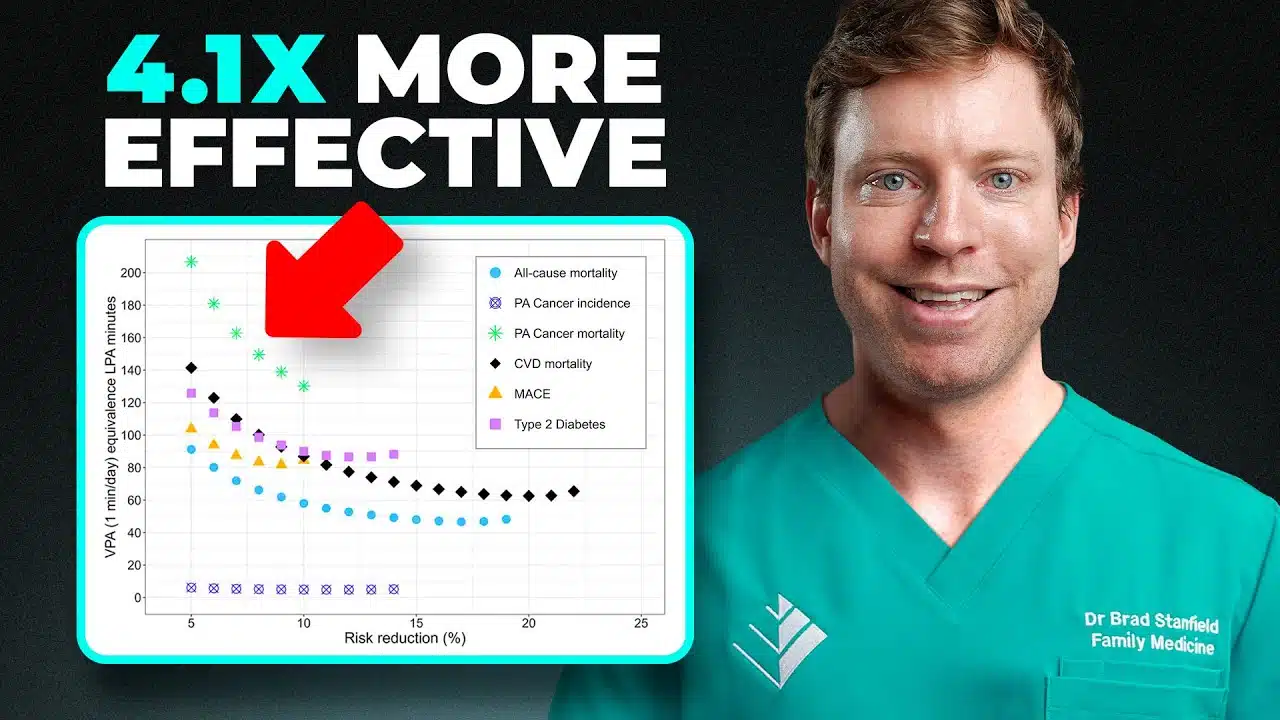
New research from the UK Biobank reveals this assumption isn’t just slightly off—it’s dramatically underestimating the power of high-intensity movement.
The findings have major implications for anyone trying to maximize health benefits while minimizing time investment.
Jump to:
The Game-Changing Discovery
Standard recommendations advise getting at least 150 minutes weekly of moderate-intensity exercise or 75 minutes of vigorous activity. This two-to-one ratio has guided public health policy for years.
But researchers analyzing data from over half a million UK Biobank participants found something shocking: vigorous physical activity delivers four to nine times the impact of moderate exercise, depending on which health outcome is measured.
For all-cause mortality, one minute of vigorous activity equals 4.1 minutes of moderate activity. For heart disease-related mortality, that ratio jumps to 7.8 minutes. The most dramatic difference appears in type 2 diabetes prevention, where vigorous exercise proves 9.4 times more effective than moderate activity.
Why Previous Studies Got It Wrong
Earlier research relied heavily on self-reported data, where participants answered questionnaires about their exercise habits. This method introduced significant bias and unreliability.
The breakthrough came from wearable devices like smartwatches that objectively measured and recorded activity levels. This technology provided unprecedented accuracy, revealing patterns previous methods couldn’t capture.
The research team examined light, moderate, and vigorous physical activity across multiple health outcomes. What they discovered challenges decades of conventional wisdom.
Light Activity: The Sobering Reality
Light-intensity activities like leisure walking require substantially more time investment to match vigorous exercise benefits.
The data shows it takes 53 minutes of light activity to equal one minute of vigorous exercise for all-cause mortality reduction. For type 2 diabetes risk, that number skyrockets to 94 minutes.
Think about those numbers for a moment. To achieve the same diabetes prevention benefits from 10 minutes of vigorous activity, someone would need approximately 940 minutes—over 15 hours—of light physical activity.
Rethinking Standard Guidelines
If this research holds up under scrutiny, current recommendations need major revision.
According to traditional advice, 75 minutes of vigorous activity equals 150 minutes of moderate exercise. But applying the new findings suggests at least 300 minutes of moderate activity would be necessary to match those benefits for all-cause mortality.
That’s double what we’ve been telling people.
Patient Case Study: Simon’s Time-Crunch Solution
Simon represents a common scenario—someone with limited time who wants maximum health benefits from minimal exercise investment.
Additional research on non-exercisers from the UK Biobank cohort revealed another crucial insight. Scientists focused on people reporting no leisure-time exercise and no more than one recreational walk weekly.
They measured what researchers termed VILPA—vigorous intermittent lifestyle physical activity. This includes brief bursts of intense movement during daily life that traditional studies completely missed.
The Power of Exercise Snacks
The median participant engaged in about three VILPA bouts daily, each lasting one to two minutes. Total weekly vigorous activity? Just 42 minutes at most.
Yet compared to those with no VILPA, this minimal activity produced extraordinary results:
- 38-40% reduction in all-cause and cancer mortality risk
- 48-49% reduction in heart disease mortality risk
- At just 3.4 to 4.1 minutes daily, mortality risk dropped 22-28%
The dose-response relationship shows diminishing returns as activity increases. Going from zero to one bout of VILPA daily creates a sharp mortality risk drop. Adding more bouts continues providing benefits, but each additional bout matters less.
Simply transitioning from completely sedentary to incorporating small activity bursts captures most of exercise’s mortality-reduction benefits.
Practical Implementation
For Simon, the recommendation focuses on “exercise snacks” throughout his day:
- Taking stairs instead of elevators for one to three flights
- Doing push-up sets during work breaks
- Performing wall squats between tasks
- Carrying heavy items with intention
- Playing actively with children
One to two minute activity bouts, three to five times daily, deliver the lion’s share of exercise benefits without requiring gym time.
When Simon eventually finds more time, prioritizing vigorous exercise will maximize his return on investment.
Patient Case Study: Henry’s Time-Rich Approach
Henry sits at the opposite end of the spectrum—he has abundant time to dedicate to fitness.
While vigorous activity proves far superior for time efficiency, doing more than two high-intensity workouts weekly isn’t recommended. Recovery matters.
Instead, Henry should incorporate Zone 2 training—exercise at an intensity where conversation remains possible. This moderate-intensity work complements high-intensity sessions without overtaxing recovery systems.
How Much Zone 2 Makes Sense?
One long-term cohort study documented measurable health improvements from up to 600 minutes weekly of moderate activity.
For someone with Henry’s time availability, combining high-intensity work with substantial Zone 2 training—plus resistance and power training—creates a comprehensive fitness program.
But the critical takeaway remains: significant health benefits come from much lower exercise volumes, especially when incorporating high-intensity movement.
The Bottom Line
This research fundamentally changes how we should think about exercise recommendations.
Vigorous activity delivers dramatically more benefit per minute than previously understood. Even brief bursts totaling just minutes daily can slash mortality risk by substantial margins.
No one can claim they’re too busy for exercise anymore. Three to five daily “exercise snacks” of one to two minutes each fit into any schedule.
The key is making those minutes count through higher intensity whenever safely possible. Walking up stairs instead of riding the elevator. Doing bodyweight exercises during work breaks. Carrying groceries with purpose.
These micro-activities that wearable devices can now track—but that questionnaires always missed—turn out to be remarkably powerful health interventions.
The future of exercise science lies in understanding not just structured gym sessions, but how accumulated daily movement patterns shape long-term health outcomes. And that future looks far more accessible than 150 weekly minutes at the gym.