Building a truly complete back isn’t about doing every exercise under the sun.
It’s about hitting four critical categories of movements that target different muscles and functions.
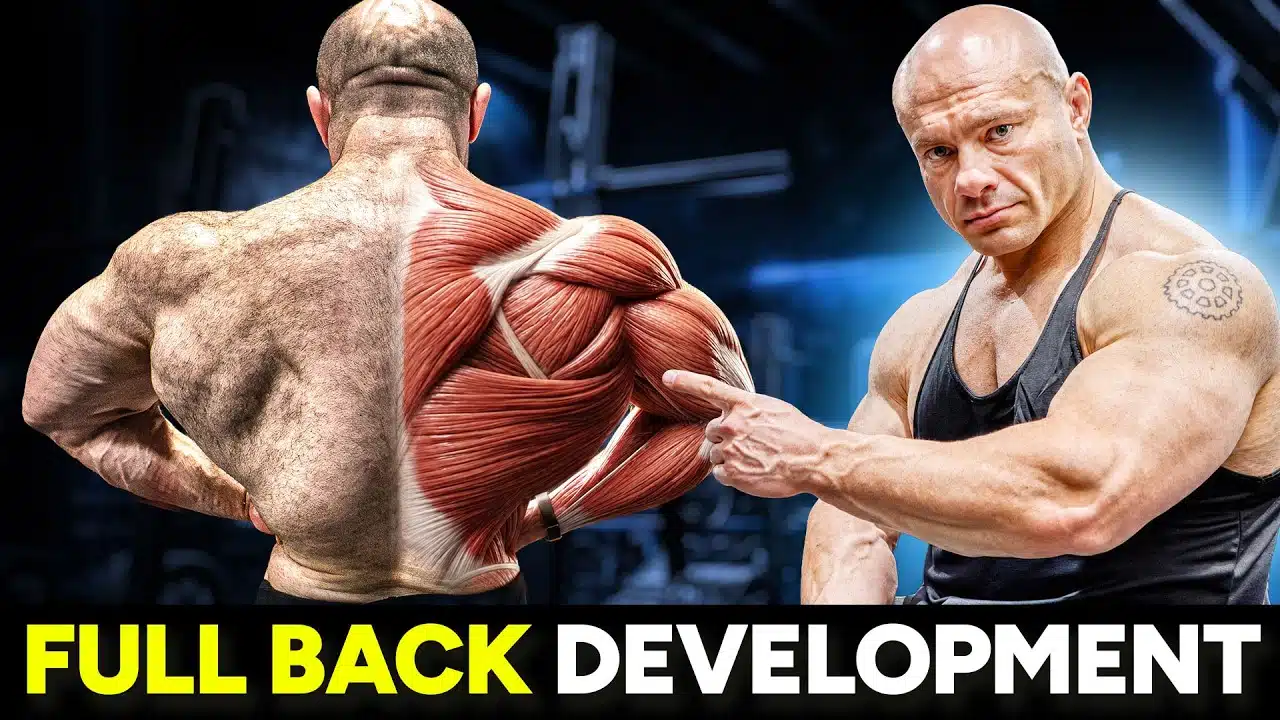
Dr. Mike Israetel, co-founder of Renaissance Periodization and respected exercise scientist, recently broke down the exact framework for constructing a logical back training plan that checks every box.
His approach eliminates redundancy while ensuring no crucial muscle group gets left behind.
Jump to:
The Problem With Most Back Training
According to Israetel, there’s a common trap lifters fall into.
There are many many many dozens of different back exercises and many of them seem to do just about the same thing. So, it’s easy to do a ton of exercises but actually end up redundantly training the same parts of your back while critically missing training foundational other parts of your back that are necessary for total development.
The solution? Focus on four core exercise categories rather than randomly selecting from dozens of variations.

If you want something simple that actually works, this is one of the most effective tools I’ve used to build strength, conditioning, and endurance without needing a full gym setup.
- Full-body training with one weight using swings, squats, and presses
- Solid cast iron build that feels stable and lasts for years
- Comfortable grip that makes high-rep workouts easier to handle
Here’s the good news: you don’t need to cram all four categories into every workout or even every week.
Category One: Straight Arm Pulls
This category includes cable lat prayers and every variation of pullover—dumbbell, barbell, EZ bar, or machine-based.
These movements target almost exclusively the lats and teres major, the muscles responsible for back width. They also toast rear delts and engage the long head of triceps.
What makes straight arm pulls special?
- Minimal systemic fatigue: They don’t drain your entire body
- Safe to failure: Easy to push hard without injury risk
- High volume capacity: Perfect for piling on sets
- Pure lat focus: Isolates lats better than compound movements
Israetel emphasizes their unique advantage: many other lat exercises create significant systemic fatigue and recruit multiple back regions simultaneously.
Straight arm pulls let you accumulate additional lat volume beyond what the rest of your back can tolerate from compound movements.
If you want something simple that actually works, this is one of the most effective tools I’ve used to build strength, conditioning, and endurance without needing a full gym setup.
- Full-body training with one weight using swings, squats, and presses
- Solid cast iron build that feels stable and lasts for years
- Comfortable grip that makes high-rep workouts easier to handle
Category Two: Vertical Pulls
This massive category encompasses every pulldown variation, every unweighted pullup, and every assisted pullup imaginable.
Literally dozens of variations exist here.
The key factors that matter:
- Big stretch at top position
- Full contraction at bottom
- Progressive overload with solid technique
- Working between 5-30 reps close to failure
There is no battle between weighted pull ups and lat pull downs. It’s all good depending on the context and if it’s between five or 30 repetitions close to failure, there are no wrong answers here.
Vertical pulls hammer your lats while also hitting rear delts, teres major, and portions of mid and upper back. They’re lat-focused movements, which matters because lats have exceptional volume tolerance.
You’ll never run out of options—a simple grip change creates essentially a brand new exercise.
Category Three: Rows
While rows do train lats to some extent, they’re really about mid-back development and thickness.
If you want something simple that actually works, this is one of the most effective tools I’ve used to build strength, conditioning, and endurance without needing a full gym setup.
- Full-body training with one weight using swings, squats, and presses
- Solid cast iron build that feels stable and lasts for years
- Comfortable grip that makes high-rep workouts easier to handle
They substantially target rhomboids, mid traps, lower traps, upper traps, and spinal erectors to some degree.
Row variations separate into distinct types:
- Barbell rows
- Underhand EZ bar rows
- Dumbbell rows
- Machine rows
- Cable rows
Israetel notes that specific details are highly individual and context-dependent. What matters universally: achieving big stretch, full range of motion, and clean technique without excessive body English.
One critical limitation exists with rows—they’re more systemically fatiguing than straight arm or vertical pulls.
You can’t just row your way to overall back size because at some point you’ll get too systemically fatigued, but your lats, which don’t experience a big stretch and thus don’t experience the biggest growth from rows, will be left unattended to relatively speaking.
This explains why complete back development requires balancing rows with lat-focused vertical and straight arm pulling.
Category Four: Spinal Erector And Trap Movements
These exercises train muscles that keep your back upright, rigid, and powerful.
If you want something simple that actually works, this is one of the most effective tools I’ve used to build strength, conditioning, and endurance without needing a full gym setup.
- Full-body training with one weight using swings, squats, and presses
- Solid cast iron build that feels stable and lasts for years
- Comfortable grip that makes high-rep workouts easier to handle
Spinal erectors run from hips to neck, forming massive cables down the center of your back. According to Israetel, you cannot achieve true thickness, injury resilience, or real-world back strength without developing gnarly spinal erectors.
Many exercises in this category also significantly stress the traps.
Deadlift Variations
Every deadlift variation tremendously stresses spinal erectors:
- Rack deadlifts
- Regular deadlifts
- Deficit deadlifts
These are extremely systemically fatiguing but essential, especially earlier in your training career when building foundations.
Hamstring-Focused Variations
Stiff-legged deadlifts and good mornings primarily target hamstrings and glutes, but they crush spinal erectors simultaneously, contributing to back thickness.
Flexion Row Variants
This subcategory includes movements that dynamically train spinal erectors through flexion and extension:
If you want something simple that actually works, this is one of the most effective tools I’ve used to build strength, conditioning, and endurance without needing a full gym setup.
- Full-body training with one weight using swings, squats, and presses
- Solid cast iron build that feels stable and lasts for years
- Comfortable grip that makes high-rep workouts easier to handle
- Jefferson curls
- Dumbbell flexion rows
- Barbell flexion rows
- Cable flexion rows
While less dangerous than heavy deadlifts (which remain quite safe with proper form), these movements build tremendous injury resilience and mid-back mass through dynamic spinal movement.
Programming Strategy: How To Structure Your Training
Israetel’s programming approach is refreshingly flexible.
You don’t need all four categories in every workout or even every week. The priority is cycling through all categories within any 6-to-12-month period.
Many exercises maintain gains from others, allowing you to focus on specific categories while leaving others on the back burner temporarily.
The Two-Group System
Think of the four categories as two broader groupings:
Group A (Width/Lats):
If you want something simple that actually works, this is one of the most effective tools I’ve used to build strength, conditioning, and endurance without needing a full gym setup.
- Full-body training with one weight using swings, squats, and presses
- Solid cast iron build that feels stable and lasts for years
- Comfortable grip that makes high-rep workouts easier to handle
- Straight arm pulls
- Vertical pulls
Group B (Thickness/Mid-Back/Spinal Erectors):
- Rows
- Spinal erector and trap movements
Pick at least one exercise from Group A and one from Group B each week.
Rotation Strategy
Regularly rotate exercises within and between categories:
- Been doing lots of rows? Switch to flexion rows or deadlifts
- Been hammering vertical pulls? Try straight arm pulls instead
- Getting stale on cable rows? Try dumbbell or machine variations
With this method of varying your back training situation, and because each one of these has dozens and dozens of options inside of its own category, you’re never going to run out of amazing back training. It’ll never get stale on you, and if it does, just switch to another exercise or another class of movement.
Frequency Considerations
Different categories demand different frequencies based on systemic fatigue:
Higher frequency options: Straight arm pulls and vertical pulls create minimal systemic stress and can be performed multiple times weekly.
Moderate frequency: Rows are more fatiguing but can typically be done twice weekly with intelligent programming.
If you want something simple that actually works, this is one of the most effective tools I’ve used to build strength, conditioning, and endurance without needing a full gym setup.
- Full-body training with one weight using swings, squats, and presses
- Solid cast iron build that feels stable and lasts for years
- Comfortable grip that makes high-rep workouts easier to handle
Lower frequency: Deadlifts, stiff-legged deadlifts, and good mornings typically appear once or twice weekly maximum. Never program all three in the same week—they’ll crush your recovery.
Spinal erector exercises create substantial fatigue but deliver fatigue “well worth it” for building thickness and injury resilience.
The Complete Back Development Blueprint
Israetel’s framework transforms back training from overwhelming complexity into elegant simplicity.
Instead of chasing every trendy exercise, focus on systematically progressing through four foundational categories. Each targets distinct muscles and movement patterns essential for complete development.
The beauty lies in built-in variety—with dozens of exercises within each category, you’ll never exhaust your options. Grip changes, equipment swaps, and angle adjustments provide endless productive variation.
Most importantly, this approach ensures balanced development. You won’t accidentally build massive lats while neglecting mid-back thickness, or develop impressive width without the spinal erector foundation to support it.
If you want something simple that actually works, this is one of the most effective tools I’ve used to build strength, conditioning, and endurance without needing a full gym setup.
- Full-body training with one weight using swings, squats, and presses
- Solid cast iron build that feels stable and lasts for years
- Comfortable grip that makes high-rep workouts easier to handle
Check boxes from both width and thickness groupings weekly, rotate exercises regularly, and cycle through all four categories over multi-month training blocks. Follow this blueprint consistently, and incomplete back development becomes impossible.