Five-time CrossFit Games champion Mat Fraser recently announced his return to competition in 2027, ending a retirement that began after his dominant 2020 victory.
But that wasn’t the only headline from his latest training session.
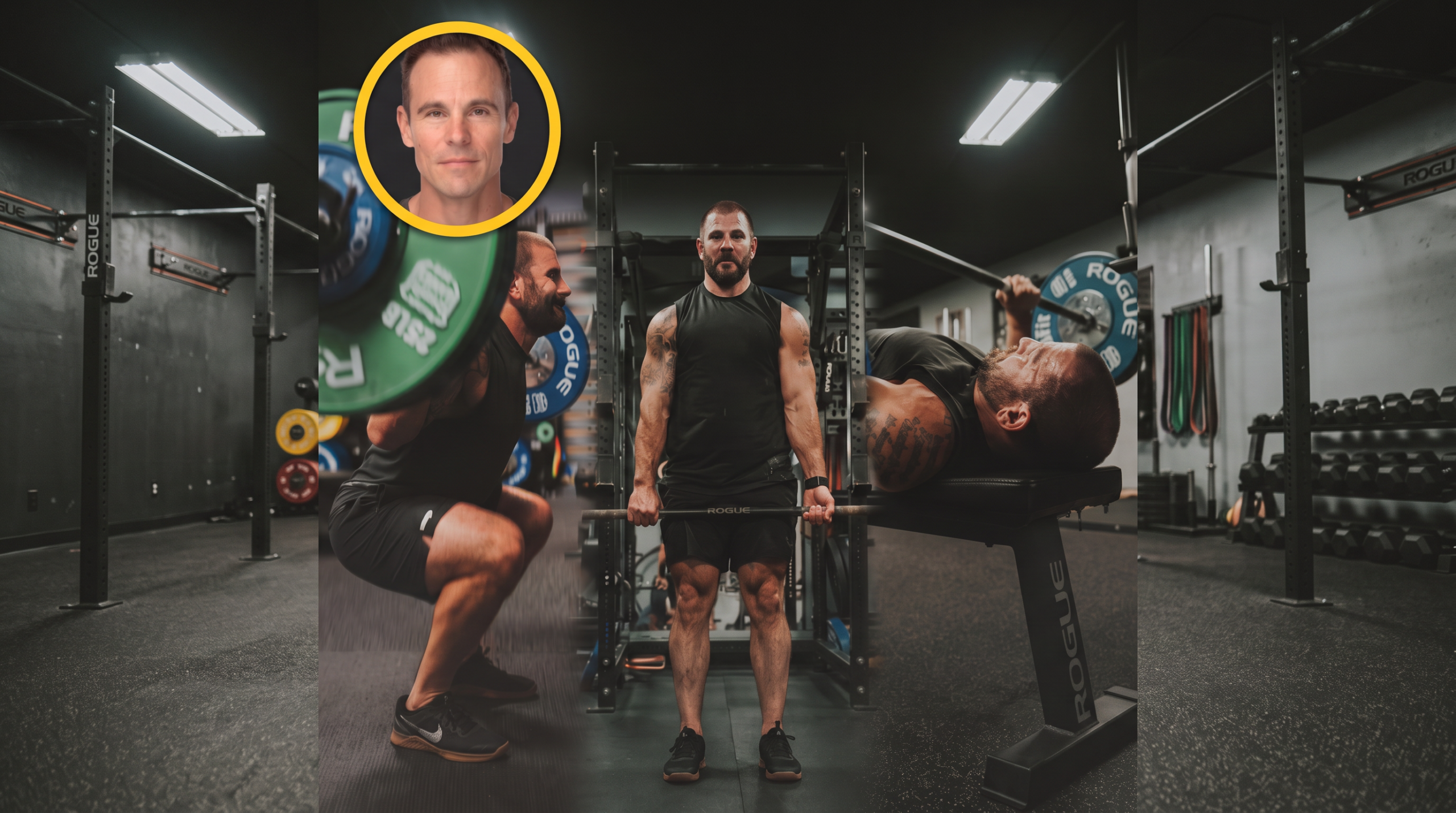
Fraser tackled a brutal bodyweight benchmark workout that revealed exactly how he approaches training—and why his methods still matter, even years into retirement.
The workout? 100 back squats, 100 bench presses, 100 deadlifts, all at bodyweight, followed by a one-mile run.
Jump to:
- The 2027 Comeback Confirmation
- The Bodyweight Benchmark That Tests Everything
- Fraser’s Strategic Approach: Sets, Reps, and Rest
- The Mile Run: Walking the Hills
- How Fraser Used to Train: Chasing Times on Social Media
- Fraser’s Remarkable Heart Rate Capacity
- Practical Lessons from Fraser’s Approach
- The Challenge: Post Your Time
- What Fraser’s Return Means for Competitive Fitness
The 2027 Comeback Confirmation
When asked directly about competing again, Fraser didn’t dodge the question.
I can confirm the plan right now is I will be competing in 2027. Yes.
The announcement marks a seven-year gap between competitions—an eternity in elite fitness.
Fraser retired after winning his fifth consecutive CrossFit Games title in 2020, cementing his legacy as one of the sport’s most dominant athletes. His return will test whether that dominance can survive years away from competition-level training.
The Bodyweight Benchmark That Tests Everything
Fraser chose a workout format popularized by athlete David Wein: a simple but devastating test of strength-endurance.
Weighing in at 194.8 pounds, Fraser loaded 195 pounds on the barbell and got to work.
The format forces athletes to manage fatigue across three major movement patterns before testing their cardiovascular capacity with a mile run. There’s nowhere to hide.
Why This Workout Format Works
High-volume resistance training followed by cardiovascular work creates what exercise scientists call “concurrent training interference”—your body must recover from strength work while performing endurance activity.
This style of training can improve both strength and aerobic capacity simultaneously, though research shows it may slightly blunt pure strength gains compared to strength training alone.
For functional fitness athletes like Fraser, that trade-off is worth it.
Fraser’s Strategic Approach: Sets, Reps, and Rest
Fraser completed the workout in 36 minutes and 58 seconds, well under his goal of 45 minutes.
His strategy revealed the calculated pacing that defined his competitive career.
Back Squats: Steady Sets of Five
Fraser maintained sets of five reps throughout the 100 squats, taking brief rest periods between sets.
Those I was just kind of winging it. Like, all right, three breaths, get back under. Three breaths, get back under.
He noted the rest periods varied—sometimes 5 seconds, sometimes 15—but the consistency of five-rep sets kept blood flowing without inducing complete muscular failure.
Bench Press: The Grind to Singles
Fraser predicted bench press would be his limiting factor, and he was right.
I think the the tough one for me is going to be the bench press. That is going to go to singles very quickly.
He started with sets of three, moved to doubles, then finished with singles in the first half of the 100 reps. Despite the reduced rep scheme, he kept rest minimal—hands staying on the bar for most breaks.
Reflecting afterward, Fraser said he’d modify his approach to sit up completely every 10 reps for more deliberate recovery.
Deadlifts: Controlled Breathing Between Sets
The deadlifts surprised Fraser—they didn’t fatigue him as much as expected.
He dropped to sets of five for the final 20 reps, using a strict breathing protocol between lifts.
Hit five, drop it, step back, sit in a squat, three deep breaths. I was giving myself five breaths every break. Three in the squat, one as I stood up, and then one as I was going down to grab the bar.
This breathing strategy served dual purposes: slowing his heart rate for recovery while also extending rest time.
The Mile Run: Walking the Hills
After 300 reps of heavy lifting, Fraser tackled the mile run on hilly terrain—a complication he noted for future attempts.
And then if I were to do this again, I would 100% do it with a flat run.
His adductors were pumped from the squats and deadlifts, limiting his agility on the inclines. He walked the steepest sections, then resumed running on flat road.
The run component tests neuromuscular fatigue—your muscles’ ability to coordinate movement after intense resistance work. Fraser’s strategic walking on hills shows experienced judgment: preserving movement quality prevents injury and often results in faster overall times than grinding through compromised running form.
How Fraser Used to Train: Chasing Times on Social Media
Fraser’s choice of this benchmark workout was nostalgic—a throwback to his early training days between 2013 and 2015.
Everyone posted their training. Everyone posted a Metcon of the day with their time and everything. So, I would just go through all my competitors’ social media pages. I would just like take their workout, like they’re all right, that’s a good one. That’s a good one.
Back then, Fraser didn’t understand why competitors shared their training publicly—he saw it as giving away competitive intelligence.
But he exploited it ruthlessly, using their posted times as benchmarks to beat.
The Noah Olsen Strategy
Fraser particularly targeted athlete Noah Olsen’s workout times.
When Comptrain was like a free blog, I didn’t know who he was. Like I never seen him before. But I would follow it like 3 days in arrears. And I would just wait until this kid, Noah Olsen, posted his times.
Fraser would wait days after workouts were posted, then attack them with Olsen’s time as his target. This gave him pacing guidance for workouts where he didn’t yet have the experience to judge effort levels.
I would look at workouts. I’m like, I don’t know if this is a 5-minute pace or a 10-minute pace workout. Like I didn’t know how to do that yet. So I would just use the resources at hand and let let other people guide me.
Fraser’s Remarkable Heart Rate Capacity
During the workout, Fraser wore a heart rate monitor—curious to see his cardiovascular response after years of semi-retirement.
He recounted an extraordinary moment from after his knee surgery when his heart rate was measured at 208 beats per minute during a moderate-intensity bike session.
I wasn’t even like going hard. Like it wasn’t like a 20-minute max effort or anything like that. I’m checking my counting for 15 seconds, doing the math and I’m like, what the
His coach Jake verified the measurement manually with a stopwatch.
That wasn’t off a chest strap. Like that was us like with a stopwatch and counting the beats.
Most remarkably, Fraser was holding a conversation at this heart rate—something typically impossible at such high cardiovascular stress.
Jake later shared this story as evidence of Fraser’s unique physiology.
Other than working harder than everybody else, he can also hold a conversation at a 208 heart rate, which is a pretty wild.
Maximum heart rate varies significantly between individuals and is primarily determined by genetics and age. While 208 bpm is exceptionally high, elite endurance athletes often have larger hearts with greater stroke volume, allowing them to sustain high heart rates with less perceived exertion than untrained individuals.
Practical Lessons from Fraser’s Approach
Fraser’s performance offers actionable strategies for anyone attempting similar high-volume workouts.
Strategic Rest Beats Random Rest
Fraser emphasized being more deliberate about rest intervals in future attempts. Structured breathing protocols—like his five-breath rule during deadlifts—provide measurable rest without allowing complete recovery that wastes time.
Drop Reps Before You’re Forced To
Fraser proactively reduced rep schemes before hitting failure. Starting bench press with triples, then doubles, then singles kept him moving steadily rather than grinding to exhaustion and needing extended breaks.
Use External Benchmarks for Pacing
Fraser’s early strategy of chasing other athletes’ times solved a common problem: not knowing how hard to push unfamiliar workouts. Having a target time provides both motivation and pacing guidance.
Environmental Factors Matter
Fraser identified terrain as a major variable affecting his mile time. Controlling environmental factors—flat running routes, climate-controlled training spaces—removes variables that complicate performance assessment.
The Challenge: Post Your Time
Fraser issued a direct challenge to anyone attempting this workout.
If you do this workout, put your time down in the comments. I would love to see how my time compares.
He also offered scaling guidance for recreational athletes.
If you’re, you know, fitness for fun, do it with a nice light weight. It will kick your ass no matter what.
The workout format works at any loading—the limiting factor is muscular endurance and cardiovascular capacity, not absolute strength. Scaling the weight allows athletes of all levels to experience the same metabolic and mental challenge Fraser faced.
What Fraser’s Return Means for Competitive Fitness
Fraser’s 2027 comeback represents an unprecedented test case in functional fitness.
No athlete has ever returned to elite CrossFit competition after such an extended retirement. Most retire due to declining performance or accumulated injuries that make continued competition unsustainable.
Fraser retired at his peak, leaving the sport undefeated. His return asks whether strategic rest and intelligent training can preserve athletic capacity better than continuous competition.
Early evidence suggests he’s retained significant capacity. Completing this bodyweight benchmark in under 37 minutes demonstrates strength-endurance levels that exceed most competitive athletes, despite years of reduced training volume.
The 2027 competition season will reveal whether Fraser’s methodical, evidence-based approach can overcome the Father Time that eventually defeats every athlete.
Based on what he showed in this workout—and the strategic thinking behind his every decision—betting against him seems unwise.