Strong forearms aren’t just about aesthetics—they’re about function, grip strength, and overall athletic performance.
Whether you’re gripping a barbell during deadlifts or simply opening a stubborn jar, forearm strength matters more than most people realize.
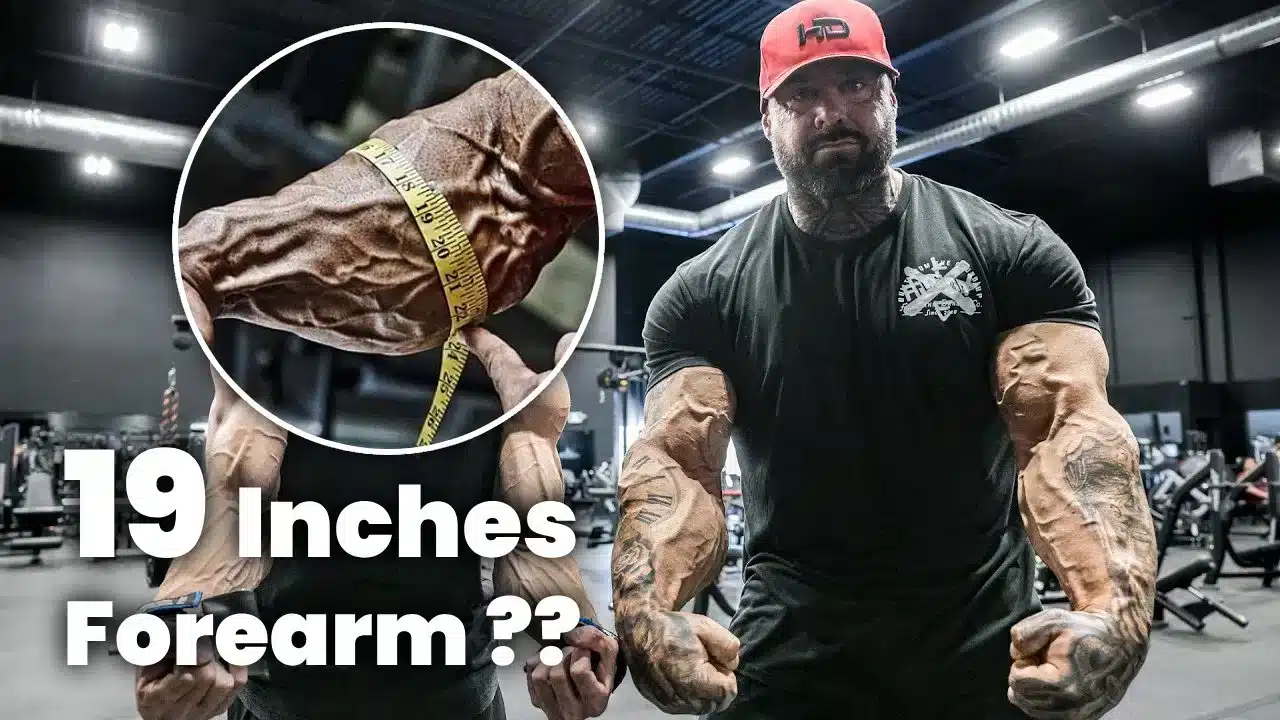
So what’s considered average, and when do forearms cross into “big” territory?
The numbers might surprise you—and understanding where you fall on the spectrum can guide your training decisions moving forward.
Jump to:
- What Are Considered Big Forearms?
- Factors That Shape Forearm Size
- Understanding Forearm Anatomy
- Why Forearm Size and Strength Matter
- Average Forearm Size for Men: The Full Breakdown
- Average Forearm Size for Women: What the Data Shows
- Can You Actually Increase Forearm Size?
- How to Measure Your Forearm Circumference Correctly
- Building Bigger Forearms: The Core Strategies
- Frequently Asked Questions About Forearm Size
- Sources
What Are Considered Big Forearms?
For men, forearms measuring over 14 inches in circumference typically fall into the “big” category, well above the average of 12.2 inches.
Women with forearms exceeding 10.5 inches are similarly considered to have larger-than-average development, compared to the typical 10.3 inches.
These benchmarks aren’t carved in stone. Height, body composition, and overall muscle development all play significant roles in what’s normal for any individual.
Genetics set the foundation, but training, nutrition, and lifestyle choices can shift those numbers dramatically over time.
Factors That Shape Forearm Size
Forearm size is a blend of nature and nurture. Genetics determine your baseline muscle composition and growth potential, but environment and lifestyle can amplify or diminish that blueprint.
Regular strength training—especially exercises that target grip and wrist movements—can markedly increase muscle size.
Conversely, a sedentary lifestyle or lack of targeted exercise typically results in less pronounced forearm development. Nutrition fuels the process: adequate protein intake supports muscle repair and growth, while deficiencies stall progress.
Age also matters. Muscle mass naturally declines with age unless actively maintained through resistance training.
Understanding Forearm Anatomy
The forearm consists of two primary bones: the radius and the ulna. These bones support a complex network of muscles divided into two main groups: flexors and extensors.
The flexors reside on the palm side and are responsible for curling fingers and bending the wrist toward the forearm. The extensors, located on the back of the forearm, facilitate straightening the fingers and wrist.
This musculoskeletal harmony allows for an impressive range of movements—from gripping a barbell to executing a perfect pull-up. Understanding this anatomy is crucial for targeted training and injury prevention.
Neglecting either muscle group can lead to imbalances and increase injury risk during lifting or daily activities.
Why Forearm Size and Strength Matter
Strong forearms enhance grip strength, which is fundamental in CrossFit, weightlifting, and functional fitness. A firm grip translates to better control and efficiency in exercises like deadlifts, rows, and kettlebell swings.
Moreover, forearm strength contributes to wrist stability and health—vital not only in lifting weights but also in everyday activities like carrying groceries or typing.
Neglecting forearm development can create imbalances that ripple through the entire kinetic chain, potentially leading to injuries in the wrists, elbows, or shoulders.
In short, strong forearms are a foundation for overall upper-body performance and longevity in training.
Average Forearm Size for Men: The Full Breakdown
Data from comprehensive measurements reveal a detailed picture of how forearm sizes vary among men across the population.
At the 1st to 5th percentile (26.3 cm – 27.5 cm / 10.35 inches – 10.83 inches), forearms are significantly smaller than average. Men in this range often have naturally slighter builds or less muscle development.
The 10th to 25th percentile (28.3 cm – 29.5 cm / 11.14 inches – 11.61 inches) indicates below-average forearm sizes, typically seen in men who don’t engage in regular resistance training.
The 30th to 50th percentile (29.8 cm – 31 cm / 11.73 inches – 12.2 inches) represents the mid-range. The 50th percentile—31 cm or 12.2 inches—is the median, the middle point of the distribution.
The 55th to 75th percentile (31.2 cm – 32.4 cm / 12.28 inches – 12.76 inches) indicates slightly above-average forearms, often found in men who train regularly or have naturally larger frames.
The 80th to 95th percentile (32.8 cm – 34.8 cm / 12.91 inches – 13.7 inches) represents noticeably larger forearms, typical of dedicated lifters or athletes.
Finally, the 97th to 99th percentile (35.4 cm – 36.5 cm / 13.94 inches – 14.37 inches) is the upper extreme—exceptionally large forearms, often seen in bodybuilders, powerlifters, or those with rare genetic advantages.
Average Forearm Size for Women: What the Data Shows
Women’s forearm sizes follow a similar distribution pattern, though the absolute measurements are smaller on average.
At the 1st to 5th percentile (22.5 cm – 23.5 cm / 8.86 inches – 9.25 inches), forearms are significantly below average, often reflecting lighter builds or minimal muscle development.
The 10th to 25th percentile (24.1 cm – 25.1 cm / 9.49 inches – 9.88 inches) indicates below-average sizes, common among women who don’t regularly engage in strength training.
The 30th to 50th percentile (25.4 cm – 26.3 cm / 10 inches – 10.35 inches) is the mid-range. The 50th percentile—26.3 cm or 10.35 inches—represents the median forearm size for women.
The 55th to 75th percentile (26.5 cm – 27.6 cm / 10.43 inches – 10.87 inches) indicates slightly above-average forearms, typical of women who train regularly or have naturally larger frames.
The 80th to 95th percentile (27.9 cm – 29.6 cm / 10.98 inches – 11.65 inches) represents noticeably larger forearms, often seen in athletes or dedicated fitness enthusiasts.
The 97th to 99th percentile (30.3 cm – 31.3 cm / 11.93 inches – 12.32 inches) is the upper extreme—exceptionally large forearms for women, typically found in competitive athletes or bodybuilders.
Can You Actually Increase Forearm Size?
Yes, forearm muscles respond to resistance training just like any other muscle group in the body. By engaging in specific exercises that target the forearm muscles, you can stimulate growth and strength gains.
Research backs this up. A 2022 study published in Applied Sciences found that high-intensity training, including bench press exercises and various forearm flexion-extension movements, produced large increases in upper extremity muscle size, including the forearms.
Isometric ulnar deviation training specifically increased the size of the flexor carpi ulnaris and radialis muscles.
Another approach involves blood flow restricted exercise (BFRE) at low intensities. A 2017 study in Experimental Gerontology showed that BFRE training increased forearm girth in older adults, suggesting effective muscle growth even with lighter loads.
Even isometric exercise has been shown to increase forearm size. A 2003 study in the Journal of the American Society of Nephrology found that isometric exercise increased the size of forearm veins in patients with chronic renal failure, suggesting similar exercises could be effective for muscle growth.
How to Measure Your Forearm Circumference Correctly
Accurately measuring your forearm circumference is essential for tracking progress. You’ll need a flexible tape measure.
Stand with your arm extended and your palm facing upward. Find the widest part of your forearm, usually about halfway between your elbow and wrist.
Wrap the tape measure around your forearm without pulling it too tight or leaving it too loose—it should sit snugly against the skin without compressing the muscle.
Record the measurement to the nearest quarter inch. For consistency, measure at the same time of day and in the same arm position each time.
Building Bigger Forearms: The Core Strategies
Gaining size in your forearms requires more than just doing a few wrist curls. It demands a strategic approach that combines intensity, volume, and exercise selection.
First, focus on increasing training intensity. This can mean upping the weight, increasing repetitions or sets, or decreasing rest times between sets.
Eccentric training—emphasizing the lowering phase of an exercise—can be incredibly effective for muscle growth. The controlled descent creates more muscle damage, which stimulates greater adaptation and growth during recovery.
Consistency matters. Training forearms 2-3 times per week with adequate rest allows for optimal growth without overtraining.
Specific Exercises That Target Forearms
When it comes to resistance training, specificity is key. Hammer curls are excellent for hitting the brachioradialis, a major muscle in the forearm that adds visible size.
Wrist curls and reverse wrist curls directly target the flexors and extensors of the forearms. These can be performed with dumbbells or a barbell.
Incorporating grip strengtheners or using thicker bars (Fat Gripz, for example) can significantly challenge these muscles, leading to increased growth and strength.
Farmer’s walks are another powerful tool—they build grip endurance and forearm size while also improving core stability and overall conditioning.
Enhancing Forearm Definition
To improve forearm muscle appearance, focus on both hypertrophy and endurance training. Incorporate exercises like wrist curls, reverse wrist curls, and farmer’s walks into your routine.
These movements target the intricate muscles in the forearms, promoting both growth and definition.
Don’t overlook the importance of overall arm strength. Exercises that work the biceps and triceps indirectly benefit forearm development by requiring stabilization and grip throughout the movement.
Consistency paired with proper nutrition—especially adequate protein intake—will yield the best results over time.
Increasing Forearm Vascularity
Enhancing forearm vascularity—the prominence of veins—is a goal for many fitness enthusiasts. Achieving this requires a combination of low body fat and increased muscle mass.
Incorporating exercises that promote blood flow to the forearms, such as high-repetition wrist curls and reverse curls, can be effective.
Hydration is also key. Well-hydrated veins are more prominent and visible beneath the skin.
Additionally, temporary vascularity can be achieved through heat exposure or exercises that temporarily increase blood pressure to the arms, such as high-rep pump work.
The Role of Cardio in Forearm Development
Cardio is often pigeonholed as a calorie burner, but its impact on forearm size is noteworthy. Activities like rowing or boxing can significantly engage and tone the forearm muscles.
While cardio may not directly increase muscle size like resistance training, it enhances vascular health, leading to better endurance and performance during strength exercises.
Better circulation also supports nutrient delivery to muscles, aiding recovery and growth. Incorporating cardio that engages the upper body can complement a forearm-focused training program.
Frequently Asked Questions About Forearm Size
How Do I Make My Forearms Bigger?
To make your forearms bigger, focus on exercises that specifically target the muscles in this area. This includes wrist curls, reverse wrist curls, hammer curls, and grip exercises.
Increase the weight and intensity of these exercises over time for continuous muscle growth. Complement your workout routine with adequate protein intake and rest for muscle recovery and growth.
What Is the Number 1 Forearm Exercise?
Arguably, the number one forearm exercise is the wrist curl. This exercise directly targets the muscles in your forearms and can be performed with dumbbells or a barbell.
To execute, sit with your forearms on your knees or a flat surface, palms up, and curl the weight toward your body, flexing at the wrist. For balanced development, incorporate reverse wrist curls as well.
How Do You Fully Train Forearms?
Fully training your forearms involves a combination of exercises that work all the muscles in the area: flexors, extensors, and the brachioradialis.
A comprehensive routine should include wrist curls, reverse wrist curls, hammer curls, and farmer’s walks. Additionally, exercises that enhance grip strength, such as dead hangs and grip squeezes, are beneficial.
Can I Strengthen My Forearm?
Absolutely. Strengthening your forearms is possible with consistent and targeted exercises. Incorporate a mix of weight lifting, gripping exercises, and flexibility routines to improve strength.
Pay attention to overall nutrition and hydration, as they are vital in supporting muscle strength and recovery. Remember, progress takes time—be patient and consistent with your training regimen.
Sources
- Yagiz, G., et al. (2022). Applied Sciences – Effects of high-intensity training on forearm muscle size: https://www.mdpi.com/2076-3417/12/3/1593
- Kim, D., et al. (2017). Experimental Gerontology – Blood flow restricted exercise and forearm girth: https://www.sciencedirect.com/science/article/abs/pii/S0531556517301961
- Leaf, D.A., et al. (2003). Journal of the American Society of Nephrology – Isometric exercise and forearm vein size: https://linkinghub.elsevier.com/retrieve/pii/S0002962915343093