Want to finally build massive arms?
Dr. Mike Israetel says the fastest way to get huge biceps and triceps isn’t by adding more weight to your curls—it’s by smartly structuring your training volume around your goal.
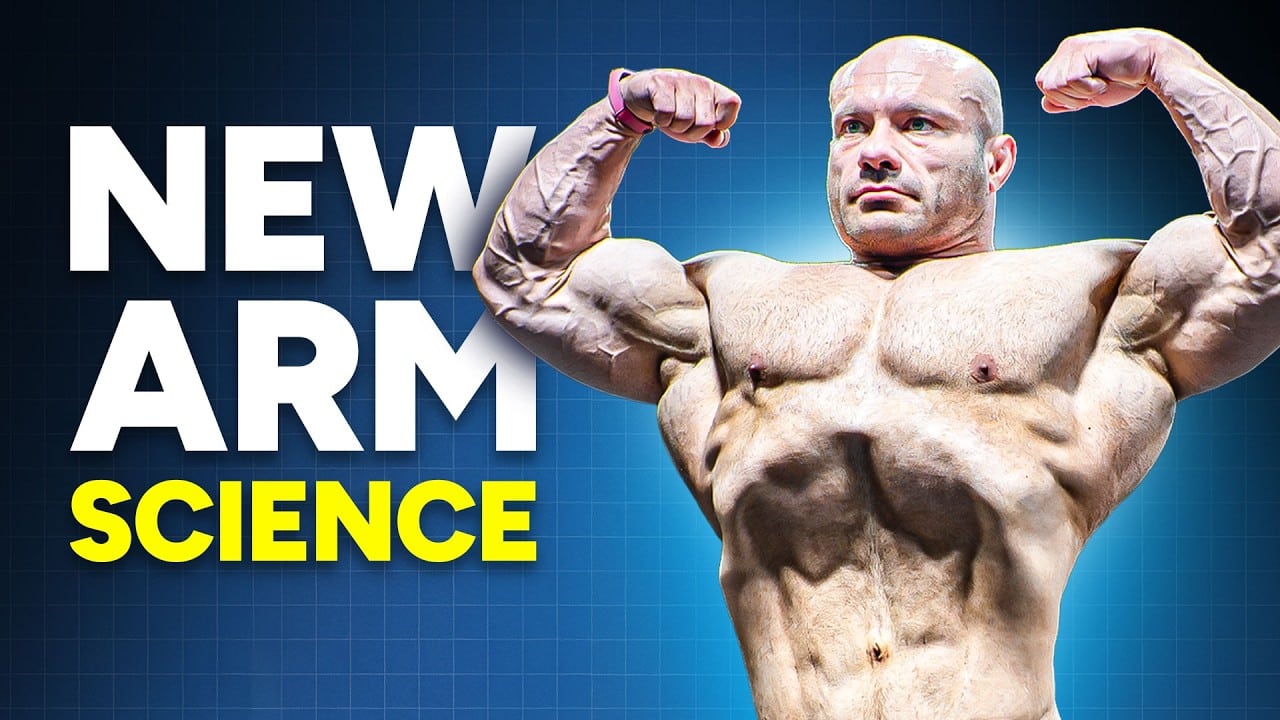
In a recent video for RP Strength, he broke down the science-backed strategy to explode arm size in just a few months—without wrecking your recovery or blowing out your elbows.
If you’ve been stuck in “maintenance mode” and your arms haven’t grown in ages, this is exactly what you need.
Ready to learn why your arms haven’t been growing—and how to fix it?
Jump to:
- Why You’re Not Building Bigger Arms
- Understanding The Systemic Recovery Limit
- The Power of Short-Term Specialization
- Why Train Arms Separately?
- Training Frequency: 3x Per Week
- Exercise Selection: Choose Wisely
- Progressive Volume: Week by Week Growth
- Progress Strategy: Add Reps or Weight
- Summary: How to Actually Get Big Arms
Why You’re Not Building Bigger Arms
Most lifters think lifting more weight means bigger muscles. But for arms, this approach often backfires.
Trying to max out your curls leads to poor form, joint stress, and minimal bicep activation. According to Dr. Mike, “That can get you hurt, but it won’t get you jacked.”
Instead, getting arm growth means one thing: volume overload targeted to the arms, not just throwing on more plates.
Understanding The Systemic Recovery Limit
Your body can’t recover from unlimited training. Dr. Mike explains that while each muscle group has its own Maximum Recoverable Volume (MRV), your total systemic recovery is limited.
Trying to train every muscle at its full potential? Not possible. You’ll burn out before you grow.
But the solution is simple: specialize.
The Power of Short-Term Specialization
Instead of blasting every muscle group, you’ll keep most of your body at maintenance volume and direct all your recovery resources into your arms.
Maintenance volume is surprisingly low—just 4 hard sets per muscle per week can keep most muscles from shrinking, especially in a calorie surplus.
Take the time you were spending on full-body training, reallocate it to the arms, and now you can push your arms past 20, 25—even up to 30+ sets per week.
Why Train Arms Separately?
“If you want bigger arms relative to the rest of your body, you need to focus on arms,” says Dr. Mike.
This doesn’t just apply to physique athletes. Whether you’re heading to the beach, the club, or just picking up your kids after school—impressive arms get noticed.
Training Frequency: 3x Per Week
For most lifters, three arm-focused workouts per week is ideal—giving just enough recovery without losing intensity.
Recommended split:
- Monday: Arms
- Tuesday: Chest, back, shoulders, legs
- Wednesday: Arms
- Thursday: Chest, back, legs, shoulders
- Friday: Arms
This allows you to hit your arms hard three times per week while keeping your full body stimulated and maintained.
Exercise Selection: Choose Wisely
Pick 3 exercises each for biceps, triceps, and forearms.
Rotate rep ranges each day:
- Monday: 5–10 reps (heavy compound or free weight focused)
- Wednesday: 10–20 reps (moderate effort)
- Friday: 20–30 reps (light, high-rep, machine or cable preferred)
Dr. Mike stresses choosing movements with a high stimulus-to-fatigue ratio—exercises that feel effective, give great pumps, and don’t beat up your joints.
If a movement starts to feel off or causes pain, replace it. There’s no arm-size badge for grinding through elbow pain.
Technique Check:
- Train with strict form. No body English.
- Feel the target muscle working—burn, pump, and stretch.
- If it doesn’t feel right in the muscle, it’s not right. Period.
Progressive Volume: Week by Week Growth
Each mesocycle (4–6 week training block) ramps up weekly volume. Here’s the recommended progression strategy:
Mesocycle 1:
- Start with 12 sets per week per muscle (e.g. 4 sets per session)
- Gradually increase each week (add 1–2 sets)
- Top out at ~21 total weekly sets
Mesocycle 2:
- Start at 15–16 weekly sets
- Climb toward 25 sets per week
Mesocycle 3:
- Start high (~20–21 sets)
- Peak at 30 sets per week, if recovery allows
Always finish with a deload week to allow for recovery and adaptation.
To save time and crank up the intensity, Dr. Mike recommends myo-rep sets—a method that mimics multiple straight sets by adding mini rest-pauses within a set. It’s brutal, but it works.
Progress Strategy: Add Reps or Weight
Progression is simple: each week, add 1 rep or 2.5–5 lbs if reps stay consistent.
Don’t jump in weight based on how you’re “feeling.” Ego lifting doesn’t build arms—consistent tension does.
Summary: How to Actually Get Big Arms
- Train arms 3x/week, using heavy, moderate, and light rep ranges
- Choose 3 exercises each for biceps, triceps, and forearms
- Start with 12 weekly sets and progress toward 30+ over 3 months
- Maintain the rest of your body with ~4 sets/week
- Progress by adding reps or small weight increases
- Use techniques like myo-reps for efficiency
- Track recovery and adjust volume accordingly
“Three months of deliberate arm training gets you what years of sloppy, under-recovered ‘bro splits’ never will,” Mike says.