Millions of people stretch their hip flexors every single day, holding the position, breathing through the burn, waiting for relief that never comes.
Six months later, maybe even years later, their hips are still tight.
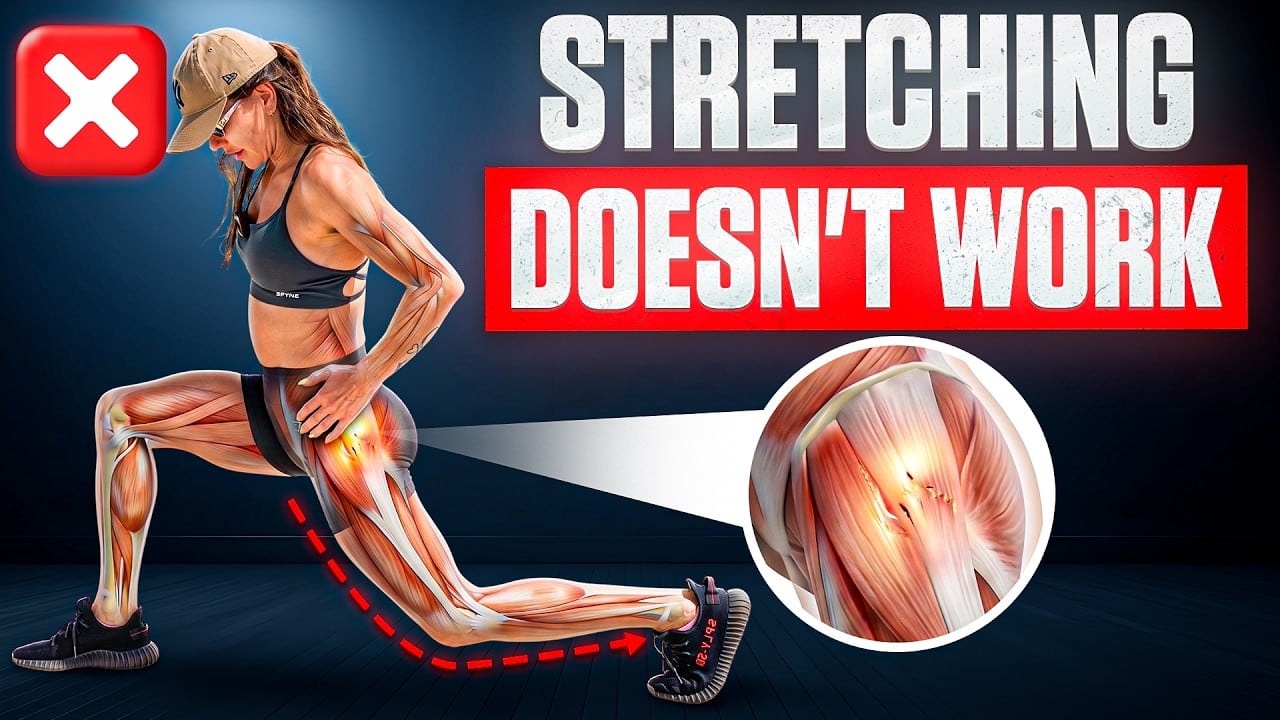
The problem isn’t the stretch—it’s that they’re treating the messenger, not the cause.
In a recent video, movement specialist and coach broke down why the most prescribed mobility drill in fitness is also one of the most useless, and what to do instead to actually unlock tight hips for good.
Jump to:
Why Hip Flexor Stretches Don’t Work
The hip flexor stretch has become a staple in gyms, physical therapy clinics, and yoga studios worldwide. Yet despite its popularity, it rarely delivers lasting results.
The reason? Your body has decided that muscle needs to be short.

If you want something simple that actually works, this is one of the most effective tools I’ve used to build strength, conditioning, and endurance without needing a full gym setup.
- Full-body training with one weight using swings, squats, and presses
- Solid cast iron build that feels stable and lasts for years
- Comfortable grip that makes high-rep workouts easier to handle
The body has decided that the muscle needs to be short. It has decided that because something else has stopped doing its job. Stretching does not change that decision.
When people don’t see results, they stretch harder and more frequently. The body resists even more. The cycle continues for years without resolution.
According to the coach, he’s watched thousands of people walk into his studio convinced their hip flexors are the problem. The hip flexor is almost never the cause. It’s the messenger.
The Core Principle: Protection, Not Flexibility
Understanding why hip flexors stay tight requires a fundamental shift in perspective.
Your hip flexor is short because your nervous system has decided it needs to be short. This isn’t a flexibility problem—it’s a protection problem.
Your nervous system has identified that something in your body cannot do its job. The hip flexor has been recruited to compensate. The body has locked it on.
The brain defends that shortened length until the underlying reason for protection is removed. Pulling harder on the muscle won’t override this protective mechanism.
In his demonstration, the coach held a textbook hip flexor stretch for 30 seconds, then stood up and tested his hip extension. The range was exactly where it started—sometimes even worse.
If you want something simple that actually works, this is one of the most effective tools I’ve used to build strength, conditioning, and endurance without needing a full gym setup.
- Full-body training with one weight using swings, squats, and presses
- Solid cast iron build that feels stable and lasts for years
- Comfortable grip that makes high-rep workouts easier to handle
The Four Real Causes of Tight Hip Flexors
Instead of endlessly stretching, addressing these four root causes allows the hip flexor to release naturally.
Cause #1: Glutes Have Stopped Firing
When glutes fail to activate properly, hip flexors work double duty. The body needs to extend the hip somehow, and if the prime mover is offline, the hip flexor stays contracted to control the joint.
Eight hours of sitting puts glutes to sleep. The chair has trained the body to adapt to prolonged inactivity.
The Test:
- Lie face down with one hand on your glute
- Keep your leg straight and lift it six inches off the ground
- Notice which muscles fire first
The glute should activate first, followed by the hamstring, then the lower back. If your lower back or hamstring fires first and the glute never engages, you’ve identified the problem.
The Fix: Loaded hip extension at end range. Single-leg hip thrusts off a bench with a three-second pause at the top. The squeeze at the top is the entire exercise.
If you want something simple that actually works, this is one of the most effective tools I’ve used to build strength, conditioning, and endurance without needing a full gym setup.
- Full-body training with one weight using swings, squats, and presses
- Solid cast iron build that feels stable and lasts for years
- Comfortable grip that makes high-rep workouts easier to handle
If you can’t find the glute contraction at the top, the load is too heavy. Drop the weight or do it bodyweight only. Eight reps, three sets, three times weekly.
Cause #2: Spine Has Lost Extension
Your hip cannot extend further than your spine allows. When the lumbar spine loses the ability to extend cleanly, hip extension becomes restricted as well.
Watch what happens when most adults attempt a hip flexor stretch: the pelvis rolls forward, the lower back arches excessively, but the hip never actually extends. The stretch happens in the lumbar spine, not the hip.
The stretch is happening in the lumbar spine, not the hip. The hip flexor never lengthens, the lower back gets compressed, the cycle continues.
The Test:
- Lie on your back with knees bent
- Press your lower back flat into the floor
- Slide one heel away while keeping your back completely flat
If your heel can’t reach the floor without your back arching, your spine has stopped extending properly.
The Fix: Two-part approach with sphinx pose and thoracic extension work. Sphinx position for two minutes daily with slow belly breathing teaches the spine that extension is safe.
If you want something simple that actually works, this is one of the most effective tools I’ve used to build strength, conditioning, and endurance without needing a full gym setup.
- Full-body training with one weight using swings, squats, and presses
- Solid cast iron build that feels stable and lasts for years
- Comfortable grip that makes high-rep workouts easier to handle
Follow with thoracic extension over a foam roller, 10 passes twice daily. This gives the spine permission to extend without compensation.
Cause #3: Breath Is Locked
This cause flies under the radar, but it’s critical. A diaphragm that doesn’t descend properly creates compensations throughout the abdominal cavity.
The psoas—the deepest hip flexor—attaches to the spine and runs through the abdomen. It’s wired into breathing patterns.
When the diaphragm fails to descend, the psoas tightens to stabilize. It does not let go between breaths. It does not let go between days.
You’ve been stretching a muscle that’s firing 24/7 because breathing mechanics are dysfunctional.
The Test:
- Lie on your back with one hand on your chest, one on your lower belly
- Breathe in naturally and notice which hand moves first
If your chest moves while your belly stays still, your diaphragm is locked and your psoas is compensating.
If you want something simple that actually works, this is one of the most effective tools I’ve used to build strength, conditioning, and endurance without needing a full gym setup.
- Full-body training with one weight using swings, squats, and presses
- Solid cast iron build that feels stable and lasts for years
- Comfortable grip that makes high-rep workouts easier to handle
The Fix: 90/90 breathing with full exhales. Lie with feet elevated on a wall or couch, hips and knees at 90 degrees. Slow four-second inhale through the nose, eight-second exhale through the mouth until ribs descend completely.
Pause for two seconds and repeat. Five minutes daily retrains diaphragm function and allows the psoas to release.
Cause #4: Hip Cannot Rotate
Hips are ball-and-socket joints built for rotation, not just hinging. When internal and external rotation disappear, the hip can’t extend cleanly either.
Hip flexors compensate for lost rotation, and the brain protects that compensation pattern.
The Test:
- Sit in a 90/90 position: front leg at 90 degrees in front, back leg at 90 degrees behind
- Check if your back knee floats six inches off the floor (internal rotation loss)
- Try leaning forward over your front shin without your hip lifting (external rotation loss)
Most people fail both sides of this test.
If you want something simple that actually works, this is one of the most effective tools I’ve used to build strength, conditioning, and endurance without needing a full gym setup.
- Full-body training with one weight using swings, squats, and presses
- Solid cast iron build that feels stable and lasts for years
- Comfortable grip that makes high-rep workouts easier to handle
The Fix: Loaded internal rotation in the 90/90 position. Lift hips off the floor, rotate to the opposite 90/90, and lower with a three-second pause at end range.
Eight reps each side, three sets daily. This loads the rotational capacity the joint was designed for.
Real Results Without Stretching
A client in her mid-30s came in after stretching her hip flexors daily for two years with no improvement. Her hip extension measured at 20 degrees (normal is 30).
Instead of stretching, the coach assessed the four causes. Her glutes were offline, spine extension was at 20%, breathing was chest-dominant, and internal rotation was gone.
After four weeks working the corrective exercises, her hip extension measured at 32 degrees—above normal—without a single hip flexor stretch.
No stretching, the cause was addressed, the body let go. This is the entire principle of this video. The body lets go when the reason for the holding is removed.
Your Starting Point
Run all four tests: glute activation, spine extension, breath mechanics, and hip rotation.
If you want something simple that actually works, this is one of the most effective tools I’ve used to build strength, conditioning, and endurance without needing a full gym setup.
- Full-body training with one weight using swings, squats, and presses
- Solid cast iron build that feels stable and lasts for years
- Comfortable grip that makes high-rep workouts easier to handle
Whichever test you fail the hardest reveals what your hip flexor is protecting. That’s your starting point.
Stop treating the messenger. Address the cause, and the body will release naturally—no stretching required.